Shares of CoreWeave, the cloud computing company that became one of the stock market's hottest artificial intelligence plays after its listing last year, fell to their lowest level in a year on Monday, November 2, as investors' concerns about the cost and financing of the AI infrastructure boom intensified.
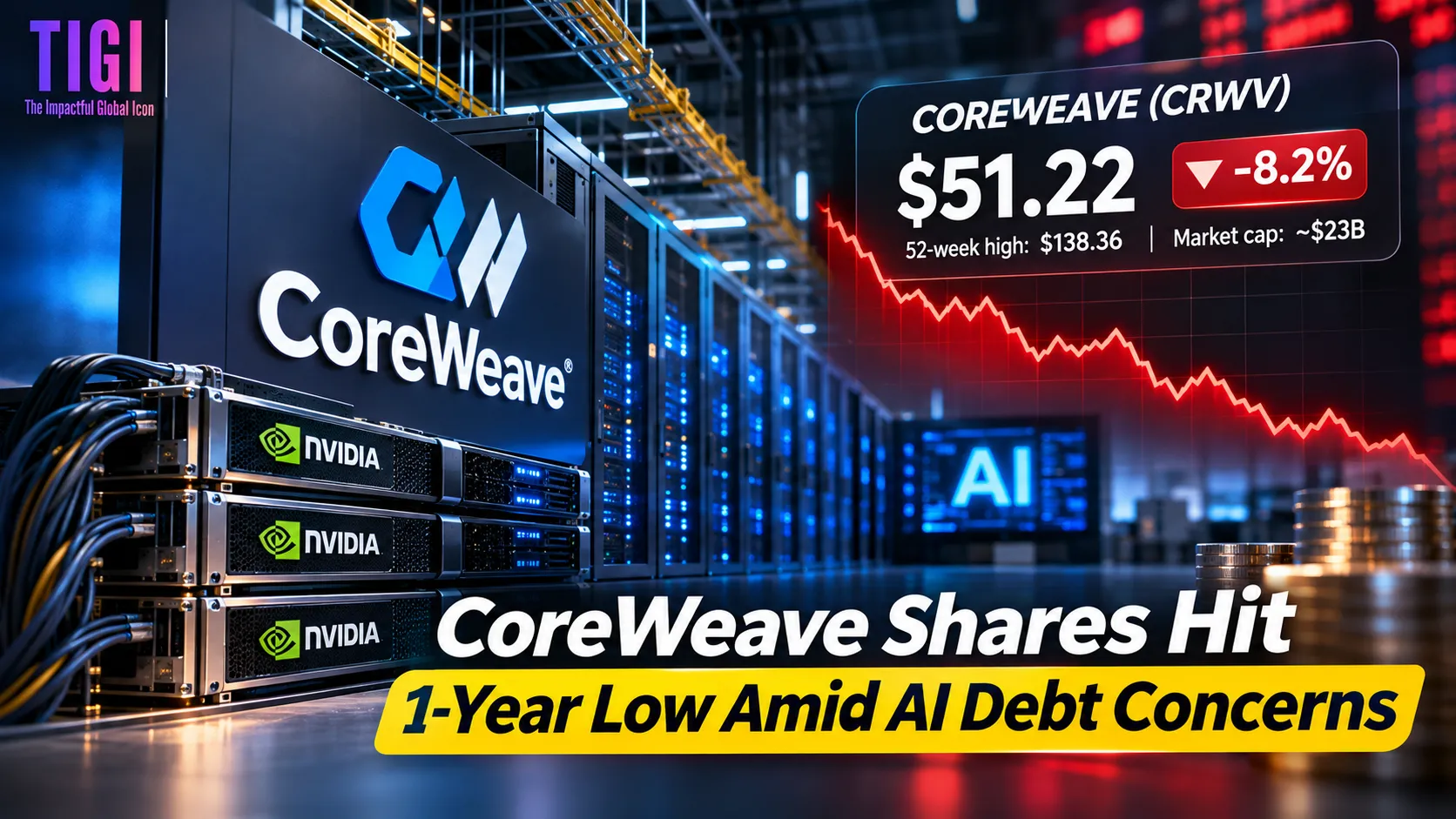
CoreWeave's stock fell to a 52-week low of $51.22, according to Investing.com, about 63% below its 52-week high of $138.36. MarketBeat reported that the shares fell 8.2% during the session to an intraday low of $50.78, from a previous close of $54.87, with about 30 million shares traded. The stock was down about 59% over the past year.
At around $51, CoreWeave's market capitalisation was about $23 billion, according to MarketBeat, a fraction of its value at the peak of the AI enthusiasm.
What CoreWeave does
CoreWeave operates data centres filled with Nvidia graphics processing units (GPUs) and rents their computing power to AI companies and large technology firms that need to train and run AI models. It is one of a group of so-called "neoclouds," specialist providers that compete with Amazon Web Services, Microsoft Azure and Google Cloud in providing AI computing capacity.
The company, which began as a cryptocurrency mining operation, grew rapidly as demand for AI computing exploded after the launch of ChatGPT. Its customers have included Microsoft and OpenAI, and Nvidia is both a supplier and an investor.
The debt question
CoreWeave's rapid expansion has been financed heavily with debt. Building AI data centres requires enormous upfront spending on GPUs, power and buildings, and CoreWeave has raised tens of billions of dollars through loans and bonds, often secured against its GPUs and customer contracts.
The company's debt-to-equity ratio was about 5.5, according to MarketBeat. Bank of America has estimated that CoreWeave needs about $20 billion of additional funding to support its contracted demand, according to Investing.com. The company has a large backlog, with remaining performance obligations of about $129 billion, according to Bank of America, but converting that backlog into revenue requires continued heavy investment.
Investors have become increasingly concerned that rising interest costs, the rapid depreciation of GPUs as newer models are released, and the concentration of its revenue among a few large customers could strain CoreWeave's finances. A CNBC commentary published on November 2 noted that "Wall Street sees a debt disaster in CoreWeave," although its author argued the stock could recover.
Analysts cut targets
Several brokerages have cut their price targets for CoreWeave in recent weeks, according to Investing.com. Morgan Stanley cut its target to $70 from $99, citing financing uncertainties that could affect the company's deployment plans. Raymond James cut its target to $75 from $125, citing concerns about the broader AI investment landscape, and UBS cut its target to $105 from $120, citing weakening investor confidence in AI infrastructure stocks.
Other analysts remain bullish. Bank of America maintains a buy rating with a $140 target, and Cantor Fitzgerald has an overweight rating with a $176 target, according to Investing.com. The consensus rating among analysts tracked by MarketBeat is "moderate buy," with an average target of about $130, more than double the current share price.
The broader AI sell-off
CoreWeave's decline is part of a broader sell-off in AI-related stocks that intensified in late October. On Friday, October 30, the S&P 500 fell about 1.8%, its first close below its 100-day moving average since April, as Intel and Alphabet led a sharp decline in technology stocks. Investors have grown more sensitive to signs that spending on AI infrastructure is outpacing the revenue it generates.
Other AI infrastructure stocks have also struggled. Core Scientific, a data centre operator that has pivoted from crypto mining to AI hosting, also hit a 52-week low on November 2, as did several other energy and infrastructure stocks linked to the AI buildout.
The weakness contrasts with continued strength in some AI software companies. Palantir reported 96% revenue growth on November 2, although its shares also slipped in after-hours trading.
Insider selling
MarketBeat noted that a CoreWeave insider, Jeff Baker, sold 6,670 shares on October 29 at an average price of $61.16, worth about $408,000, to cover tax withholding on vested equity awards. Such sales are routine and are not necessarily a signal about the company's prospects.
The AI bubble debate
CoreWeave has become a focal point in the debate about whether the AI boom has created a bubble. Bulls argue that demand for AI computing will continue to grow for years, as companies deploy AI across their operations and AI models become more capable and widely used. Bears warn that the massive investment in data centres, financed partly by debt, could lead to overcapacity, falling prices for computing power and financial distress for heavily leveraged companies.
Circular financing arrangements, in which chipmakers invest in AI companies that then buy their chips, have also drawn scrutiny from investors and analysts.
The India angle
India is experiencing its own data centre boom, with companies such as Reliance, Adani, Yotta and global cloud providers investing billions of dollars in capacity to serve growing demand for cloud and AI computing. The government's IndiaAI Mission has subsidised access to GPUs for Indian startups and researchers. The volatility in AI infrastructure stocks in the United States is a reminder of the financial risks involved in capital-intensive data centre businesses, which Indian investors and companies will be watching closely.
The cost of capital
For companies such as CoreWeave, the cost of capital is a crucial variable. Higher interest rates increase the cost of financing new data centres and GPUs, while rising concerns about credit risk can push up borrowing costs further. The company's ability to secure financing on favourable terms will be critical to its growth plans.
The rapid pace of innovation in AI chips also poses a risk, as each new generation of Nvidia GPUs can reduce the value of older ones. If GPUs lose value faster than expected, the economics of renting computing power could deteriorate, affecting companies that have borrowed heavily against their hardware.
What comes next
CoreWeave is due to report third-quarter results in about a week, according to Investing.com. Investors will focus on revenue growth, backlog, financing plans and the cost of its debt. The results will be a key test of whether the company can reassure investors that its growth is sustainable, or whether the sell-off in AI infrastructure stocks has further to run.