TechArtificial Intelligence5 MIN READ

CoreWeave Makes India Debut With 240 MW AI Data Centre Deal at AdaniConneX's Navi Mumbai Campus

The US AI cloud provider will be the sole tenant of three 80 MW buildings at AdaniConneX's Taloja campus, with an option to double capacity to 480 MW and Nvidia Vera Rubin systems due from mid-2028.

By Aravind Kumar · Author9 October 2026New

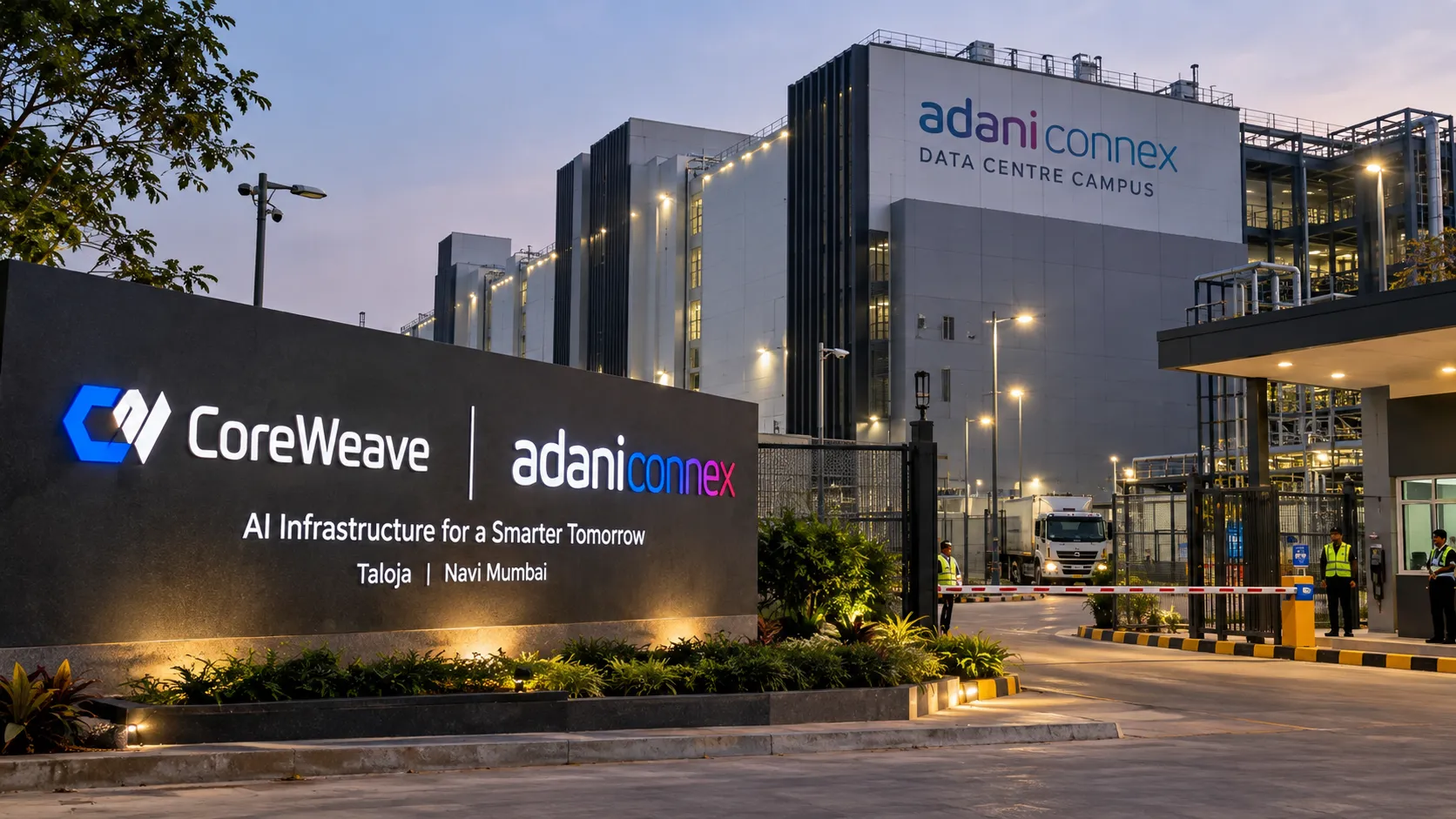
MUMBAI, Oct 8 CoreWeave, the US-listed specialist cloud provider that rents out high-end Nvidia computing to artificial intelligence developers, has made its first move into India, agreeing to take 240 megawatts of data-centre capacity at AdaniConneX's campus in Taloja, Navi Mumbai.

Under the arrangement announced on Thursday, CoreWeave will be the sole tenant of three 80 MW buildings on the campus. The agreement also carries an option on a further 240 MW, which would take the company's potential footprint at the site to 480 MW and make it one of the largest single-tenant AI compute commitments yet seen in the country. The first phase is scheduled to go live in mid-2028.

The deal places one of the fastest-growing names in global AI infrastructure alongside one of India's most aggressive builders of digital capacity. AdaniConneX is a 50:50 joint venture between Adani Enterprises and EdgeConneX, the data-centre developer, and it has become the vehicle for the Adani Group's ambitions in a sector that the conglomerate now treats as strategically as ports, airports and power.

What CoreWeave is building

CoreWeave said the Taloja facilities will house Nvidia's Vera Rubin platform, the successor generation to the Blackwell systems that currently anchor most frontier AI training clusters. The buildings are designed around direct liquid cooling, which pipes coolant to the chips themselves rather than relying on chilled air, and a non-evaporative chilled water system intended to limit water consumption — a point of growing sensitivity for data-centre operators in water-stressed Indian cities.

The company also confirmed it will open an office in India and hire locally, signalling that the Navi Mumbai campus is meant to be an operating base rather than a remote server hall managed from New Jersey.

Chief operating officer Sachin Jain spoke for the company on the announcement. The decision to build, staff and operate in-country puts CoreWeave in a position to serve customers and public bodies that increasingly want their data and models processed within national borders.

Why India, and why now

For CoreWeave, India offers three things that are becoming scarce in its home market: land with grid access, a regulatory push toward local data processing, and a large pool of engineers who can staff both the facility and the customers using it. Power constraints in established US hubs such as northern Virginia have pushed hyperscalers and so-called neoclouds to look further afield, and the cost of building in India remains competitive even after accounting for the premium on liquid-cooled, high-density halls.

Policy is also moving in the industry's favour. The IndiaAI Mission, launched by the Union government in 2024, has made subsidised access to GPU capacity a central plank of the country's AI strategy, and state governments, including Maharashtra, have offered incentives to attract hyperscale facilities. Data-protection rules that encourage — and in some regulated sectors require — local storage and processing add to the commercial case for building in-country.

The timing matters too. Global AI developers are now looking beyond the training of a handful of very large models toward inference at scale: the daily work of serving answers, agents and applications to hundreds of millions of users. India, with one of the world's largest internet populations, is a natural place to locate that kind of capacity.
8d93164e-e541-48d4-953a-56bdb25a7dc0.png

The Adani dimension

“India is no longer just a market for AI applications. It is becoming a place where the compute itself gets built.”
— The Impactful Global Indian

For the Adani Group, the CoreWeave contract is a marquee validation of a capital-intensive bet. The group has said it plans to invest around $100 billion in AI-focused data centres by 2035, and it has been signing anchor customers at a steady clip. Uber said in May that it would set up a data centre in India in partnership with Adani, and in June the group announced a partnership with Jabil, the US manufacturing services company, to build AI data infrastructure.

AdaniConneX is also involved in the campus that Google is developing in Visakhapatnam, part of Google's $15 billion investment commitment in India announced in October 2025, which is intended to create the company's largest AI hub outside the United States.

Securing a single tenant for an entire 240 MW block gives AdaniConneX the revenue visibility that lenders and equity investors look for before committing to further phases. The option for another 240 MW suggests both parties expect demand to keep climbing through the rest of the decade.

What it means for India's AI ecosystem

The arrival of a dedicated AI cloud provider at this scale could reshape the options available to Indian start-ups, research institutions and enterprises. Until now, most domestic developers have relied on the large US hyperscalers or on smaller local GPU clouds that have expanded under the IndiaAI Mission's subsidy programme. CoreWeave's entry adds a provider whose entire business is built around renting large, tightly networked GPU clusters — the kind needed to train and fine-tune large models rather than simply host them.

It also strengthens the argument, increasingly made in New Delhi, that India can host what policymakers call sovereign AI capacity: compute that sits inside the country, under Indian law, even if the hardware and some of the operators are foreign.

There are open questions. A 2028 start date means the first Vera Rubin clusters will arrive in a market that could look very different by then, with domestic players, hyperscalers and other neoclouds all adding capacity. Power availability and transmission upgrades in the Mumbai metropolitan region will need to keep pace with a campus that could eventually draw close to half a gigawatt. And the economics of GPU rental, which have been under scrutiny globally as prices for older-generation chips have fallen, will be tested over the life of the contract.

The bigger picture

Even so, the agreement is a clear signal of where global capital believes the next wave of AI infrastructure will be built. A US company that has grown on the back of demand from the world's leading AI labs is choosing to plant a flag in India for the first time, and is doing so at a scale that puts the country on the map of serious AI compute locations.

For business leaders and investors watching India's digital economy, the message is straightforward. The country is no longer only a large market for AI applications and a deep pool of engineering talent; it is becoming a place where the underlying compute is built and operated. How quickly that capacity comes online, and who gets to use it, will shape India's competitive position in AI for years to come.

For the global Indian diaspora working across the AI value chain, from chip design in California to model research in London, the deal is also a reminder that some of the most consequential AI infrastructure of the coming decade may be built not in Silicon Valley but on the outskirts of Mumbai.

TagsCoreWeaveAdaniConneXAdani GroupAI Data CentreNavi MumbaiTalojaNvidiaVera RubinAI InfrastructureNeocloudSovereign AIIndia TechData CentresCloud ComputingGPULiquid CoolingForeign InvestmentMaharashtraDigital InfrastructureArtificial Intelligence

Reader reviews

Sign in to rate and review this article.
Loading reviews…