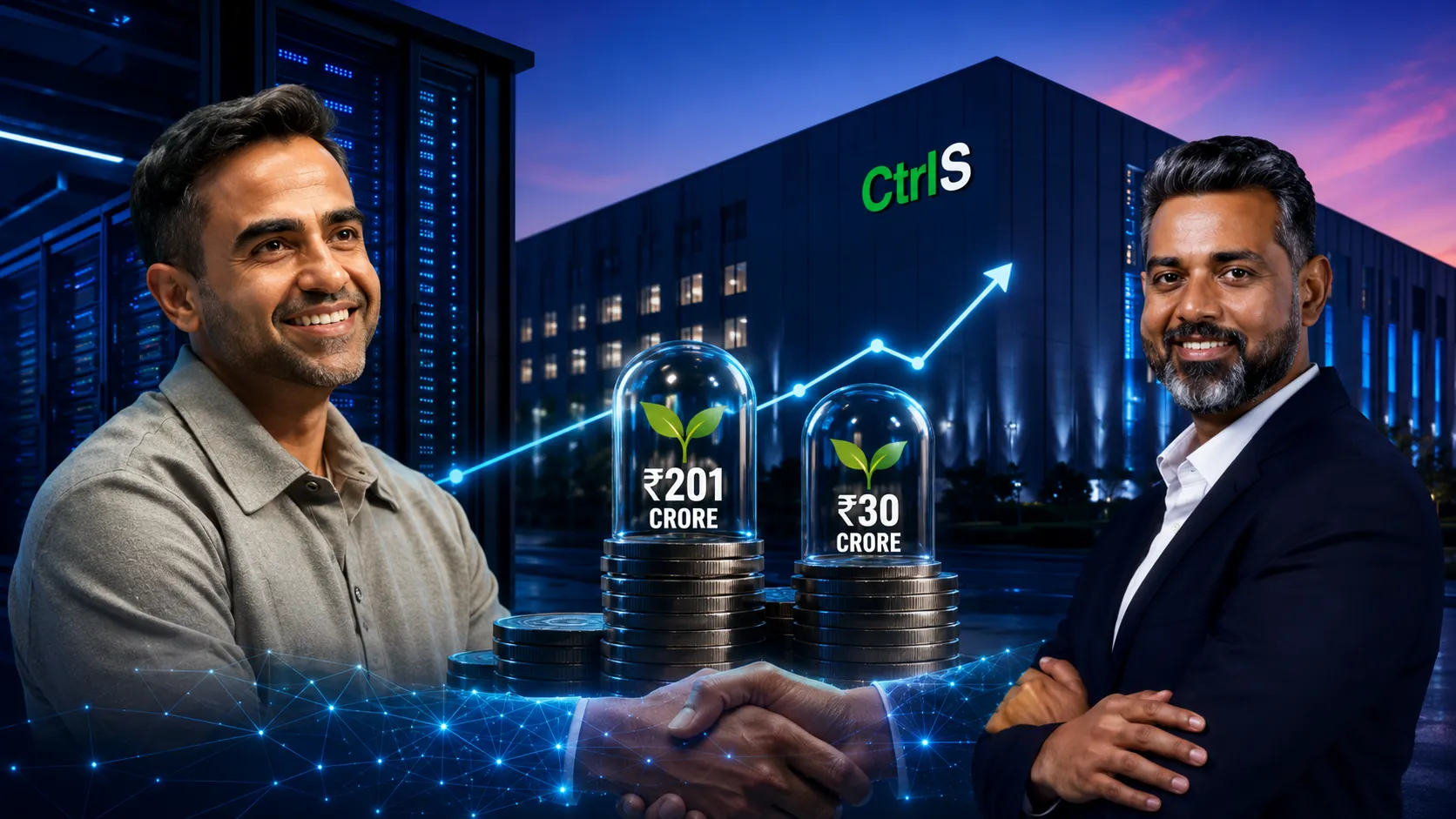
CtrlS Datacenters, one of India's oldest privately held hyperscale data centre operators, has raised Rs 250 crore in fresh capital, with Zerodha co-founder Nikhil Kamath contributing Rs 200 crore of the round and Hyderabad-based entrepreneur Sreeram Reddy Vanga accounting for the remainder. The infusion, disclosed on 19 August 2026, will go toward expanding CtrlS's infrastructure footprint at a moment when India's digital economy is absorbing an unprecedented surge in demand for compute, storage and connectivity.
The round places Kamath — among India's most prolific angel investors and a co-founder of the country's largest retail brokerage — squarely inside the physical backbone of the AI economy, rather than the software layer built on top of it. It is the latest example of India's marquee entrepreneurs deploying personal capital into hyperscale infrastructure rather than only consumer apps or fintech wrappers.
Founded in 2008 by Sridhar Pinnapureddy, CtrlS has grown from a single Hyderabad facility into a network of Tier III- and Tier IV-certified data centres serving banks, e-commerce platforms and telecom operators across India. The company has previously counted global infrastructure investors, including Apollo Global Management and Principal Asset Management, among its backers — a reflection of the scale of institutional interest the Indian data centre sector now commands.
That interest has accelerated sharply through 2026. India's data centre capacity has become a strategic priority as hyperscalers, telecom operators and sovereign-AI initiatives compete for land, power and grid access in metros such as Mumbai, Chennai, Hyderabad and the National Capital Region. Industry estimates place India among the fastest-growing data centre markets globally, driven by data localisation mandates, expanding cloud adoption among mid-sized enterprises, and the compute requirements of large language model training and inference.
For a company like CtrlS, capital raised today is less about survival and more about velocity — securing land parcels, locking in power purchase agreements, and pre-committing to the specialised cooling and electrical infrastructure that GPU-dense facilities require. Next-generation AI-ready facilities demand far higher power density per rack than traditional enterprise data centres, driving up both construction costs and the urgency to build ahead of demand.
Kamath's involvement is notable beyond the cheque size. Since stepping back from day-to-day operations at Zerodha, he has built one of India's most closely watched personal investment portfolios, spanning fintech, deep tech, climate and healthcare. Backing a hyperscale infrastructure company, rather than a consumer app, fits a broader pattern among India's newer generation of angel investors, who have grown comfortable writing cheques into capital-intensive businesses once considered the domain of private equity and sovereign wealth funds.
Analysts tracking the sector note that India's data centre capacity, while growing quickly, still lags materially behind China and the United States on a per-capita basis, leaving substantial headroom for continued build-out through the remainder of the decade. That headroom is precisely what is drawing capital from angel investors, family offices and infrastructure funds alike, even as questions persist about the pace at which India's power grid and renewable energy supply can keep up with data centre electricity demand.
For CtrlS, the Rs 250 crore raise is unlikely to be transformational in isolation — it is a fraction of the capital required to build a single hyperscale facility from the ground up. But as a signal, it reinforces a narrative that has taken hold across India's investor community through 2026: that owning the physical infrastructure underpinning artificial intelligence may prove just as lucrative, and arguably less volatile, than betting on the applications built on top of it.
Neither CtrlS nor the investors involved have disclosed the post-money valuation attached to the transaction, or the specific facilities the new capital will fund.