Cupid, a little-known manufacturer of condoms that has become one of the Indian stock market's most remarkable growth stories, has reported another quarter of explosive growth.
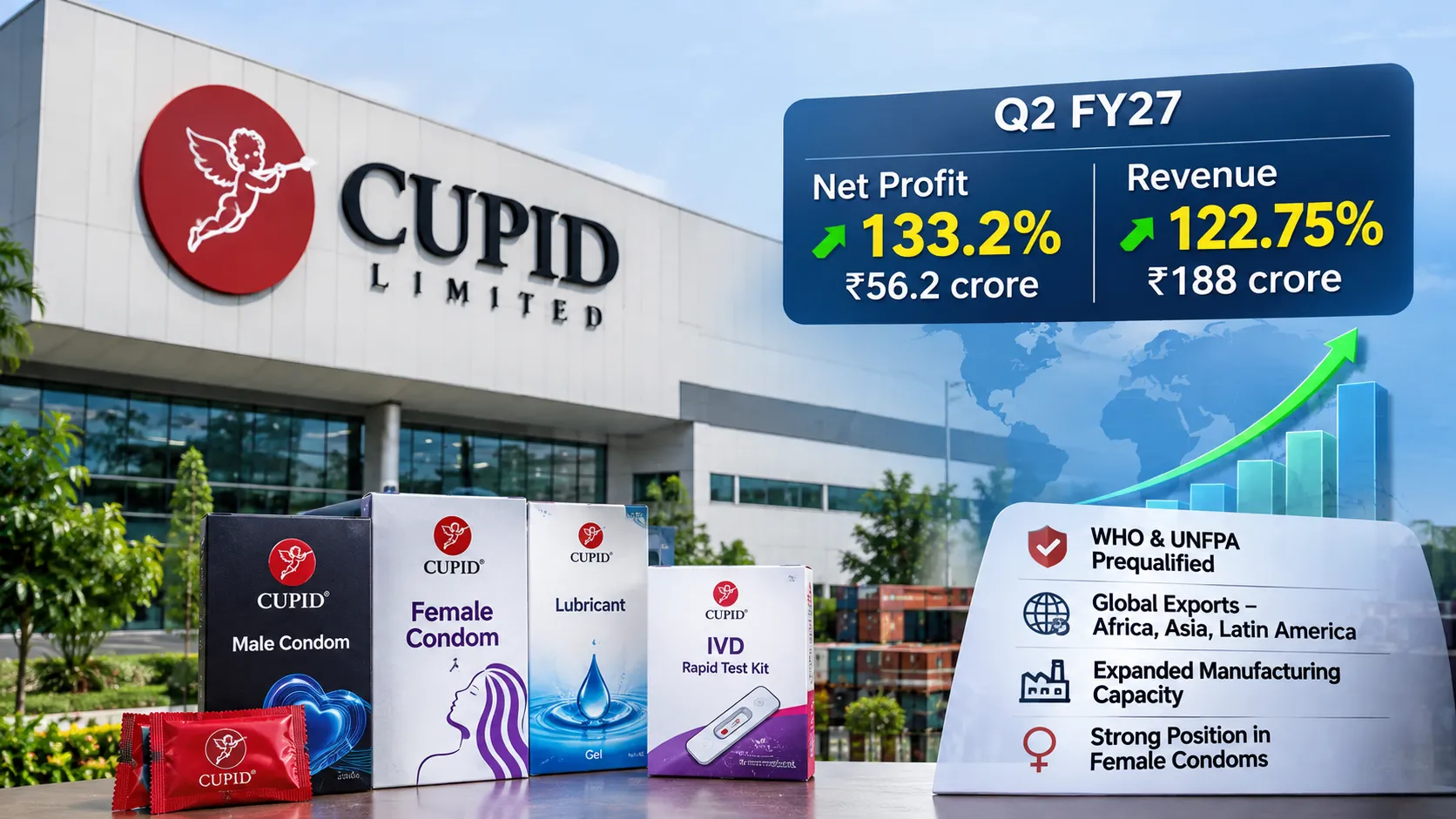
The company's net profit rose 133.2% year-on-year to ₹56.2 crore for the July-September quarter, the second quarter of the 2026-27 financial year, from ₹24.1 crore a year earlier, according to Upstox, citing results announced on Wednesday, November 11. Revenue from operations rose 122.75% to ₹188 crore from ₹84.4 crore.
The results continue a sharp acceleration in Cupid's business. In the first quarter, the company's net profit rose 194% year-on-year to ₹44.15 crore, according to Angel One, making the second quarter's profit a sequential increase of about 27%.
Against the guidance
Cupid has repeatedly raised its full-year guidance this year. On September 30, the company lifted its revenue guidance for the 2026-27 financial year to more than ₹800 crore, from ₹725 crore to ₹750 crore in August and an initial target of ₹600 crore in June, according to SAHI. It raised its net profit guidance to more than ₹250 crore, from ₹210 crore to ₹225 crore.
At the time, the company said it expected second-quarter revenue to top ₹200 crore, according to SAHI. The reported revenue of ₹188 crore fell short of that expectation, although profit growth remained strong. Combined first-half revenue and profit figures suggest the company would need a significant acceleration in the second half to meet its full-year targets.
What Cupid makes
Cupid, based in Maharashtra, manufactures male and female condoms, lubricants and other sexual wellness products, and has expanded into in-vitro diagnostic kits and consumer products. A large part of its business comes from supplying condoms to governments and international agencies for public health programmes, including family planning and HIV prevention.
The company holds WHO and UNFPA prequalification for both male and female condoms, according to SAHI, an important credential that allows it to bid for supply contracts from international organisations. Female condoms, which are produced by only a few manufacturers worldwide, are a niche in which Cupid has a strong position.
Growth drivers
The company has cited several drivers for its growth, including the operationalisation of its facility at Palava in Maharashtra, which expands its manufacturing capacity, according to SAHI. It has also received in-principle approval for an asset-light manufacturing venture in South Africa, which could help it serve African markets, where demand for condoms through public health programmes is significant.
Exports are a major part of Cupid's revenue, supplying markets in Africa, Latin America, Asia and elsewhere. Its domestic business, including retail sales of condoms and lubricants under its own brands, is also growing.
A stock market phenomenon
Cupid's shares have been among the strongest performers in India's smallcap segment, earning the label of a multibagger. The company joined the Nifty Smallcap 250 index on September 30, 2026, according to SAHI, increasing its visibility among institutional investors. Brokerages estimated institutional inflows of about $10 million linked to the inclusion.
Managing director Aditya Kumar Halwasiya bought 5,90,304 shares on September 28, raising his direct stake to 34.71%, SAHI reported. Purchases by promoters are often seen by investors as a sign of confidence in the company's prospects.
The risks
Despite its rapid growth, Cupid faces risks. The timeline for setting up its South African facility is uncertain, and its large export business exposes it to foreign exchange fluctuations, according to SAHI. Its dependence on government and institutional tenders means revenue can be lumpy, varying with the timing of large orders.
Competition is also a factor. The global condom market includes large companies such as Reckitt, which owns Durex, Karex of Malaysia and Church & Dwight, which owns Trojan, as well as numerous manufacturers in Asia. In India, Mankind Pharma's Manforce brand, Reckitt's Durex and the government's own HLL Lifecare are significant players.
The public health dimension
Cupid's business is linked to important public health goals. Condoms are one of the most effective tools for preventing sexually transmitted infections, including HIV, and for family planning. Female condoms give women greater control over their sexual and reproductive health, and international agencies have sought to expand their availability.
Funding for global health programmes, including those supported by the United States, has faced cuts and uncertainty, which could affect demand for products supplied through these programmes. Cupid's results suggest that, so far, demand for its products has remained strong.
Breaking taboos
Sexual wellness has long been a taboo subject in India, limiting open discussion and marketing of products such as condoms. That is changing, as younger consumers become more open, e-commerce and quick commerce platforms allow discreet purchases, and brands advertise more boldly. The growth of the sexual wellness market in India has attracted startups and established companies alike.
Cupid's growth suggests that a company focused on a once-unglamorous category can create significant value for shareholders.
Margins and profitability
Cupid's profit margins are high for a manufacturing company. Based on the second-quarter figures, its net profit margin was about 30% of revenue. SAHI calculated a net profit margin above 31% based on the company's upgraded full-year guidance. Investors will watch whether the company can maintain these margins as it scales up and enters new markets.
What it means for investors
For investors, Cupid's results reinforce its status as a high-growth smallcap stock, but also highlight the importance of execution against ambitious guidance. The second-quarter revenue shortfall relative to the company's own expectation may prompt questions about the timing of orders and the pace of capacity ramp-up.
The female condom niche
Female condoms remain far less widely used than male condoms, partly because of higher costs and limited availability. International health agencies have sought to expand access to them as a method that women can initiate themselves, both for contraception and protection against sexually transmitted infections. Only a handful of manufacturers worldwide hold the necessary approvals to supply international procurement programmes.
Cupid's position in this niche gives it a degree of pricing power and visibility that is unusual for a small Indian manufacturer, and helps explain its attractiveness to investors seeking specialised growth stories.
What comes next
Investors will watch Cupid's ability to deliver on its full-year guidance, the progress of its South African venture and the ramp-up of its Palava facility. With its WHO and UNFPA credentials and growing capacity, the company is positioned to benefit from demand for sexual and reproductive health products, but it must manage the risks that come with tender-driven and export-focused business.