China's push to build its own supply of the specialised memory chips that power artificial intelligence may be approaching an important milestone, though the country's leading memory maker still lags far behind global leaders in manufacturing efficiency.
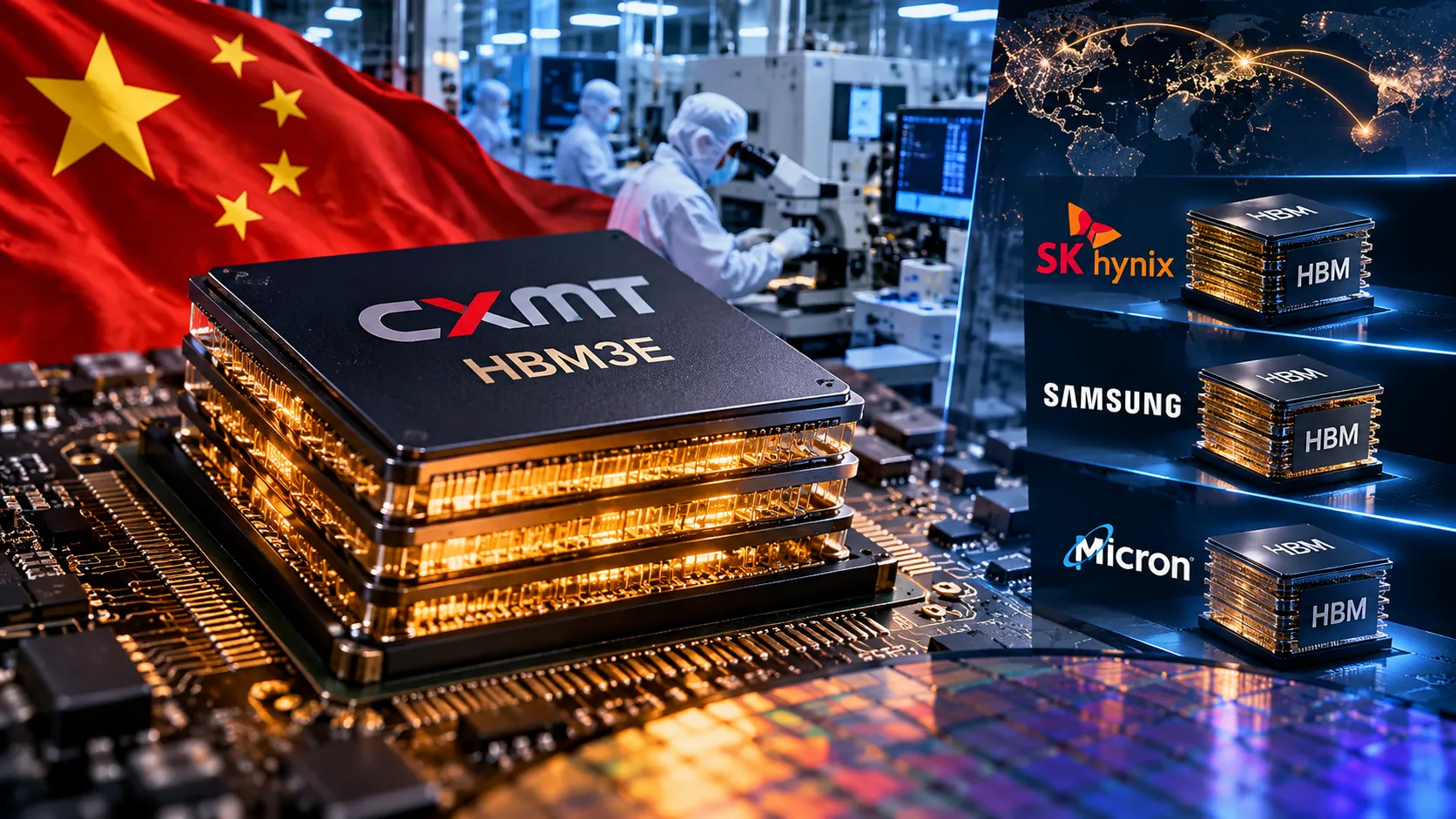
ChangXin Memory Technologies (CXMT), China's largest maker of DRAM memory chips, is preparing to begin limited production of HBM3E high-bandwidth memory within about two months, according to reports this week. The company has sent samples to Chinese AI chip designers, the reports said.
Yields, the share of chips on a wafer that work properly, are reported to be about 20-30%, compared with roughly 70% at South Korea's SK hynix, the market leader. CXMT has not publicly confirmed the production schedule, and the figures should be treated with caution.
Why HBM matters
High-bandwidth memory, or HBM, is made by stacking several DRAM chips on top of one another and connecting them with tiny vertical links, allowing data to move between memory and processor at very high speeds. HBM is packaged alongside AI accelerators, such as Nvidia's graphics processing units, and is essential for training and running large AI models.
HBM3E is the current mainstream generation used in leading AI accelerators, while the industry is moving towards HBM4. Demand for HBM has surged with the AI boom, making it one of the most profitable products in the semiconductor industry. Samsung Electronics this week reported record operating profit driven by memory demand, and SK hynix has also posted record results.
China's dependence
The HBM market is dominated by three companies: SK hynix, Samsung and Micron. US export controls introduced in recent years restrict the sale of advanced HBM to China, as well as the equipment needed to make advanced chips. These restrictions have made it harder for Chinese AI chip designers, such as Huawei, to obtain the memory they need.
Developing a domestic HBM supply has therefore become a strategic priority for China. Without it, Chinese AI accelerators would be constrained regardless of how advanced their processor designs become.
The yield challenge
The reported yield gap illustrates how difficult HBM is to manufacture. Because HBM stacks several memory dies together, a defect in any one die can render the whole stack unusable, so yields for each individual layer must be very high. Advanced packaging techniques, including through-silicon vias that connect the layers, add further complexity.
A yield of 20-30% would make production much more expensive per working chip than at SK hynix. However, yields typically improve as manufacturers gain experience, and Chinese chipmakers may accept higher costs in exchange for supply security, particularly with state support.
Equipment constraints
CXMT faces additional challenges because of export controls on chipmaking equipment. The most advanced lithography machines from ASML are not available to Chinese companies, and restrictions apply to other equipment from American, Japanese and Dutch suppliers. Chinese equipment makers are working to fill the gap, but their tools generally lag the leading edge.
Despite these constraints, Chinese chipmakers have made progress in recent years. CXMT has expanded its DRAM production significantly and has become a meaningful supplier of conventional memory chips, while Huawei and its partners have developed advanced processors despite restrictions.
Market implications
For now, CXMT's limited HBM3E output is unlikely to affect the global market significantly. SK hynix, Samsung and Micron are expanding capacity rapidly to meet demand from Nvidia, AMD, Google and other AI chip customers, and Samsung said this week it expects memory demand to exceed supply in 2027.
Over the longer term, however, a domestic Chinese HBM supply could reduce China's reliance on imports, allow Chinese AI chipmakers to scale production and potentially create competition in the lower end of the market.
The geopolitical context
The development comes amid continuing technological competition between the United States and China. Washington has sought to restrict China's access to advanced chips and chipmaking technology, citing national security concerns, while Beijing has invested heavily in building a self-sufficient semiconductor industry. Memory chips have become an important front in this contest.
What it means for India
India is building its own semiconductor industry, with government-supported projects including Micron's assembly and test facility in Gujarat and Tata Electronics' fabrication plant at Dholera. India does not yet manufacture advanced memory, but it is positioning itself as a trusted partner in diversified semiconductor supply chains. Shifts in the global memory market, including China's progress, will shape the opportunities available to India as it develops packaging, testing and eventually manufacturing capabilities.
The AI memory market
Demand for high-bandwidth memory has grown so rapidly that the major producers have struggled to keep up. SK hynix has said its HBM output is effectively sold out well in advance, and Samsung and Micron are racing to expand capacity. HBM prices are far higher than those of conventional DRAM, reflecting its complexity and the strength of demand from AI chip makers.
For Chinese AI chip designers, access to HBM is a critical bottleneck. Without sufficient memory, AI accelerators cannot reach their full performance, regardless of the power of their processors. Domestic HBM production, even at lower yields and older generations, could help Chinese companies build more AI systems.
State support
China has provided substantial support to its semiconductor industry through national investment funds, subsidies and preferential policies. CXMT, based in Hefei, has received backing from local government and state-linked investors. Such support allows Chinese chipmakers to invest in new technologies even when the commercial returns are uncertain, a strategy aimed at long-term self-sufficiency rather than short-term profitability.
What comes next
Whether CXMT meets the reported timeline, and how quickly it can improve yields, will be watched closely by the semiconductor industry and by policymakers in Washington. Any progress will also be scrutinised for its implications for export controls. For now, the reports suggest that China is moving closer to producing advanced AI memory at home, but that it remains well behind the global leaders in manufacturing efficiency. Industry analysts will also watch whether Chinese AI chipmakers adopt CXMT's HBM3E in their products, and how those products perform compared with systems built using memory from the global leaders. Adoption by major Chinese AI chip designers would be a significant validation of the company's progress.
For now, the global HBM market remains firmly in the hands of SK hynix, Samsung and Micron, but CXMT's progress shows that the gap may narrow over time.


