
FundingLatest Deals5 MIN READ

Daylight Raises $80 Million Led by Goldman Sachs at a $400 Million Valuation to Scale AI-Driven Managed Cyber Defence

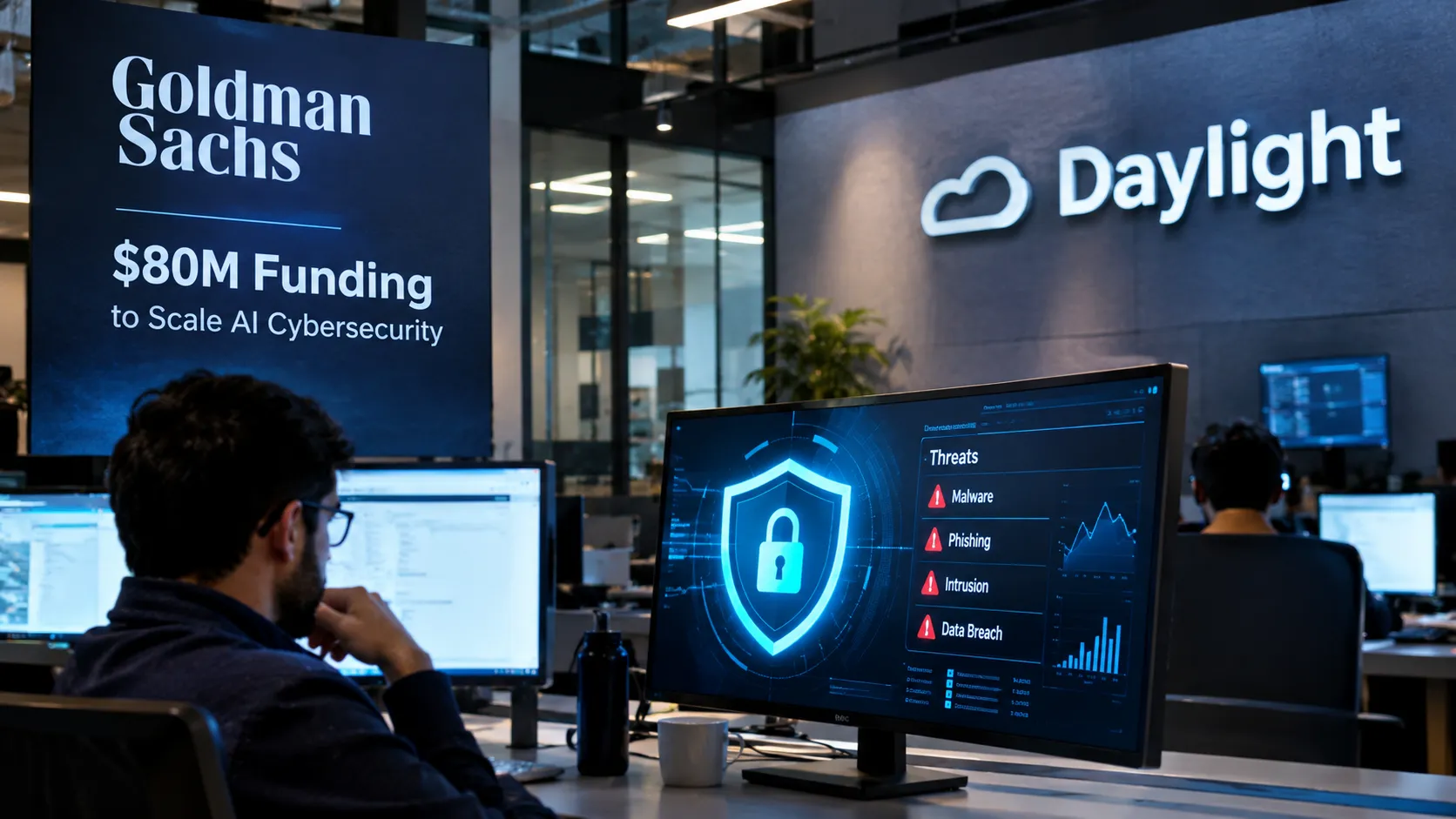
Cybersecurity startup Daylight completed an $80 million Series B on November 11, led by Growth Equity at Goldman Sachs Alternatives, at a valuation of $400 million. Founded by Unit 8200 veterans Hagai Shapira and Eldad Rodich, Daylight provides managed detection and response built on AI agents that investigate and contain threats under analyst supervision.

By Nisha Omkumar · Author12 November 2026New
Daylight Raises $80 Million Led by Goldman Sachs at a $400 Million Valuation to Scale AI-Driven Managed Cyber Defence

As cyberattacks grow faster and more sophisticated, a startup that uses artificial intelligence agents to defend companies around the clock has attracted backing from one of Wall Street's most prominent investors.

Daylight, a cybersecurity company providing AI-driven managed detection and response services, has completed an $80 million Series B financing round led by Growth Equity at Goldman Sachs Alternatives, according to TokenPost, which reported the funding on Wednesday, November 11. The round values Daylight at $400 million.

The round comes almost exactly a year after Daylight announced a $33 million Series A led by Craft Ventures in November 2025, which brought its total funding at the time to $40 million, according to FinTech Global.

Who is behind Daylight?

Daylight was co-founded by chief executive Hagai Shapira and Eldad Rodich, both veterans of Unit 8200, the Israeli military's elite signals intelligence unit, according to FinTech Global. Unit 8200 has produced founders of many of the world's most successful cybersecurity companies, and its alumni are highly sought after by investors.

Its earlier backers include Craft Ventures, Bain Capital Ventures and Maple VC, along with angel investors who are founders and executives of cybersecurity companies including Wiz, Torq, Cyera, Armis and EON, according to FinTech Global.

What Daylight does

Managed detection and response (MDR) services monitor an organisation's networks, devices and cloud systems for threats, investigate suspicious activity and help contain attacks. Traditionally, these services rely on teams of human security analysts working in security operations centres (SOCs), who review large volumes of alerts.

Daylight's approach uses AI agents that learn from each investigation and act autonomously under analyst supervision to detect, analyse and contain threats in real time, according to FinTech Global. The company describes its category as Managed Agentic Security Services. Its platform deploys in under an hour and works with both cloud and on-premise systems.

"Cyber threats are evolving faster than traditional SOC and MDR services can handle," Shapira said at the time of the Series A, according to FinTech Global.

Customers

Daylight serves enterprises in the United States and Europe. Its customers have included The Motley Fool, AI customer service company Cresta and the McKinsey Investment Office, according to FinTech Global. Craft Ventures said at the time of the Series A that "dozens of organizations" were already using the service.

Why investors are backing AI security

Cybersecurity is one of the most active areas of AI investment. Security teams face a growing volume of alerts and a shortage of skilled analysts, making it difficult to respond to every potential threat. AI agents promise to handle routine investigations automatically, freeing human analysts to focus on the most complex and serious incidents.

At the same time, attackers are using AI to create more convincing phishing emails, automate the discovery of vulnerabilities and develop malware faster. Defenders argue they must use AI to keep pace.

Cyberattacks have risen sharply, and the average cost of a data breach was about $4.45 million, according to figures cited by FinTech Global.

Goldman's bet

Goldman Sachs Alternatives, the bank's alternative investments business, invests in growth-stage companies across sectors. Leading a round in Daylight signals confidence that AI-driven security services can capture a significant share of the MDR market, which is currently served by established companies such as CrowdStrike, Arctic Wolf, Rapid7 and Palo Alto Networks, as well as many smaller providers.

“Cyber threats are evolving faster than traditional SOC and MDR services can handle.”
— Hagai Shapira, Co-founder and CEO, Daylight (2025)

The valuation of $400 million, roughly a year after the Series A, reflects strong investor appetite for AI security startups, although it is modest compared with some of the larger valuations in the sector.

Israel's cybersecurity engine

Israel has one of the world's most successful cybersecurity industries, with companies such as Check Point, CyberArk, Wiz and others. Many founders gained experience in military intelligence units before building startups, and the country's ecosystem of investors, engineers and experienced founders has produced numerous successful companies.

Wiz, one of the angel investors' companies, agreed to be acquired by Google for $32 billion in 2025, one of the largest acquisitions of a cybersecurity startup ever, reinforcing investor interest in the sector.

Plans for expansion

Daylight has said it plans to add identity threat response and cloud workload protection modules to its platform, according to FinTech Global. Identity-based attacks, in which attackers steal or misuse login credentials, have become one of the most common ways that hackers gain access to organisations, while cloud workloads present a growing attack surface as companies move more operations to the cloud.

bd7d68af-390a-4851-b183-233a438b6488.png

What it means for India

India faces a rising number of cyberattacks on businesses, government agencies and critical infrastructure, and has a shortage of skilled security professionals. AI-driven security services could help Indian organisations, particularly mid-sized companies that cannot afford large in-house security teams, to detect and respond to threats. Indian IT services companies also provide managed security services to global clients and are integrating AI into their offerings, putting them in competition with startups such as Daylight.

India's Digital Personal Data Protection Act and CERT-In's incident reporting requirements are increasing pressure on organisations to strengthen their cybersecurity.

The economics of MDR

Managed detection and response is a growing market, as organisations without large security teams outsource monitoring to specialist providers. The economics of MDR depend on how many customers a provider can serve with a given number of analysts. AI agents that handle routine investigations could allow providers to serve more customers with fewer people, improving margins and allowing them to offer services at lower prices.

This is the core of Daylight's pitch: that agentic AI can deliver better security outcomes at a cost that traditional, labour-intensive MDR services cannot match.

The trust challenge

Security is a field in which mistakes can be costly. An AI agent that wrongly shuts down a critical system, or fails to catch a real attack, could cause significant damage. That is why Daylight emphasises human supervision of its agents, and why many organisations remain cautious about giving AI systems autonomy to take actions on their networks.

Building trust will require a track record of accurate detection and response, transparency about how agents make decisions, and clear accountability when things go wrong.

What comes next

Daylight is expected to use the funding to expand its platform and grow its customer base in the United States and Europe. Investors will watch whether its AI agents can deliver reliable protection at scale, and whether AI-driven services can displace traditional MDR providers. As both attackers and defenders embrace AI, companies such as Daylight are betting that autonomous, supervised agents will become the foundation of modern cyber defence.

TagsDaylightcybersecuritymanaged detection and responseMDRAI agentssecurity operationsGoldman Sachs AlternativesHagai ShapiraEldad RodichUnit 8200Craft VenturesBain Capital VenturesSeries BIsraeli startupsagentic AISOCcyberattacksenterprise securityIndia cybersecurityinvestors

Reader reviews

Sign in to rate and review this article.
Loading reviews…

