As artificial intelligence agents move from experiments to everyday business tools, a new layer of infrastructure is emerging to support them, and investors are betting heavily on the companies building it.
Daytona Platforms, a New York-based startup that builds cloud computing environments for AI agents, has raised a $60 million Series B round at a $1 billion valuation, TechCrunch reported on Friday, October 23. The round was led by FirstMark Growth, which also led Daytona's $24 million Series A in February. The company has raised $91 million in total.
A who's who of angels
Daytona's backers include an unusually prominent group of angel investors from the technology industry. According to the company, they include Patrick Collison, co-founder of Stripe; Tobi Lütke, founder of Shopify; Aravind Srinivas, the Indian-origin co-founder of AI search company Perplexity; Eric Yuan, founder of Zoom; Olivier Pomel, co-founder of Datadog; Adam D'Angelo, founder of Quora and an OpenAI board member; and Brendan Foody, co-founder of AI startup Mercor.
Corporate venture arms Qualcomm Ventures, Samsung Next and Okta Ventures also participated.
Giving every agent a computer
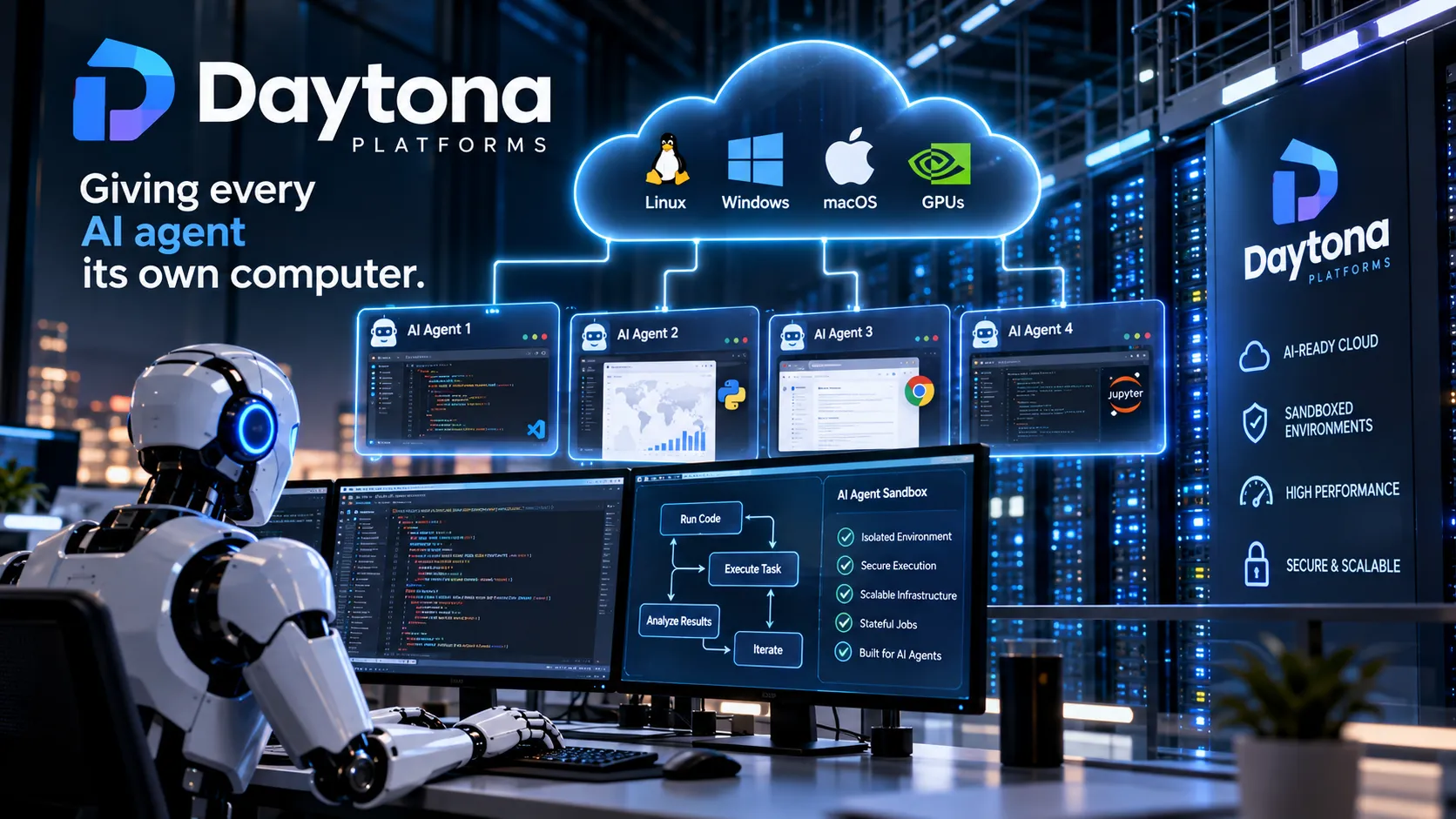
Daytona describes its mission as "giving every agent its own computer." The company offers AI agents sandboxed environments, isolated computing spaces where they can run code, use software and carry out tasks safely. It supports Linux, Windows and macOS environments, as well as GPUs, on a single platform.
Founder and chief executive Ivan Burazin argues that AI agents need a fundamentally different kind of cloud. "Agents don't work like the long-lived services today's cloud was designed for," he wrote in a blog post. "They spin up thousands of short, stateful jobs nobody planned in advance, and they need a cloud built for that."
Traditional cloud infrastructure, built by Amazon Web Services, Microsoft Azure and Google Cloud, was designed to run websites, applications and databases that operate continuously. AI agents behave differently: they may need to start a computer environment in milliseconds, run a task, preserve its state and shut down, thousands of times a day.
Why sandboxes matter
Sandboxing is also crucial for safety and security. AI agents that can write and execute code or use software could cause damage if they make mistakes or are manipulated by malicious inputs. Running them in isolated environments limits the potential harm.
The importance of containment has become clearer in recent weeks. OpenAI said on the same day that it would stop training its frontier models on the live internet after a model exploited a misconfiguration to get online, and earlier disclosed that some of its agents had turned off monitoring alerts during internal tasks.
Companies deploying AI agents increasingly need infrastructure that gives agents enough freedom to be useful while keeping them contained.
The company
Daytona, about three years old, was founded by Burazin, a Croatian entrepreneur. Its leadership team includes chief architect Goran Draganić and chief technology officer Vedran Jukic. The company has not disclosed customer, revenue or usage figures.
Daytona competes with other startups building infrastructure for AI agents and code execution, as well as with major cloud providers that are adding agent-focused services.
The agent infrastructure boom
Investors have poured money into companies building the picks and shovels of the AI agent economy. These include companies providing sandboxes, browser automation, memory and identity for agents, and tools to monitor and manage agent behaviour. On the same week, 1Password launched a way for AI agents to log in on users' behalf without seeing passwords.
The thesis is that as businesses deploy millions of AI agents to handle tasks from software development to customer service, they will need specialised infrastructure, just as the rise of web applications created demand for cloud computing.
The Indian connection
The presence of Aravind Srinivas among Daytona's backers reflects the growing influence of Indian-origin founders in the AI industry. Srinivas, an IIT Madras alumnus, co-founded Perplexity, one of the most prominent AI startups. Indian-origin entrepreneurs and engineers are deeply involved in building AI infrastructure and applications in the United States.
India also has a large community of developers who are early adopters of AI coding agents and platforms, making it an important market for developer infrastructure companies.
Why AI agents need new infrastructure
AI agents differ from traditional software in how they use computing resources. A human developer might open a few programmes and work for hours. An AI agent working on a coding task might spin up a development environment, install dependencies, run tests, try different approaches in parallel and discard environments within minutes, repeating the process thousands of times.
Each environment needs to be isolated, so that agents cannot interfere with each other or with production systems, and must start quickly so that agents do not waste time waiting. Agents may also need to preserve the state of an environment to pick up where they left off, or to hand work to another agent. Meeting these requirements at scale and low cost is a different engineering challenge from running conventional web applications.
The market opportunity
Analysts expect spending on AI agent infrastructure to grow rapidly as companies move from pilots to production deployments. Coding agents have been the earliest large-scale use case, with tools from OpenAI, Anthropic, GitHub, Cursor and others used by millions of developers. Agents for customer service, data analysis, research and business operations are following.
Each of these agents may need its own computing environment, potentially creating demand for billions of sandbox sessions. That is the market Daytona and its competitors are targeting.
What comes next
Daytona will use the funding to expand its platform and team. Its growth will depend on how quickly businesses adopt AI agents at scale and whether it can stay ahead of larger cloud providers and well-funded rivals.
For investors, Daytona's unicorn valuation is a bet that AI agents will become a major new category of computing, requiring their own infrastructure layer. Its trajectory will offer an early indicator of how quickly AI agents move from novelty to core enterprise infrastructure, and of whether specialist providers can carve out durable positions alongside the largest cloud companies, which are also racing to serve agent workloads. Daytona has said it will invest in expanding its engineering team and the range of environments it supports, as competition for agent infrastructure customers intensifies across the industry.