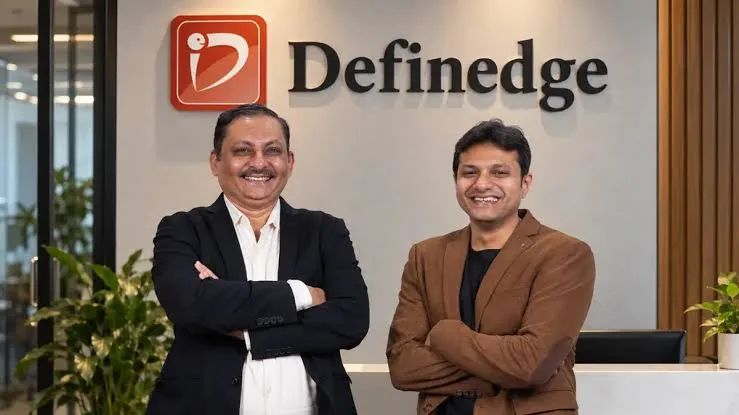
Definedge, the Pune-based trading and wealth-technology company, has raised ₹22 crore in a Pre-Series A funding round, taking its total capital raised to ₹30 crore, as it expands a product suite that spans trading tools, research, investor education and a new generation of AI-driven wealth products.
The round, announced on 22 September 2026, saw continued participation from existing investors Nitin Agarwal and D. Prasad, alongside new investors Anant Jain and Sachin Kasera. The company said the capital will be deployed towards infrastructure and low-latency execution, product development, marketing and distribution, margin funding, and AI and automation capabilities.
An ecosystem, not a single app
Co-founded in 2021 by Prashant Shah and Rajesh Badiye, Definedge has taken an unusual approach in a market dominated by large discount brokers. Rather than building a single trading app, it operates a full-stack ecosystem of more than 14 platforms aimed at active retail traders and investors.
These include Opstra, an options analytics platform; Zone, its trading terminal; Algostra, which the company is expanding into a no-code retail algorithmic-trading platform; Momentify, a wealth-creation product; and Gurukul, its investor-education arm. The strategy is to capture users at multiple points in their journey, from learning and research to execution and long-term wealth building.
The company says its user base has grown 125% over the past 14 months and roughly tenfold over the past 36 months. Momentify has crossed ₹1,000 crore in assets under management, and Definedge is targeting ₹5,000 crore through the platform over the next 24 months.
Building for machines as well as people
One of the more forward-looking elements of the Definedge story is its decision to introduce a Model Context Protocol (MCP) interface. MCP is an open standard that allows AI models and agents to connect to external tools and data sources in a structured way. By exposing market data, technical indicators, chart patterns and other tools through such an interface, Definedge is making its infrastructure directly accessible to AI assistants.
The strategic logic is straightforward. If investment research increasingly shifts from humans clicking through dashboards to AI agents querying structured financial infrastructure, the platforms that are easiest for agents to use could gain an advantage. It is an early bet, and adoption among Indian retail investors remains uncertain, but it places Definedge among a small group of Indian fintech firms explicitly designing for agentic workflows.
The company is also applying for full membership of GIFT City, India's international financial services centre. It initially plans to make more international market data available to Indian investors, before exploring broader global distribution of its products.
A crowded, heavily regulated arena
Definedge operates in one of the most competitive and closely watched segments of Indian finance. Retail participation in equity and derivatives markets expanded dramatically after the pandemic, drawing millions of first-time investors. That growth prompted the Securities and Exchange Board of India to introduce a series of measures aimed at curbing excessive speculation in futures and options by retail traders, and to formalise rules for algorithmic trading by retail investors through brokers.
Those regulatory changes create both risk and opportunity. Tighter derivatives rules have dampened trading volumes that once powered broker revenues. At the same time, a clearer framework for retail algo trading could legitimise the kind of no-code strategy-building tools that Algostra is designed to provide, provided they are delivered within the compliance boundaries set by the regulator.