
TechArtificial Intelligence6 MIN READ

Dextr AI Raises $6.7 Million Led by Elevation Capital to Put AI Agents on the Hotel Front Desk, With India Next on Its Map

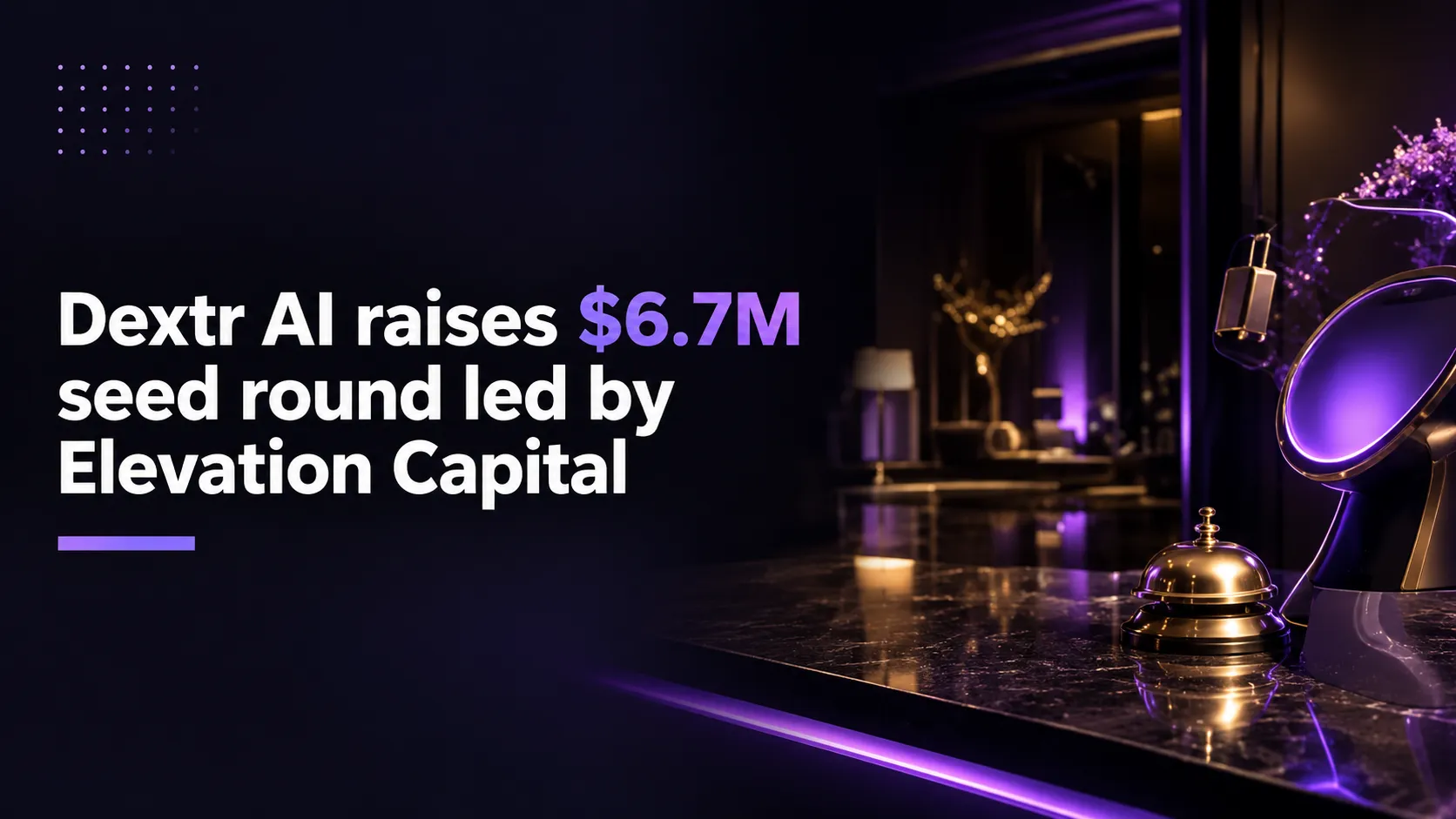
Dextr AI, which builds AI agents that answer calls, take reservations and manage guest requests for hotels, has raised $6.7 million in a seed round led by Elevation Capital with Foundation Capital participating. The company has named India as an expansion market.

By Aravind Kumar · Author26 September 2026New
Dextr AI Raises $6.7 Million Led by Elevation Capital to Put AI Agents on the Hotel Front Desk, With India Next on Its Map

The hotel front desk has become one of the most practical proving grounds for artificial intelligence agents. Dextr AI, a start-up that builds AI agents for hospitality businesses, has raised $6.7 million in seed funding led by Elevation Capital, with participation from US-based enterprise investor Foundation Capital.

The round, announced on September 25, is Dextr's first institutional financing. The company said it will use the money to hire customer-focused engineers, deepen integrations with hotel property management systems, build additional agents and expand deployments across global hospitality markets. India has been identified specifically as an expansion market.

Dextr was founded in July 2025 and is headquartered in San Francisco. It is led by chief executive Sajid Shariff and chief technology officer Scott Arnold. In little more than a year, the team has grown from three people to 21.

What Dextr's agents do

Dextr has built a family of AI agents, each designed to take on a specific set of tasks that hotel staff traditionally handle. According to details shared with Crunchbase News, the product line includes an agent called Alfred for guest management and one called Daisy that handles voice reservations. Other agents manage group bookings and staff coordination. A companion interface called Doss lets employees direct the system by text or voice.

In practice, that means an AI agent can answer the phone at two in the morning, take a booking, respond to a question about late check-out, or route a maintenance request, without a human having to be at the desk. The agents connect to the property management systems that hotels already use, so that the information they capture flows directly into existing workflows.

The company says its software is now used by hundreds of hotels ranging from 21 to 550 rooms. Customers include independent properties as well as hotels operating under major brands such as Hilton, Wyndham, Best Western and IHG. Dextr also serves reservation centres, vacation rental operators and outdoor hospitality venues.

Traction that caught investors' attention

The metrics Dextr has disclosed help explain why investors moved quickly. The company says its agents handle more than one million interactions a month, that its annual recurring revenue has been growing by 20 to 30 per cent month on month, and that it has not lost a single customer.

Early-stage figures such as these should be read with caution, because growth rates are easier to sustain from a small base. But zero churn is a meaningful signal in hospitality, an industry known for being slow to adopt new technology and quick to abandon tools that do not deliver.
ChatGPT Image Sep 26, 2026, 02_09_28 PM.png

The labour problem behind the product

Dextr's growth is rooted in a problem that has troubled hotel operators since the pandemic: finding and retaining staff. Many properties cut headcount during the downturn of 2020 and have struggled to rebuild, particularly for unpopular night shifts.

Shariff pointed to the economics in California, where an overnight front-desk position can cost $70,000 to $80,000 a year. "It was very hard to hire for these shifts to begin with," he told Crunchbase News.

For a mid-sized hotel, that is a significant cost for a role that may involve only a handful of guest interactions each night. An AI agent that can handle routine calls and requests around the clock, and hand off to a human when needed, offers a clear return on investment. It also allows existing staff to focus on in-person service rather than answering the phone.

“For hotels, the business case for AI agents is not futuristic. It is the overnight shift that nobody wants to work and every guest expects to be covered.”
— TIGI Tech Desk

Revenue is the other half of the equation. Hotels lose bookings when calls go unanswered or when group enquiries sit in an inbox. An agent that responds instantly can capture demand that might otherwise go to a competitor or an online travel agency that charges commission.

Why Elevation is backing a San Francisco start-up

Elevation Capital is one of India's best-known venture firms, and its decision to lead a round in a San Francisco-headquartered company reflects a wider shift. Indian investors are increasingly backing founders who build globally from day one, often with engineering and operations spread between the US and India.

For Dextr, India is both a potential market and a talent base. India's hospitality sector has expanded rapidly with the growth of domestic tourism, new hotel supply in smaller cities and rising business travel. Many of those properties face the same challenge as American hotels: guests expect instant responses on phone, WhatsApp and email, while operators work with limited staff.

Foundation Capital's participation adds weight on the enterprise side. The Silicon Valley firm has long backed business software companies and has been an active investor in AI applications that automate specific workflows.

Integrations as a competitive moat

One of Dextr's stated priorities is expanding integrations with property management systems. The company named platforms including Oracle Hospitality's OPERA Cloud, StayNtouch, Cloudbeds and Hostaway as targets for deeper connections.

Integration is where many hospitality technology start-ups succeed or fail. Hotels run on a patchwork of systems for reservations, housekeeping, revenue management and payments. An AI agent is only useful if it can read and write data across those systems reliably. Each additional integration expands the number of hotels Dextr can serve and makes its product harder to replace once installed.

A crowded but fast-growing field

Dextr is not alone in targeting hospitality. A growing number of start-ups are building AI voice agents and guest messaging tools, and large hospitality software vendors are adding AI features to their own platforms. The category is attractive because the tasks are repetitive, the data is structured and the value of an answered call is easy to measure.

What will separate winners from the rest is reliability. A reservation agent that makes errors, misquotes prices or mishandles a complaint can do real damage to a hotel's reputation. Dextr's emphasis on hiring engineers who work closely with customers suggests it understands that the product has to be tuned property by property.

Where AI agents pay off first

Dextr's seed round is modest by the standards of today's AI mega-deals, but it is a clear example of where AI agents are delivering measurable value first: in narrow, operationally intensive roles where labour is scarce and customers expect a response at any hour.

With Elevation Capital's backing and India on its expansion list, Dextr is also one more example of how the lines between Indian and American start-ups are blurring. The company is headquartered in San Francisco, sells to global hotel brands and is funded by one of India's leading venture firms. For hotel operators in both markets, the question is no longer whether AI will answer the phone, but how quickly it can do so well.

TagsDextr AIElevation CapitalFoundation CapitalAI AgentsHospitality TechHotelsSeed FundingVoice AISajid ShariffArtificial IntelligenceStartup FundingIndia Expansion

Reader reviews

Sign in to rate and review this article.
Loading reviews…