There is a problem sitting at the heart of modern computing that does not get nearly as much attention as it deserves. AI chips are getting more powerful at an extraordinary pace — but they are also getting hotter, generating heat exceeding 140 watts per square centimetre in some configurations. Managing that heat has become one of the semiconductor industry's most significant engineering challenges, and the solution, most experts agree, lies in better materials: new substances with better thermal properties, better conductivity, and better performance across the board.
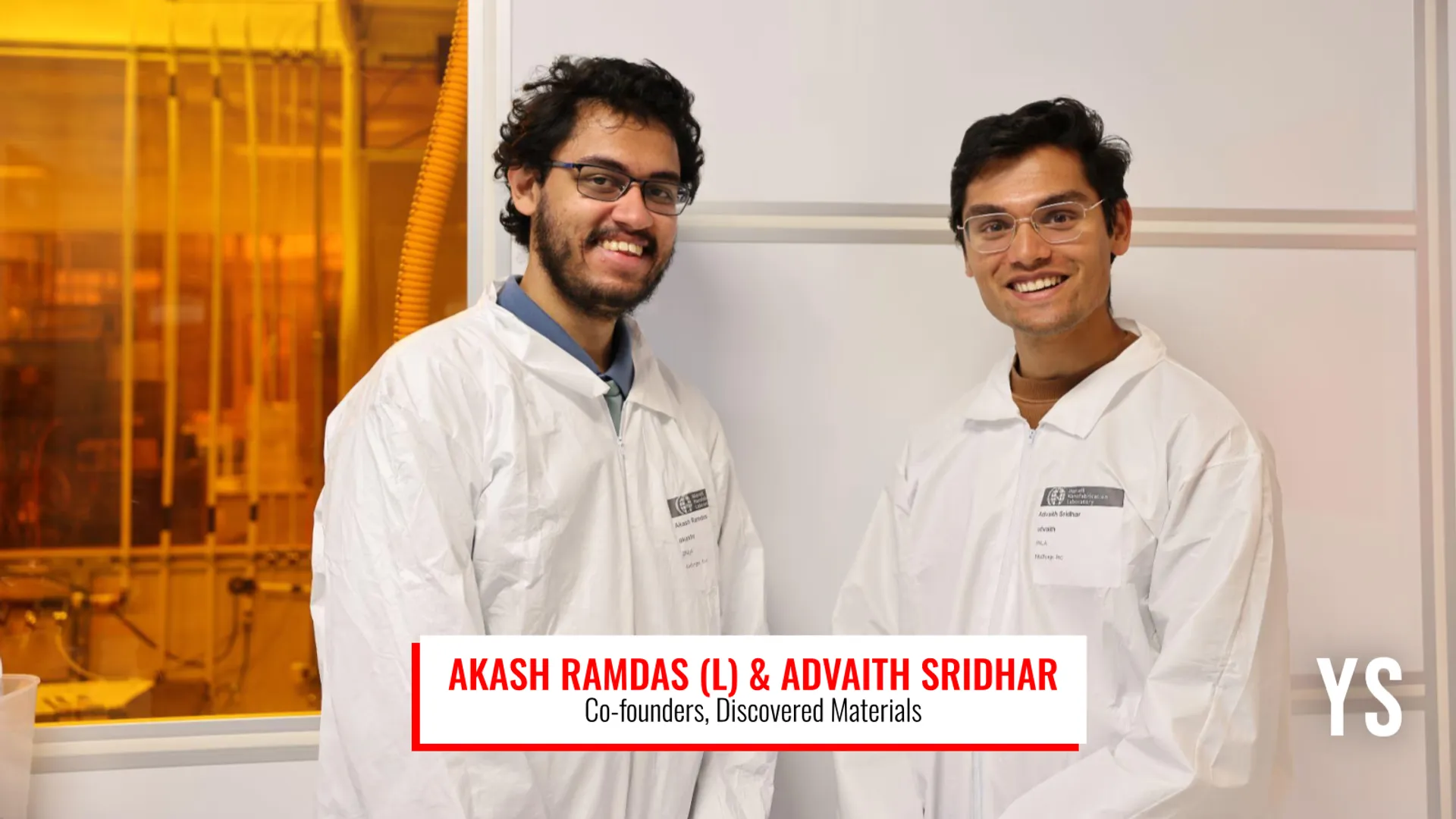
Two IIT Madras alumni believe they have found a faster way to get there. Discovered Materials, a San Francisco-based deep-tech startup founded by Advaith Sridhar and Akash Ramdas, has raised $9 million (roughly ₹85.9 crore) in a seed funding round led by Lightspeed India Partners. The round drew participation from Y Combinator and Peak XV Partners, alongside angel investors including Paul Graham, Gokul Rajaram and Thariq Shihipar.
Sridhar and Ramdas met more than a decade ago as students at IIT Madras, one of India's premier engineering institutions, and their post-graduation paths diverged in ways that, in retrospect, look almost perfectly designed to converge on this exact problem. Sridhar went on to Stanford University, where he earned a PhD in Materials Science and spent the following eleven years researching new materials specifically for semiconductor chips; his work on nanoscale interconnects was Stanford Engineering's most widely read story of 2025. Ramdas, meanwhile, studied artificial intelligence at Carnegie Mellon University and spent years as a research engineer building video models and AI agents at Persona AI — later acquired — and at Luma Labs.
Founded in 2026, Discovered Materials is building AI agents designed to automate large parts of the materials-discovery pipeline for semiconductor chips, including simulation, synthesis and experimental validation — work that traditionally requires years of interdisciplinary laboratory research. By compressing that timeline using AI, the company aims to help chipmakers keep pace with the compute industry's relentless demand for more powerful, and hotter-running, processors.
Alongside the funding announcement, Discovered Materials unveiled hundreds of AI-discovered materials and introduced what it calls the Material Discovery Bench — described by the company as the first benchmark built specifically to evaluate how well AI agents perform on real-world semiconductor materials-discovery problems. The initial focus is thermal management, but the founders have said their ambitions extend across the entire semiconductor materials stack, from conductivity to durability.
The fresh capital will be used to expand the company's team and laboratory infrastructure, and to scale its AI research agents further. For a founding team rooted in IIT Madras's engineering culture and shaped by Stanford's materials-science tradition and Carnegie Mellon's AI research ecosystem, the seed round is as much a validation of a specific technical bet as it is of a broader trend: Indian-origin engineers and researchers, trained at India's top technical institutions and later specialised at America's leading research universities, are increasingly founding the deep-tech companies now attracting Silicon Valley's most prominent early-stage investors.
That trend is visible in the investor roster itself. Lightspeed India Partners' decision to lead the round, with Y Combinator and Peak XV Partners — two of the most active backers of Indian-founder startups globally — joining alongside marquee angels such as Y Combinator co-founder Paul Graham, signals strong institutional confidence in the founders' combined technical depth. For the broader IIT Madras alumni network, which Tracxn estimates has founded more than 1,450 companies raising a combined $24.6 billion, Discovered Materials adds a fresh, high-profile entry to a growing list of deep-tech ventures with roots in Chennai but headquarters in the Bay Area.
As AI infrastructure investment continues to accelerate globally, the thermal ceiling facing next-generation chips is increasingly viewed as a genuine bottleneck rather than a routine engineering hurdle. Discovered Materials' bet — that AI itself can be turned on the materials-science problem holding AI back — places it squarely at the intersection of two of the most closely watched investment theses in deep tech today, and gives its IIT Madras-trained founders a shot at solving a problem with outsized consequences for the entire compute industry.
The founders' respective research backgrounds explain much of the confidence institutional investors have placed in the venture. Sridhar's eleven years studying materials for semiconductor applications, capped by Stanford Engineering naming his interconnect research its most-read story of 2025, gave him a first-hand view of just how slow and expensive traditional materials discovery remains — often requiring years of iterative synthesis and testing before a single candidate material is validated for commercial use. Ramdas's parallel path through AI research, including building video-generation models and autonomous agents at now-acquired Persona AI and at Luma Labs, gave him direct experience in exactly the class of AI-agent architecture the company now applies to materials science rather than media generation. That combination — deep domain expertise paired with frontier AI-systems experience — is precisely the founder profile that deep-tech investors have increasingly sought out as the AI funding boom broadens beyond consumer and enterprise software into physical-science applications.
Discovered Materials also arrives at a moment when semiconductor thermal management has become a strategic, not merely technical, concern. As data centre operators race to deploy ever-denser clusters of AI accelerators, the industry's ability to dissipate heat efficiently has begun to constrain how much compute can physically be packed into a given rack, building or campus — a limitation with direct consequences for the pace of AI model training globally. Materials that improve thermal conductivity, even incrementally, translate into meaningful gains in how much AI compute the same physical infrastructure can support, giving Discovered Materials' work commercial relevance well beyond the academic materials-science community from which its founders emerged.
The company's emergence also adds to a broader narrative taking shape in Silicon Valley around IIT Madras as a consistent source of deep-tech founding talent. With more than 1,450 companies founded by its alumni globally — 373 of them headquartered in the United States, according to Tracxn data — IIT Madras has increasingly positioned itself alongside IIT Bombay and IIT Delhi as one of the most productive Indian engineering-education pipelines feeding directly into US venture-backed deep-tech founding teams, particularly in hardware-adjacent and AI-infrastructure categories where technical depth, rather than pure software velocity, tends to determine early traction with sophisticated investors.


