
DOMS Industries Limited, one of India's leading manufacturers of stationery and art materials, marked a significant milestone at Paperworld India 2026 in New Delhi, occupying one of the exhibition's largest and most immersive brand pavilions and reinforcing the company's position as one of the more consequential consolidators within India's fast-evolving stationery manufacturing landscape. The showcase reflects a broader trajectory for DOMS, which has grown over the past decade from a joint venture stationery manufacturer into one of the sector's most recognisable listed companies, having completed a well-received public market listing in recent years that drew considerable investor interest in what had historically been viewed as an unglamorous, low-growth category.
Paperworld India has established itself over successive editions as the country's primary trade platform for the stationery, office supplies and paper products industry, drawing manufacturers, distributors, retailers and international buyers seeking to source from India's expanding stationery manufacturing base. The exhibition's growing scale and international buyer participation reflect India's increasing significance within the global stationery supply chain, a position built substantially on the country's cost-competitive manufacturing base, growing domestic consumption driven by rising school enrolment and literacy rates, and a gradual diversification of global stationery sourcing away from China amid broader supply chain de-risking trends that have benefited a range of Indian manufacturing sectors over recent years.
DOMS Industries' own growth story offers a useful window into how India's stationery manufacturing sector has professionalised and consolidated over the past decade. The company, which traces its roots to a joint venture between Indian promoters and Italian stationery manufacturer FILA Group, has built a broad product portfolio spanning writing instruments, colouring and art materials, paper stationery and a range of adjacent categories including kits and bags targeted at the school-going demographic that continues to anchor much of India's domestic stationery demand. This diversified category presence has allowed the company to build meaningful scale advantages in manufacturing, distribution and brand recognition relative to the historically fragmented, largely unorganised landscape that has traditionally characterised much of India's stationery sector.
The Indian stationery industry's organised segment has grown considerably as a share of overall category sales over recent years, a shift that mirrors broader formalisation trends visible across numerous Indian consumer goods categories as tax reforms, improved logistics infrastructure and changing retail formats have progressively favoured organised manufacturers over the unorganised, often regionally fragmented players that historically dominated categories such as stationery, where low individual product price points and localised manufacturing had long sustained a highly dispersed competitive landscape resistant to consolidation.
Export growth has emerged as an increasingly important growth vector for India's leading organised stationery manufacturers, including DOMS, as global buyers have sought to diversify sourcing away from concentrated dependence on Chinese manufacturing amid broader geopolitical supply chain considerations that have affected numerous manufacturing categories over recent years. India's stationery export growth has been supported by improvements in manufacturing quality and scale among leading domestic producers, alongside government policy support for manufacturing exports more broadly under various production-linked incentive and export promotion schemes that have targeted a range of manufacturing sectors as part of India's broader ambition to expand its share of global manufacturing output.
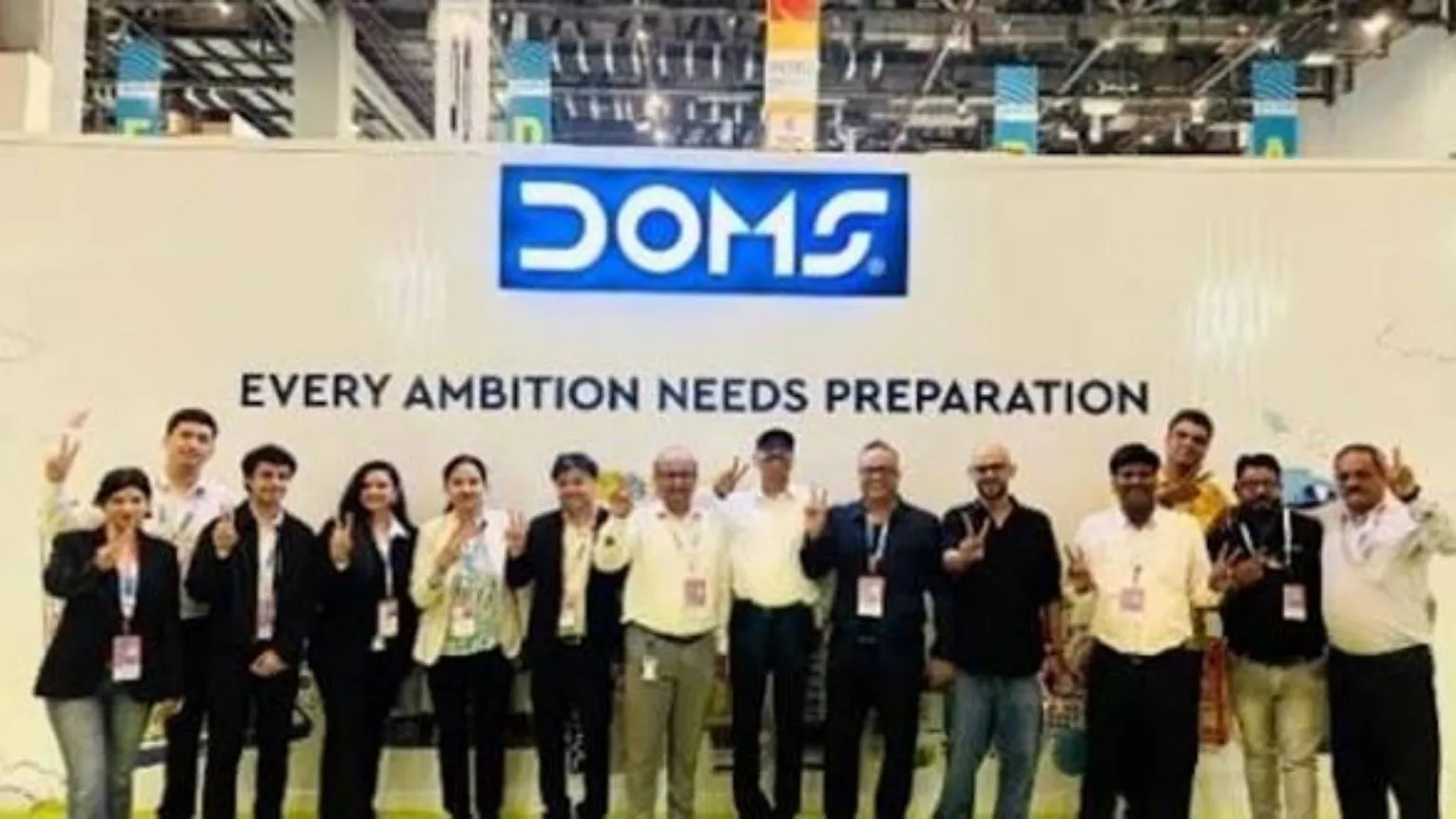
DOMS Industries' presence at Paperworld India 2026 with one of the exhibition's largest pavilions reflects a deliberate strategy of using major trade platforms to reinforce brand visibility among both domestic trade partners and the international buyers increasingly attending Indian stationery trade exhibitions as part of their sourcing diligence process. Immersive brand pavilions of the kind DOMS presented at this year's exhibition typically serve multiple simultaneous purposes for exhibiting companies: showcasing new product launches to trade buyers, reinforcing brand positioning and manufacturing credibility to prospective export customers, and providing a venue for direct relationship-building with the distributor and retail networks that remain central to how stationery products ultimately reach consumers across India's vast and geographically dispersed retail landscape.
The broader Indian stationery and school supplies market has benefited from several durable structural tailwinds over recent years, including continued growth in school enrolment across both public and private education systems, rising discretionary spending on educational and creative products among India's expanding middle class, and a gradual premiumisation trend as consumers increasingly favour branded, quality-assured stationery products over unbranded alternatives, particularly for products used by children where parental quality and safety considerations have grown more prominent purchasing factors over time. These tailwinds have provided a supportive demand backdrop for organised manufacturers such as DOMS even as the broader Indian consumer discretionary spending environment has shown some variability across different income segments and geographic regions.
Competitive dynamics within India's organised stationery sector have also evolved considerably, with DOMS operating alongside other established players including both domestic manufacturers and multinational stationery brands with established Indian operations, creating a competitive landscape that has pushed leading companies toward continuous product innovation, manufacturing efficiency improvements and brand-building investment to defend and expand market share. DOMS' scale advantages, built through its diversified product portfolio and integrated manufacturing capabilities spanning multiple stationery categories rather than a narrower single-category focus, have positioned the company to compete effectively across this evolving landscape, a positioning reinforced by the kind of high-visibility trade exhibition presence demonstrated at this year's Paperworld India.
Raw material cost management represents a further important operational consideration shaping profitability across India's stationery manufacturing sector, given the industry's reliance on a range of input materials including wood pulp and specialised paper grades for writing instruments and paper products, alongside various plastics, pigments and specialised materials used across the sector's broader colouring and art materials category. Global commodity price volatility affecting these inputs, combined with periodic currency fluctuation affecting the cost of imported raw materials and components not yet sourced domestically at competitive quality and cost levels, has required stationery manufacturers to develop increasingly sophisticated procurement and hedging strategies to protect margins from the kind of input cost volatility that has periodically affected numerous Indian manufacturing sectors reliant on globally traded commodity inputs.
Sustainability considerations have also begun exerting growing influence over product development and manufacturing decisions across India's stationery sector, mirroring similar trends visible across global consumer goods categories more broadly. Increasing consumer and institutional buyer interest in environmentally responsible stationery products, spanning recycled paper content, sustainably sourced wood for pencils, and reduced plastic packaging, has prompted leading manufacturers including DOMS to invest in expanding their sustainable product lines, both to meet genuine evolving consumer preference and to position themselves favourably with the growing cohort of international buyers, particularly from European markets, where sustainability credentials have become an increasingly important, and in some cases regulatory, consideration in stationery sourcing decisions.