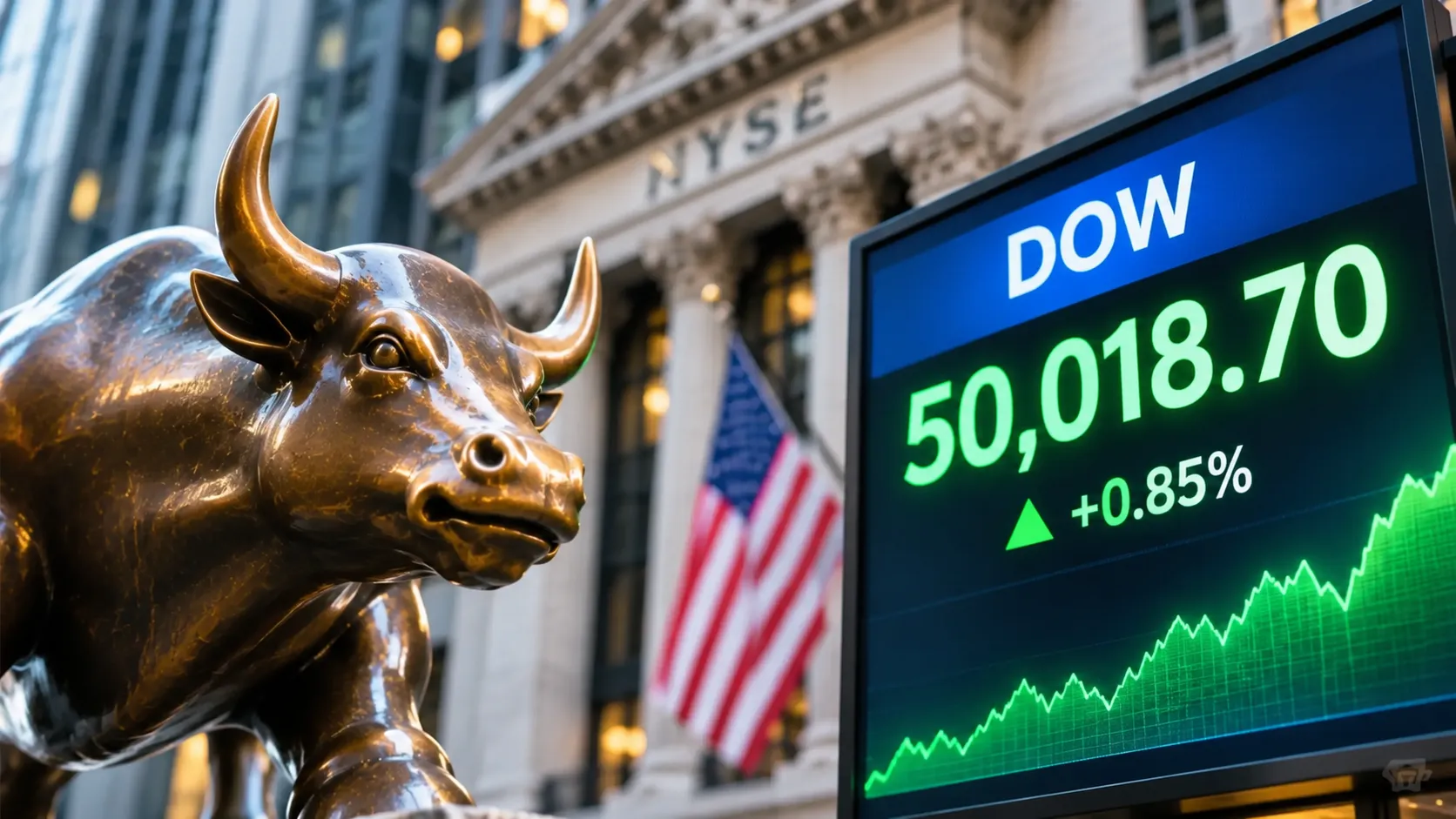
Wall Street reached a historic milestone on Tuesday, but beneath the headline, the market told a more complicated story.
The Dow Jones Industrial Average closed above 50,000 for the first time on November 24, gaining 423.39 points, or 0.85%, to finish at 50,018.70, according to closing data compiled by VistaP Global. The blue-chip index has now risen roughly tenfold since it first crossed 5,000 in 1995.
Yet the broader market moved in the opposite direction. The S&P 500 fell 36.08 points, or 0.50%, to 7,201.09, and the technology-heavy Nasdaq Composite dropped 356.02 points, or 1.48%, to 23,733.54. The small-cap Russell 2000 rose 0.57% to 2,684.94.
A rotation from growth to value
The divergence reflected a rotation from technology and growth stocks into more traditional, value-oriented companies. The Dow is a price-weighted index of 30 large companies, including industrial, financial, healthcare and consumer businesses, and is less dominated by technology than the Nasdaq or the S&P 500.
The move came a day after one of the most dramatic sessions of the year, when Nvidia shares surged about 31% after the chipmaker reinstated Jensen Huang as chief executive, lifting the Nasdaq more than 6%. On Tuesday, Nvidia gave back some of those gains, falling about 3.9%, according to Business Today, as investors locked in profits and questions about the episode continued.

Anthropic under pressure
Among technology stocks, Anthropic closed down about 6.5%, slipping below its $83 initial public offering price less than a week after its debut, according to VistaP Global. The decline added to concerns about the valuations of AI companies, which had been tested by the turmoil at Nvidia.
Consumers more confident
Economic data provided support for cyclical and consumer stocks. The Conference Board's Consumer Confidence Index jumped 11.4 points to 103.3 in November from a revised 91.9 in October, its highest level since January 2025.
The improvement suggests that American households are feeling better about the economy and their finances heading into the holiday shopping season, which is crucial for retailers.
Retail earnings shine
Retailers reported strong results. Best Buy posted comparable-sales growth of 6.1%, its best in five years, with revenue rising 5% to $10.2 billion and adjusted earnings per share of $1.62, and raised its outlook. Dick's Sporting Goods and Dollar Tree also reported stronger-than-expected results and raised their guidance.
These results, combined with the consumer confidence data, helped support the Dow, which includes major consumer companies.
Deals and healthcare
Healthcare stocks were in focus after Sanofi agreed to acquire Insmed for $41 billion in cash, or $175 per share. Large pharmaceutical deals tend to lift sentiment across the biotech sector, as investors anticipate further acquisitions.
Kymera Therapeutics priced an upsized share offering of about $1.75 billion, one of the largest biotech equity raises of the year.
Dell after the bell
After the close, Dell reported third-quarter revenue and adjusted earnings above forecasts, raised its full-year outlook and reported a $132.3 billion backlog of AI-related orders, according to VistaP Global. The figures offered further evidence of strong demand for AI servers, even as investors debate the sustainability of AI spending.
Why 50,000 matters
Round-number milestones carry no fundamental significance, but they often capture public attention and reflect long-term trends. The Dow's climb to 50,000 reflects decades of growth in corporate profits, as well as the strong performance of US equities in recent years, driven by technology, robust consumer spending and resilient economic growth.
The Dow first crossed 10,000 in 1999, 20,000 in 2017, 30,000 in 2020 and 40,000 in 2024. The pace of gains has accelerated as the index has grown.
Looking ahead to PCE
Investors are awaiting the personal consumption expenditures (PCE) price index, the Federal Reserve's preferred measure of inflation, due on the eve of Thanksgiving. Inflation has remained above the Fed's 2% target, partly because of higher energy prices earlier in the year, and markets have been weighing the possibility of a rate increase in December.
A higher-than-expected reading could renew pressure on growth stocks, while a softer figure could support a broader rally.
The holiday-shortened week
US markets will be closed on Thursday for Thanksgiving and will close early on Friday. Trading volumes typically decline during the holiday week, which can amplify price moves.
What it means for Indian investors
For Indian investors with exposure to US markets through international mutual funds or overseas investment platforms, the Dow's milestone and the rotation away from technology highlight the importance of diversification across sectors. Indian markets reopen on Wednesday, November 25, after the Guru Nanak Jayanti holiday, and will be influenced by the swings in US technology stocks and the global AI trade.
Sector leaders and laggards
Financial, industrial and healthcare stocks were among the best performers on the day, reflecting the shift towards companies tied to economic growth and less exposed to high valuations. Semiconductor and software stocks were among the weakest, as investors trimmed positions after the previous day's surge.
The pattern suggests that many investors used the Nvidia-led rally of November 23 as an opportunity to rebalance portfolios that had become heavily concentrated in technology.
What strategists are saying
Market strategists have been urging investors to diversify beyond a small group of AI-related stocks for much of 2026. The Dow's milestone, achieved while the Nasdaq fell, offers some evidence that leadership in the market may be broadening.
However, technology companies still account for a large share of US market value and earnings growth, and any sustained rally is likely to require participation from the sector.
Bond and currency moves
Treasury yields were little changed, as investors balanced strong consumer data against expectations for the Federal Reserve's next move. The dollar held steady against major currencies, while oil prices remained well below the levels seen earlier in the autumn, helping contain inflation expectations.
Gold prices, which have fallen sharply from their January peak, remained under pressure as investors favoured equities.
Earnings season wraps up
With most large companies having reported third-quarter results, attention is shifting to guidance for 2027. Corporate profits have grown solidly in 2026, supported by AI investment and resilient consumer demand, and analysts expect further growth next year, though forecasts vary widely by sector.
What comes next
Investors will watch the PCE data, the holiday shopping season and comments from Federal Reserve officials ahead of the December policy meeting. Whether the rotation into value stocks continues, or technology regains leadership, will shape market direction into the end of the year.