FundingMarket Data Women5 MIN READ

Dow Plunges 1,100 Points as Nvidia Slides for a Sixth Day and Traders Price a December Fed Rate Hike

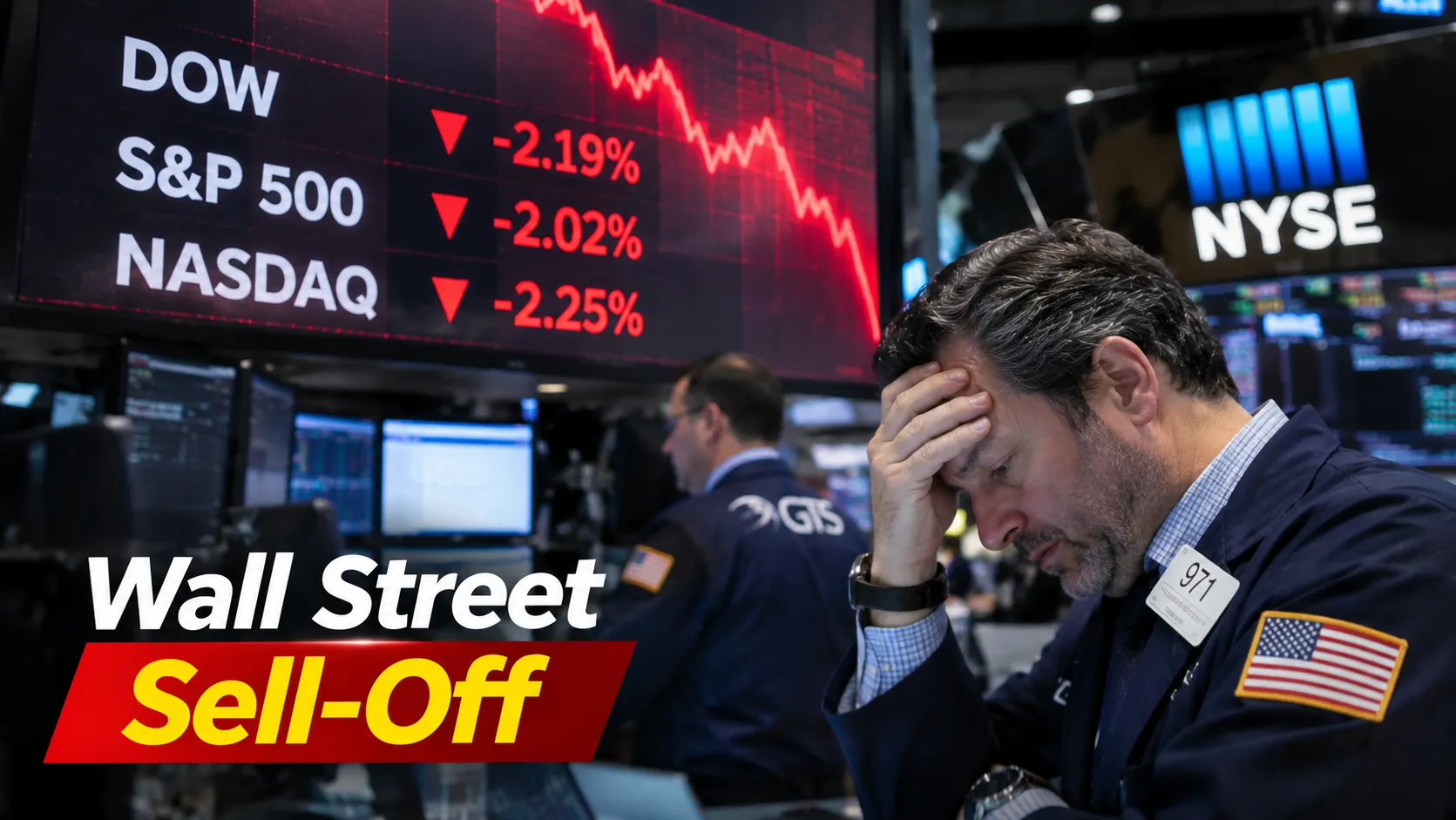
The Dow Jones Industrial Average fell 1,101.11 points, or 2.19%, to 49,097.06 on November 19, while the S&P 500 lost 2.02% and the Nasdaq Composite 2.25%, as traders priced in a near-certain Federal Reserve rate increase in December and sold AI stocks. Nvidia fell for a sixth straight session, AMD dropped 7.7% and AI cloud providers Nebius and CoreWeave slumped.

By Shaym Kumar · Author20 November 2026New
Dow Plunges 1,100 Points as Nvidia Slides for a Sixth Day and Traders Price a December Fed Rate Hike

Wall Street suffered one of its worst days of the year on Thursday, as fears of higher interest rates collided with growing doubts about the AI trade.

The Dow Jones Industrial Average fell 1,101.11 points, or 2.19%, to close at 49,097.06 on November 19. The S&P 500 dropped 2.02% to 7,175.83, and the technology-heavy Nasdaq Composite lost 2.25% to 23,879.20. The small-cap Russell 2000 fell 2.18%.

The decline was broad-based, with technology and semiconductor stocks leading the losses.

The Fed factor

The main driver was a sharp shift in expectations for Federal Reserve policy. Futures markets priced a probability of about 96.4% that the Fed will raise interest rates at its December meeting, according to market data cited in reports on Thursday.

Earlier in 2026, investors had expected the Fed to continue cutting rates. But inflation has remained stubbornly elevated, partly because of higher energy prices linked to the conflict involving Iran and disruptions in the Strait of Hormuz, as well as tariffs and strong demand. Minutes of the Fed's last meeting, released this week, showed policymakers increasingly concerned about inflation.

Investors are awaiting personal consumption expenditures (PCE) data, the Fed's preferred inflation gauge, with core PCE inflation expected at 3.2%, well above the central bank's 2% target.

AI stocks under pressure

Nvidia fell 3.3%, its sixth consecutive decline, even after the chipmaker reported strong quarterly results earlier in the week. The stock's slide reflects concerns that the AI spending boom may slow, as well as the impact of higher interest rates on high-valuation growth stocks.

AMD fell 7.7% after a short-seller associated with the research firm Hunterbrook published a critical report on the company. The Philadelphia Semiconductor Index dropped 2.4%.

AI cloud providers were hit particularly hard. Nebius fell 9.4% and CoreWeave lost 6.1%. These companies, which rent AI computing capacity to customers, have borrowed heavily to build data centres, making them sensitive to interest rates and to any slowdown in AI demand.

Bright spots

Not every stock fell. Palo Alto Networks rose 6.4% after the cybersecurity company reported strong quarterly results and announced the acquisition of AI startup Applied Compute for $4.5 billion.

Anthropic, which made its stock market debut on Thursday, closed 17% above its IPO price, valuing the company at about $1.27 trillion, despite the broader sell-off.

Walmart fell about 1% even after raising its full-year guidance, as investors weighed its strong results against concerns about consumer spending.

The market view

Market commentators, including Jed Ellerbroek of Argent Capital Management, pointed on Thursday to the combination of tighter monetary policy expectations and high valuations, particularly for AI-related stocks.

Higher interest rates reduce the present value of future earnings, which hits growth stocks hardest. They also increase borrowing costs for companies and consumers, potentially slowing economic growth.

A turning point?

The sell-off comes after a strong run for US stocks, which reached record highs earlier in the year driven by enthusiasm for AI. The S&P 500 is still well above its levels of a year ago.

However, some investors have warned that the market had become overly dependent on a small number of AI-related stocks, leaving it vulnerable to any shift in sentiment. Concerns have also grown about the massive capital spending by technology companies on AI infrastructure and whether it will generate sufficient returns.

“The market is having to come to terms with the idea that the next move from the Fed may be up, not down.”
— TIGI Markets Desk
8fc638af-1b78-45db-bdee-2db8ae79bff1.png

What it means for global markets

A sharp fall on Wall Street often spills over into other markets, as investors reduce risk globally. Higher US interest rates also strengthen the dollar and can draw capital away from emerging markets.

For India, higher US rates could put pressure on foreign portfolio flows and the rupee. Indian IT stocks, which earn much of their revenue in the US, have already fallen for three straight sessions, while the broader Indian market rallied strongly on Thursday on domestic factors.

What investors will watch

Key events in the coming days include the PCE inflation data, further comments from Fed officials and the G20 summit in Miami next month. The Fed's December meeting will be the most important event for markets before the end of the year.

Sector performance

Technology was the worst-performing sector on Thursday, followed by communication services and consumer discretionary stocks, which are typically most sensitive to interest rates. Defensive sectors such as utilities and consumer staples held up relatively better, as investors moved into stocks seen as less vulnerable to economic slowdowns.

Bond yields rose as traders adjusted their expectations for Fed policy, increasing pressure on stocks with high valuations.

The AI capital spending debate

Large technology companies have committed hundreds of billions of dollars to building AI data centres, buying chips and securing power supplies. Investors have generally rewarded this spending, but there are growing questions about when it will generate sufficient revenue and profit.

If AI spending slows, companies that supply chips, servers, networking equipment and data centre services could see weaker demand. Concerns about this possibility have contributed to the recent weakness in Nvidia and other AI-related stocks.

Volatility returns

Measures of expected market volatility rose on Thursday as stocks fell. After a long period of relatively calm markets, the return of volatility could prompt some investors to reduce risk, particularly those using leverage or momentum-based strategies.

Historically, sharp one-day declines have sometimes been followed by rebounds, but they can also mark the beginning of longer corrections when they reflect a fundamental change in the economic outlook.

Lessons for long-term investors

Financial advisers often remind investors that sharp daily moves are a normal part of stock market investing and that trying to time the market is difficult. Long-term investors who stay diversified across sectors and regions have historically been rewarded, even after significant corrections.

However, the combination of high valuations and the prospect of rising interest rates has led some advisers to recommend reviewing portfolio concentration, particularly in technology and AI-related stocks, which have accounted for a large share of market gains in recent years. Balancing growth holdings with more defensive assets can help investors weather periods of volatility.

What comes next

The question for investors is whether Thursday's sell-off marks a brief correction or the start of a deeper reassessment of the AI trade and the interest rate outlook. With a December rate increase now largely priced in, market attention will turn to how far the Fed is prepared to go in 2027.

TagsDow JonesS&P 500NasdaqWall Streetstock market sell-offNvidiaAMDPalo Alto NetworksWalmartNebiusCoreWeavesemiconductorsFederal Reserverate hikeinflationPCEAI stocksUS marketsRussell 2000investors

Reader reviews

Sign in to rate and review this article.
Loading reviews…

