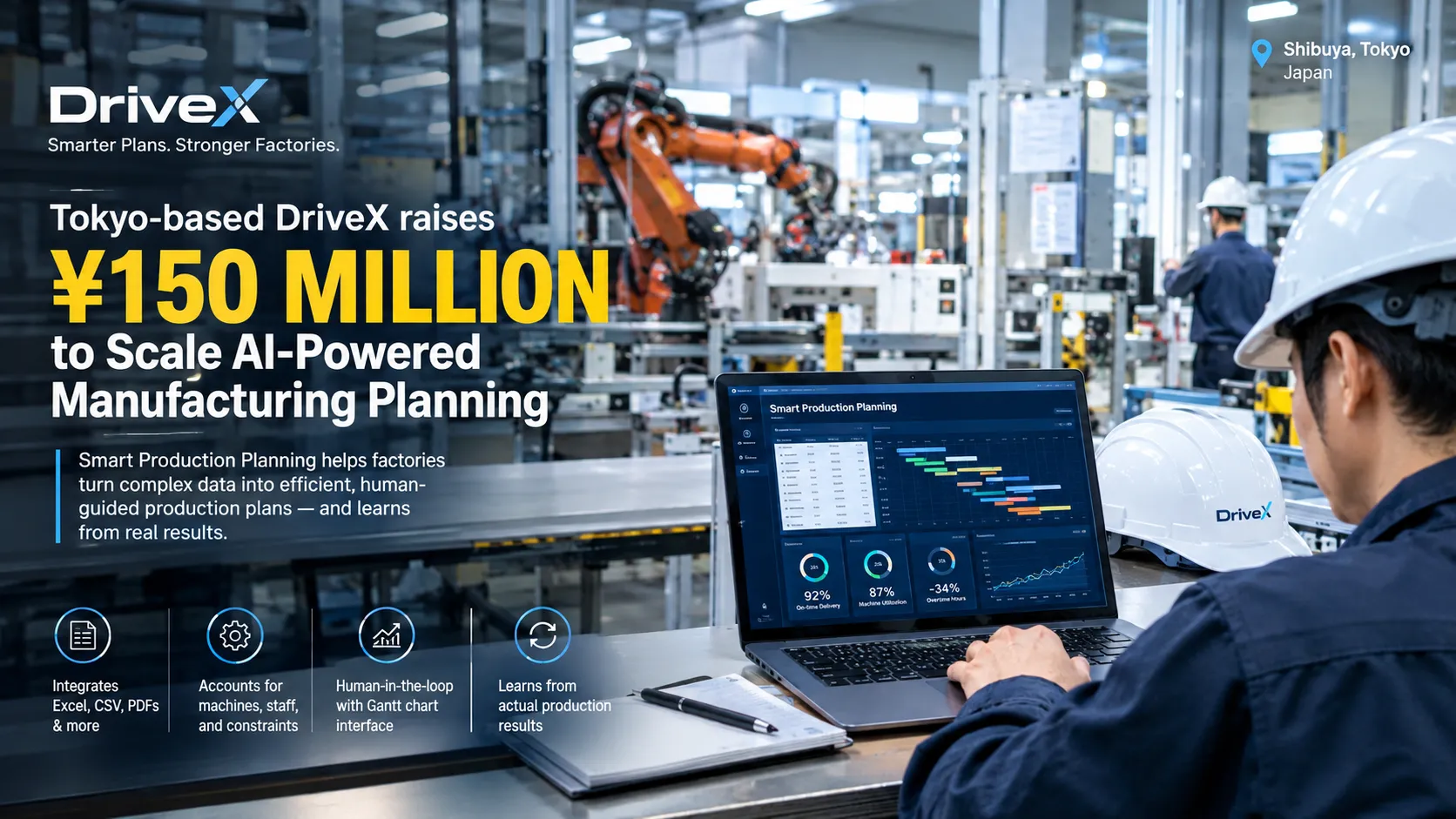
Factories may run sophisticated machines, but the plans that tell those machines what to make, and when, are often still built in spreadsheets by a handful of experienced planners. DriveX, a startup based in Tokyo's Shibuya district, wants to change that, and it has raised fresh capital to do so.
DriveX has raised approximately ¥150 million, a little over $1 million, from corporate and individual investors to expand Smart Production Planning, its artificial intelligence system for manufacturing operations, according to an announcement on 2 October reported by TechStartups. The investors' names and the round's stage were not disclosed.
The company previously raised about ¥50 million in October 2025 from Kaga Electronics and angel investors, bringing its publicly disclosed funding to at least ¥200 million. At that time, its focus included enterprise AI knowledge infrastructure. The new round marks a sharper move into manufacturing-specific software.
The amount is modest, but the problem DriveX is tackling is large, especially in Japan, where an ageing workforce threatens to take decades of factory know-how into retirement.
The spreadsheet problem
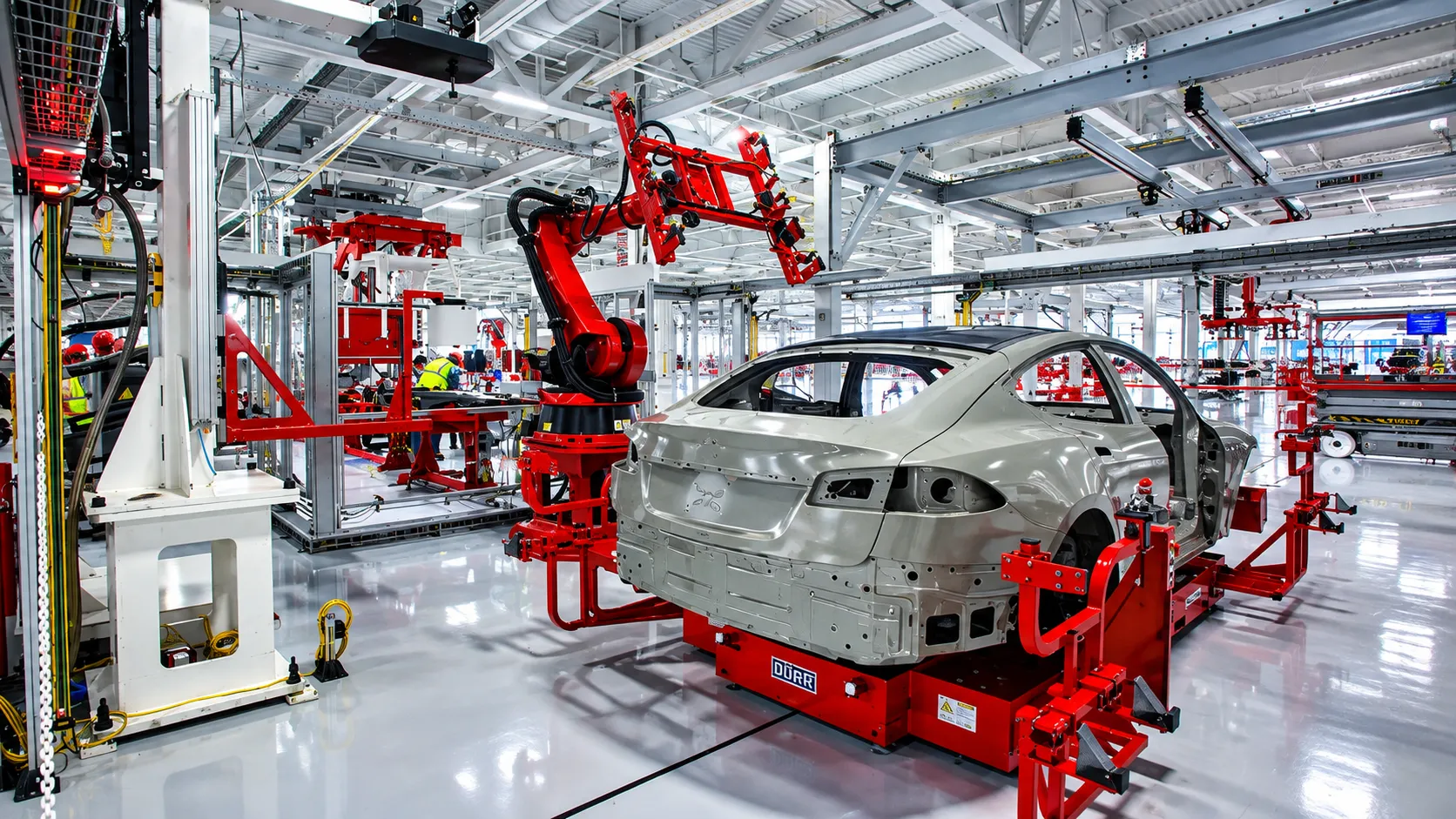
Production planning is one of the most consequential decisions a factory makes. A good plan keeps machines busy, meets delivery dates, avoids excess inventory and uses staff efficiently. A poor plan leads to idle equipment, late orders, overtime and waste.
Yet in many factories, especially small and medium-sized manufacturers, planning is still done by hand. Planners combine order data, machine capacity, staff rosters and countless one-off exceptions, often using Excel workbooks that have grown over years. The knowledge of how to balance those constraints frequently sits in the heads of a few veteran employees.
DriveX's Smart Production Planning is designed to take over much of that work. The system ingests the materials planners already use, including Excel files, CSV data, PDFs, orders and master data. It then builds production plans that take account of machine availability, employees, operating calendars and process constraints.
Human planners remain in the loop. They can adjust the resulting schedule through a Gantt chart interface, moving jobs, changing priorities and handling exceptions that the system may not foresee.
The learning loop
The most strategically interesting feature is what happens after the plan is executed. DriveX feeds actual production results back into its models, updating standard work times and assumptions about workers' skills. Over time, the system's plans should reflect how the factory really performs rather than how it was assumed to perform when the spreadsheets were first built.
That loop is what could make the product defensible. Generating a production schedule from a prompt using a general-purpose AI model is easy to copy. Integrating with a factory's enterprise resource planning and manufacturing execution systems, understanding its specific constraints and accumulating its production history is not. Once a system has learned how a particular plant actually runs, replacing it becomes costly.
Why Japan, why now
Japan's manufacturing sector faces a demographic squeeze. The country's working-age population has been shrinking for years, and many factories, particularly small suppliers in industrial clusters, struggle to recruit young workers. When an experienced planner retires, the knowledge of how to run the plant efficiently can leave with them.
That makes tools that capture and systematise expertise particularly valuable. Japanese manufacturers have long been known for operational excellence and continuous improvement, but many smaller firms have been slower to digitise their back-office processes than their production lines. Government programmes have encouraged digital transformation among small and medium-sized enterprises, and labour shortages have made automation of planning and administrative work more urgent.
DriveX's earlier investor, Kaga Electronics, is a Tokyo-listed electronics trading and manufacturing services company. Corporate investors of this kind can be valuable to a startup like DriveX not only for capital but for introductions to manufacturing customers and partners in the supply chain.
A growing industrial AI market
DriveX is part of a broader wave of startups bringing AI into specific industrial workflows rather than building general-purpose models. The venture thesis behind such companies is that the greatest value lies not in model access, which is becoming commoditised, but in proprietary operating context: the data, integrations and domain knowledge that tie AI to real business decisions.
TechStartups noted that DriveX's approach is to insert AI at one expensive decision point, where poor planning causes idle machines, late orders, excess inventory or wasted labour, rather than replacing a factory's entire software stack. That focused strategy can make adoption easier, because customers do not have to overhaul systems they already rely on.
Competition will come from established enterprise software vendors offering advanced planning and scheduling modules, from manufacturing execution system providers adding AI features and from other startups. DriveX's advantage will depend on how quickly and cheaply it can be deployed in smaller factories that cannot afford large implementation projects. Measuring success will be straightforward in principle, if demanding in practice. Factories can track on-time delivery rates, machine utilisation, overtime hours and inventory levels before and after deploying a planning system. Improvements of even a few percentage points can translate into significant savings for manufacturers operating on thin margins. Clear, quantifiable results of this kind are what persuade cautious plant managers to adopt new software, and they will be central to DriveX's ability to win customers beyond its early adopters.
Lessons beyond Japan
The challenges DriveX is addressing are not unique to Japan. Manufacturers in Europe, South Korea and China face similar demographic pressures, and even countries with younger workforces, such as India, have many small manufacturers that rely on informal planning practices.
India's push to expand manufacturing through production-linked incentive schemes and supply chain diversification has brought thousands of small and medium enterprises into global value chains, where delivery reliability and efficiency are critical. Tools that help such firms plan better could become an important part of that transition, and Japanese industrial software companies have long had partnerships with Indian manufacturers, particularly in the automotive sector.
For now, DriveX is a small company with a clear focus. Its ¥150 million will fund product development and customer expansion in Japan. The test will be whether its learning loop delivers measurable improvements, fewer late orders, less idle time and lower inventory, in real factories. If it does, the startup will have shown that some of the most valuable AI applications are not the most glamorous ones, but those that quietly fix how work actually gets done.