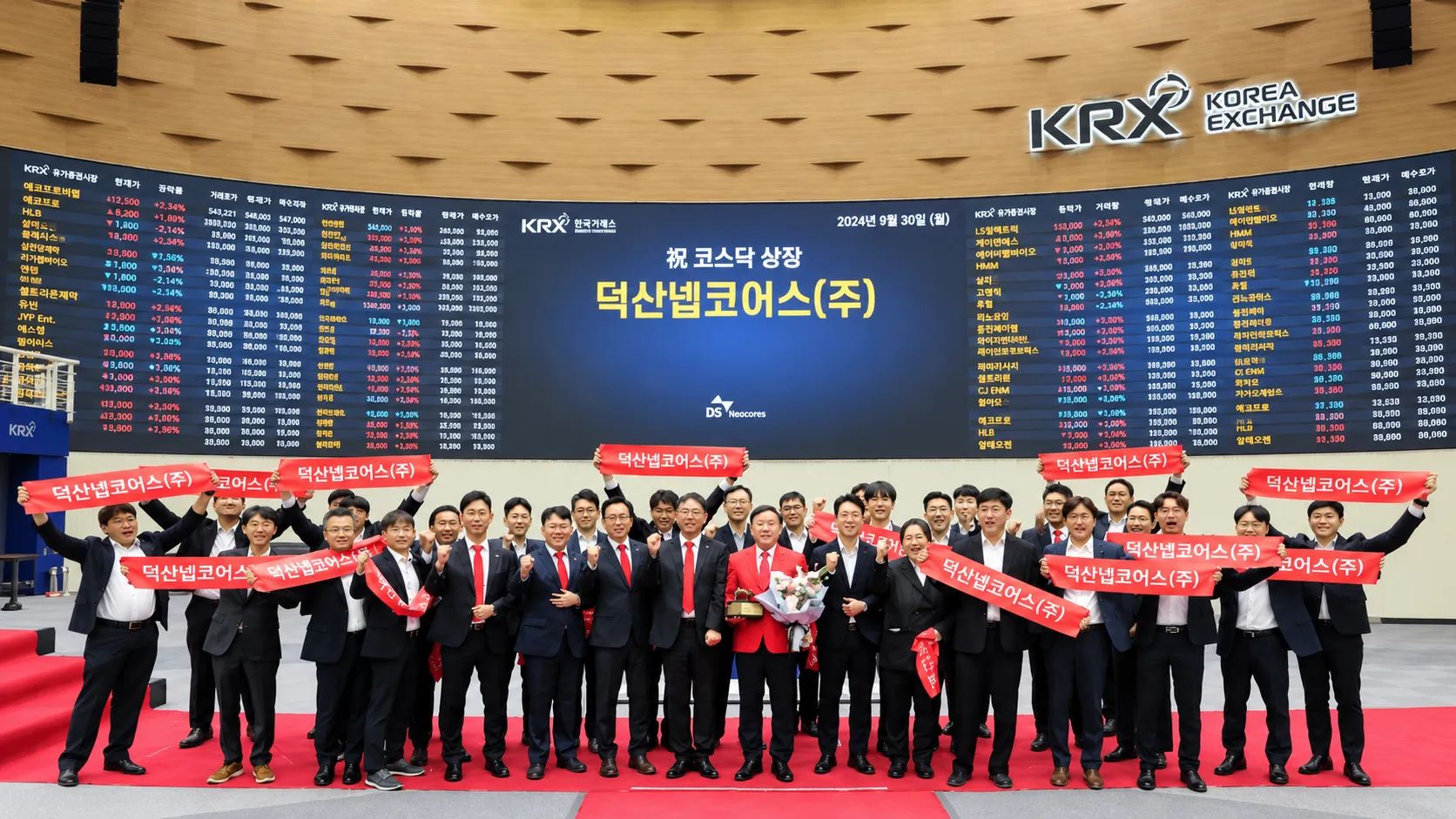
Duksan Navcours, a South Korean company that designs navigation and anti-jamming equipment for weapons systems, aircraft and drones, made a strong debut on the KOSDAQ market on 30 September 2026. Its shares traded about 75.68% above the offer price shortly after the market opened, highlighting investor enthusiasm for defence technology at a time of heightened global security concerns.
The company, also known as DS Navcours, priced its initial public offering at ₩14,600 per share, the top of its indicative range of ₩12,400 to ₩14,600. It offered three million shares, raising about ₩43.8 billion. Based on the final number of shares outstanding, the offer price implied a market capitalisation of about ₩275.9 billion.
What DS Navcours makes
Founded in 2012, DS Navcours designs and manufactures navigation and anti-jamming equipment for ground weapons, guided weapons, aircraft, unmanned aerial vehicles, launch vehicles and satellites. Many of its products are developed jointly with South Korea's major defence system integrators and then mass-produced, and the company also provides maintenance and performance-improvement services.
Navigation systems allow weapons and vehicles to know precisely where they are and where they are going. Most modern systems rely in part on satellite navigation signals, such as GPS, which are weak by the time they reach Earth and can be disrupted by jamming or deceived by spoofing.
Anti-jamming technology protects receivers from such interference, allowing a missile, drone or aircraft to keep navigating accurately even in a contested electronic environment. The company is also developing a miniature integrated navigation system for use in guided weapons, robots and drones.
Why investors want exposure
The demand for DS Navcours shares reflects lessons from recent conflicts. Electronic warfare, including large-scale GPS jamming and spoofing, has become a defining feature of the war in Ukraine and of tensions in the Middle East, where commercial aviation and shipping have also been affected by navigation interference. Militaries around the world are investing heavily in systems that can operate when satellite navigation is unreliable.
At the same time, South Korea has become one of the world's fastest-growing defence exporters. Its tanks, howitzers, aircraft and missile systems have won major contracts in Europe, the Middle East and Asia, and listed defence companies in Seoul have been among the best-performing stocks in the market. That success has drawn investors to smaller suppliers in the defence supply chain, such as DS Navcours, that can benefit from rising production volumes.
The company has been selected for a South Korean government programme supporting exports by small and medium-sized defence companies, and is targeting overseas markets.
Where the money will go
DS Navcours plans to use the IPO proceeds to invest in production facilities and research and development, expanding mass production for its defence business. It also intends to build satellite navigation infrastructure and broaden its operations into the aerospace sector.
"We will use the listing as a starting point for the company's next stage of growth and strengthen our R&D and production capabilities to respond to the defense and aerospace markets," said chief executive Hwang Tae-ho.

A test case for new listing rules
The IPO is notable for another reason. DS Navcours is the first approved case of an exception for overlapping listings since South Korea revised its rules on spin-offs and the separate listing of subsidiaries of already-listed companies.
Those rules were tightened after investors complained that parent companies were listing promising subsidiaries separately, diluting the value of the parent's shares and harming minority shareholders, a practice that critics said contributed to the so-called "Korea discount" in stock market valuations. The DS Navcours case shows that regulators are willing to approve such listings where the justification is strong, but under closer scrutiny.
Supply of shares on day one
Ahead of the listing, the share of stock available for trading on the first day fell to 33.29%, below the 40.11% estimated in the company's initial registration statement. The decline came as a larger proportion of institutional investors agreed to lock-up periods in the final allocation, with the final lock-up rate reaching 57.26%. A smaller tradable float typically reduces selling pressure in the early days of trading and can amplify price moves.
Some existing minority shareholders had bought their shares in over-the-counter trading at prices between ₩20,000 and ₩27,400, above the IPO price, according to the company, which could influence trading as those investors look to exit.
A busy KOSDAQ IPO season
DS Navcours is part of a revival in South Korea's market for new listings. Eugene Investment & Securities estimated that eight to eleven companies would debut on KOSDAQ in September, up from six in August and well above the pace of the first half, when there were just 17 IPOs across the KOSPI and KOSDAQ combined.
Robotics, artificial intelligence, biotechnology and defence companies have featured prominently among the new listings. However, analysts warn that sharp first-day gains are not always sustained. Some recent debuts have surged on their first day and then fallen sharply as investors reassessed valuations. Economists have cautioned against treating debut rallies as evidence of a broad market recovery.
The wider market backdrop was supportive on the day. The KOSPI index rose more than 1% in early trading on 30 September, driven by foreign buying, while the KOSDAQ also opened higher.
The aerospace ambition
Beyond weapons programmes, DS Navcours sees opportunity in the space and aerospace sectors. South Korea has been building its own space capabilities, including domestically developed launch vehicles and plans for a Korean satellite navigation system intended to improve positioning accuracy across the Korean peninsula. Navigation equipment for launch vehicles and satellites, together with ground infrastructure for satellite navigation, could give the company a source of growth that is less dependent on defence budgets. Diversifying in this way is important for smaller defence suppliers, whose revenue can be lumpy and closely tied to the timing of large government contracts.
What it means for global investors
For global investors, including those in India tracking the growth of defence manufacturing, the DS Navcours listing illustrates how electronic warfare and navigation resilience have become investable themes. India, too, has been expanding its domestic defence production and exports, and navigation technology, including its own regional satellite navigation system, NavIC, is a strategic priority.
The longer-term test for DS Navcours will be whether it can convert investor enthusiasm into sustained growth, by winning export contracts and expanding into aerospace. Its strong debut gives it a solid platform to try.