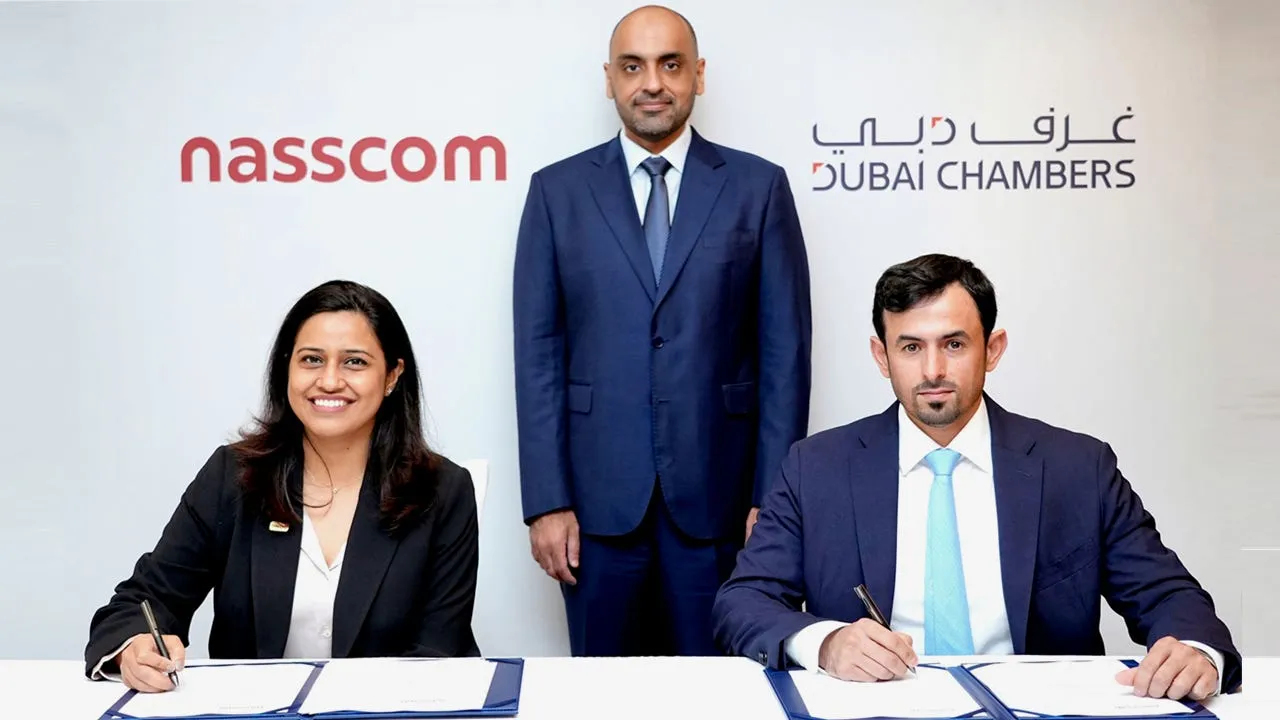
Dubai has signed a memorandum of understanding with NASSCOM, India's apex technology industry association, establishing a formal framework for collaboration in agentic artificial intelligence and deeptech sectors. The agreement is designed to create structured market access for Indian technology companies seeking to expand into Dubai, while supporting the emirate's broader ambitions around advanced technology adoption.
The MoU covers a range of collaborative mechanisms, including knowledge sharing, coordinated business delegations, business-to-business meetings, and joint innovation initiatives aimed at connecting Indian AI and deeptech companies with Dubai-based enterprises, government entities and investors.
Gulf states' pivot toward AI-driven economic diversification has accelerated markedly over the past two years, with the UAE in particular pursuing an explicit national strategy to position itself as a global leader in AI adoption across both government services and private industry, a strategy that has created substantial demand for AI talent and technology partnerships the country's domestic ecosystem cannot yet fully supply.
For India's technology services exporters, the agreement adds to a growing list of formal government-to-government frameworks designed to smooth market entry into the Gulf, a region that has become an increasingly important growth market as traditional Western demand growth has moderated.
For Dubai, the partnership supports a wider strategic objective of accelerating private-sector adoption of agentic AI — systems capable of autonomously executing complex, multi-step tasks — while strengthening the emirate's position as a regional hub for advanced technology deployment. Gulf states more broadly have been investing heavily in AI infrastructure and policy frameworks over the past several years, seeking to diversify their economies away from hydrocarbon dependence and toward knowledge-intensive, technology-driven growth.
For NASSCOM and the Indian technology companies it represents, the agreement offers a structured, government-endorsed pathway into a market that has become increasingly attractive to Indian IT services firms, AI startups and enterprise software companies. Dubai's combination of regulatory openness, capital availability and geographic positioning as a bridge between Asian, European and African markets has made it a magnet for Indian technology expansion over the past decade, a trend this MoU is designed to accelerate further.
NASSCOM's engagement with Dubai builds on a longer history of the Indian IT industry body pursuing government-to-government and industry-to-government partnerships aimed at opening structured market access for its member companies, a strategy that has proven particularly effective in markets, like the Gulf, where government relationships and regulatory navigation can significantly influence the pace and ease of market entry for foreign technology firms.
Indian technology companies pursuing Gulf expansion have historically had to navigate a patchwork of individual relationship-building and market entry strategies; formal MoU frameworks of this kind are intended to reduce that friction by establishing clearer institutional channels, joint working groups and structured business-matching mechanisms that individual companies can plug into rather than building relationships entirely from scratch.
Indian IT services companies with existing Gulf operations, including several NASSCOM member firms already serving banking, government and telecommunications clients across the UAE, are expected to be among the most immediate beneficiaries of the expanded market access and business-matching opportunities the Dubai MoU is designed to facilitate.
Agentic AI specifically represents one of the fastest-evolving frontiers in enterprise technology, with companies globally racing to deploy systems capable of handling increasingly autonomous workflows across customer service, operations, software development and data analysis. India's technology sector, with its deep bench of AI engineering talent and established enterprise software expertise, is positioning itself as a key supplier of agentic AI capabilities to markets like Dubai that are eager to adopt the technology but may lack the same depth of domestic AI engineering talent.
The partnership is expected to be operationalised through a combination of trade delegations, joint working groups and knowledge-exchange programmes over the coming months, with both NASSCOM and Dubai-based counterparts indicating an intention to move quickly given the fast-moving nature of the agentic AI sector globally. Analysts tracking India-Gulf technology cooperation note that agreements of this kind, while not immediately transformative on their own, tend to meaningfully lower the friction Indian companies face when establishing initial footholds in Gulf markets.
Agentic AI specifically has become a particular area of focus for Gulf government digitisation strategies, with UAE government entities among the more aggressive global adopters of AI-driven automation for citizen services, a use case that plays directly to the enterprise AI and government technology expertise many Indian IT services and software companies have built over decades of serving demanding public and private sector clients domestically.
The MoU's business delegation and B2B meeting components are expected to be operationalised relatively quickly, according to people familiar with the agreement, reflecting an urgency on both sides to translate the diplomatic framework into concrete commercial outcomes before the current wave of enthusiasm around agentic AI adoption potentially cools or shifts toward other emerging technology priorities.
Dubai's own AI strategy has emphasised rapid, practical deployment over purely theoretical research investment, a pragmatic orientation that aligns closely with the applied, enterprise-focused AI expertise many Indian technology companies have built through decades of serving demanding global clients across banking, telecommunications and government sectors.
As agentic AI adoption accelerates globally, partnerships like the Dubai-NASSCOM MoU illustrate how governments and industry bodies are moving to formalise technology corridors between fast-growing AI supplier markets like India and fast-adopting markets like the UAE, potentially reshaping the competitive geography of enterprise AI deployment across the wider region.
As India and Gulf economies continue deepening technology ties across AI, deeptech and digital infrastructure, agreements like the Dubai-NASSCOM MoU illustrate a broader pattern of formal government-industry partnerships increasingly serving as the connective tissue translating high-level bilateral relationships into company-level commercial opportunity.
Both NASSCOM and Dubai's government technology bodies have indicated that this MoU should be viewed as an initial framework rather than a final commitment, with further sector-specific agreements expected to follow as the two sides identify the highest-potential areas for deeper agentic AI collaboration between Indian technology suppliers and Gulf enterprise and government adopters.
Officials involved in drafting the agreement say further sector-specific working groups, covering areas such as fintech, healthtech and government digitisation, are expected to be announced in subsequent months as both sides identify the highest-potential areas for deeper collaboration between India's AI talent base and Dubai's fast-moving enterprise and government adopters.