
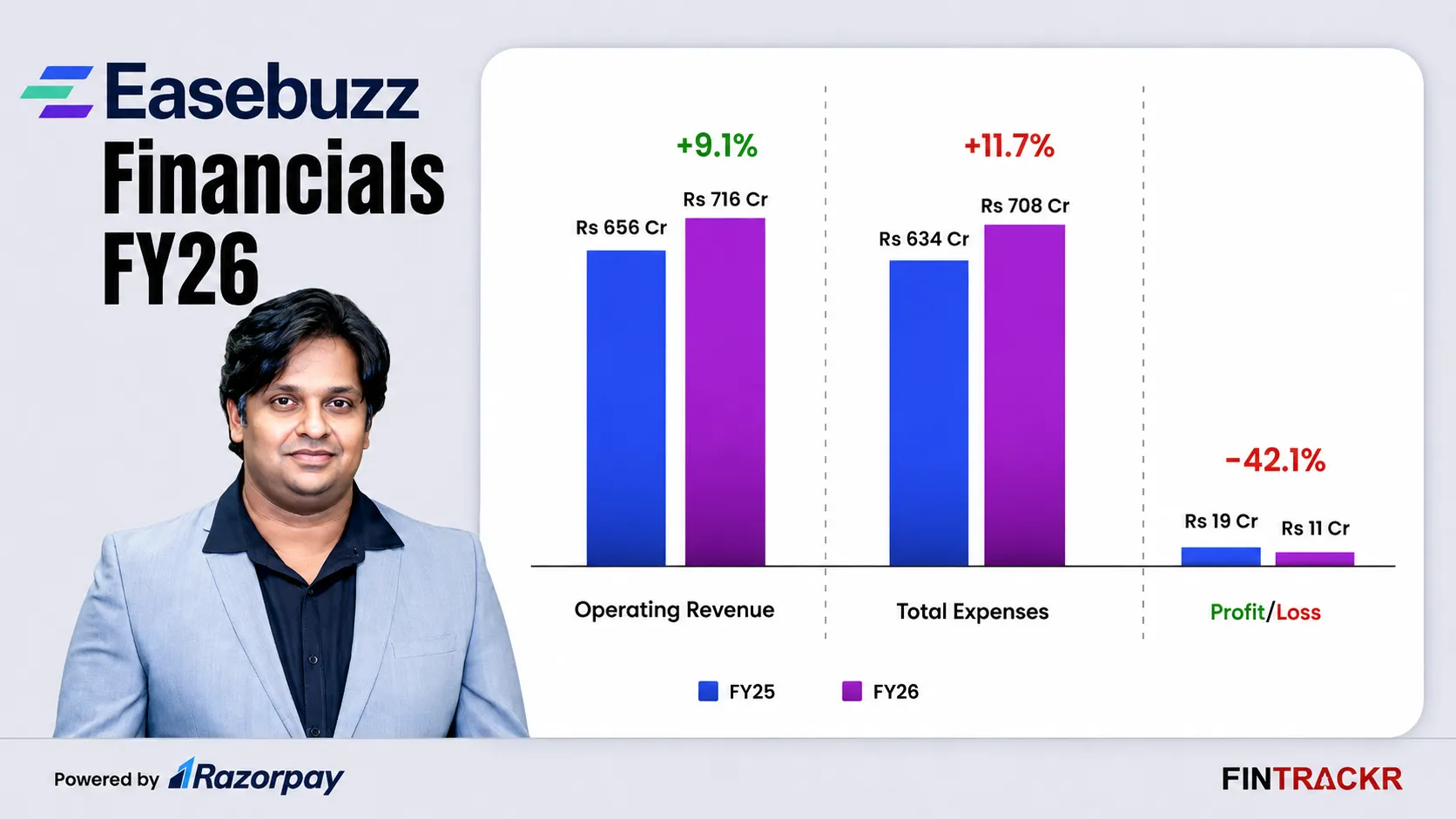
Easebuzz, the Pune-based full-stack payments and financial infrastructure platform, closed FY26 with revenue crossing the ₹700 crore mark for the first time, even as a sharp profit decline exposed just how exposed the company's growth has been to a single regulatory shock: the government's ban on real-money gaming apps, imposed at the start of the fiscal year. According to financial statements filed with the Registrar of Companies, Easebuzz's revenue from operations grew 9.1% to ₹716 crore in FY26, up from ₹656 crore in FY25 — a marked slowdown from the 127% revenue growth the company had posted just one year earlier, when its topline more than doubled from ₹289 crore in FY24.
Profitability took a considerably harder hit than revenue growth alone would suggest. Net profit fell 42.1% to ₹11 crore in FY26, down from ₹19 crore in FY25 — itself a year in which profit had surged more than 46-fold from a mere ₹40 lakh in FY24. The whiplash across three consecutive fiscal years, from near-breakeven to explosive profit growth to a sharp reversal, illustrates how sensitive Easebuzz's business model remains to shifts in transaction volume from specific high-frequency merchant categories, even as the company has worked to diversify into steadier, sector-specific revenue streams.
The mechanics of the slowdown are straightforward. Easebuzz operates as a B2B payment gateway for small and medium enterprises, generating the overwhelming majority of its revenue — 97.35% in FY26 — from transaction fees on payments processed through its plug-and-play APIs, with the remainder split between information technology and support fees (₹14 crore) and SaaS fees (₹5 crore). Real-money gaming platforms had historically represented a significant, high-transaction-volume merchant category for payment gateways across the industry; the government's ban on such apps at the start of FY26 removed a meaningful chunk of processing volume industry-wide, and Easebuzz's single-digit revenue growth for the year — a sharp deceleration from its historical trajectory — reflects that disruption directly.
Total income for the year, including ₹7 crore in other income, reached ₹723 crore, up from ₹659 crore in FY25. But total expenses grew faster than revenue, rising 11.7% to ₹708 crore from ₹634 crore — a gap that, on a business already operating on relatively thin transaction-fee margins, was enough to more than halve the company's profit growth trajectory. EBITDA fell to ₹14 crore from ₹28 crore, with EBITDA margin dropping to 1.96% from 4.27%, while return on capital employed collapsed to 3.52% in FY26 from 18.25% in FY25 — a particularly steep decline that reflects both the profit contraction and a larger capital base following the company's prior fundraising. At the unit level, Easebuzz spent ₹0.99 to earn every rupee of operating revenue in FY26, up marginally from ₹0.97 the year before, underscoring the industry-wide reality that payment gateway margins in India remain notoriously thin even for well-capitalised, profitable players.
Balance sheet metrics moved in the same direction. As of March 2026, Easebuzz's total current assets declined 28.4% to ₹141 crore from ₹197 crore in FY25, while cash and bank balances fell 26.1% to ₹105 crore from ₹142 crore — a meaningful drawdown that the company has not publicly detailed the cause of, though it follows a period of continued investment in expanding its regulatory footprint and product suite. Notably, the company reported a sizable rise in other non-current assets during the year, which some financial trackers have linked to proceeds and structuring related to a prior Series A funding round, suggesting at least part of the balance sheet shift reflects deliberate capital allocation rather than operational distress.


