Royal Enfield's motorcycles continue to sell in record numbers, but rising costs are slowing the pace at which those sales translate into profit growth for its parent, Eicher Motors.
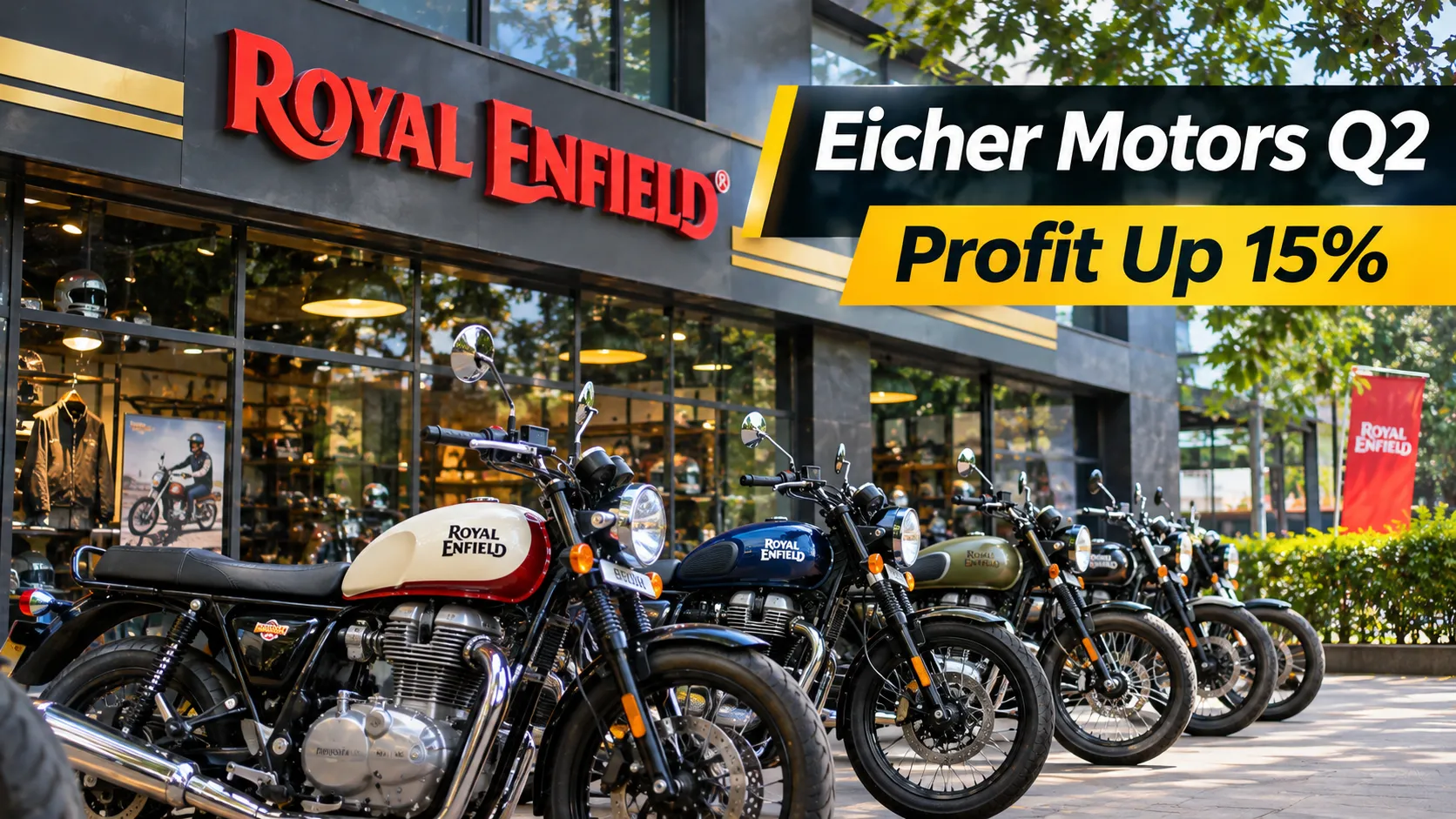
Eicher Motors reported a consolidated net profit of ₹1,573.37 crore for the July-September quarter, the second quarter of the 2026-27 financial year, up 14.9% year-on-year, according to Upstox, citing results announced on Friday, November 13. Revenue rose 20.3% to ₹7,421.72 crore.
The profit was higher than the ₹1,462.51 crore reported in the first quarter, according to CompoundingAI, reflecting stronger sequential sales during the festive season build-up.
Record sales months
Royal Enfield, Eicher's motorcycle business, has been setting sales records. It sold a record 133,958 motorcycles in September, up 8% year-on-year, according to CompoundingAI, and 133,442 in October, up 7%. Year-to-date sales from April to October reached 842,538 units, up 18%.
In the first quarter, Royal Enfield sold a record 332,940 motorcycles, up 27.4%, according to CompoundingAI.
The bigger-bike dip
Sales of Royal Enfield's larger motorcycles, those above 350cc, weakened during the quarter. Sales in this segment fell 13% in August and 26% in September, before rebounding 18% to 16,626 units in October, according to CompoundingAI.
Changes to goods and services tax rates in 2025, which reduced the tax on smaller motorcycles while raising it on bikes above 350cc, have shifted demand towards smaller models. Royal Enfield's most popular models, including the Classic 350, Bullet 350, Hunter 350 and Meteor 350, sit just below this threshold, while its 450cc and 650cc models are above it.
Cost pressures
Rising raw material costs have squeezed margins. In the first quarter, input-cost inflation reduced Eicher's gross margin by 4% to 4.5%, partly offset by a 1.2% price increase on 350cc motorcycles and savings from value engineering, according to CompoundingAI. Aluminium prices were up about 25% year-on-year in August.
Profit growth of 14.9%, slower than revenue growth of 20.3%, suggests that cost pressures continued in the second quarter.
International expansion
Royal Enfield has been expanding overseas, positioning itself as a global middleweight motorcycle brand. International revenue crossed ₹1,000 crore for the first time in the first quarter, according to CompoundingAI, with subsidiaries in markets such as Brazil contributing to growth. The company assembles motorcycles in several countries and has been exploring further local assembly, including in Indonesia.
Its 650cc twin-cylinder motorcycles, the Interceptor and Continental GT, and newer models such as the Super Meteor 650 and Bear 650, have helped it compete with established global brands in markets such as the UK, Europe, the United States and Australia.
Commercial vehicles
Eicher also owns a stake in VE Commercial Vehicles (VECV), a joint venture with Sweden's Volvo Group that makes trucks and buses. In the first quarter, VECV's revenue grew 16.6% to about ₹6,610 crore, but its EBITDA margin fell to 8.4% from 9.2%, according to CompoundingAI. Commercial vehicle dispatches in India rose 28.7% in the second quarter, according to industry body SIAM, suggesting strong demand for VECV's vehicles.
New launches
Royal Enfield has been expanding its product range. The Guerrilla 450 sells about 2,500 units a month and its 650cc twins about 4,000 to 4,200 units a month, according to CompoundingAI. It is also expanding retail sales of Flying Flea, its electric motorcycle brand, in cities including Hyderabad, Pune and Bengaluru.
The electric motorcycle market in India is still small, but Royal Enfield's entry is an important step for a brand associated with the sound and feel of traditional engines.
Capacity expansion
Royal Enfield has been expanding manufacturing capacity to meet demand. It targeted capacity of 1.6 million units a year by July 2026, according to CompoundingAI, and is planning further expansion at Cheyyar in Tamil Nadu and a new plant at Tada in Andhra Pradesh, which involves ₹1,225 crore of capital expenditure for 4.5 lakh units at full utilisation, targeted for completion by the 2029-30 financial year.
A unique brand
Royal Enfield, whose roots go back to a British company founded in the late 19th century, has been manufactured in India since the 1950s. Under managing director Siddhartha Lal, who took charge in the 2000s, it was transformed from a struggling brand into one of the most profitable motorcycle makers in the world, with a loyal following and a dominant position in India's mid-size motorcycle segment.
The two-wheeler market
India is the world's largest two-wheeler market, and demand has been strong this year, supported by lower GST rates on smaller motorcycles, a good monsoon, rising rural incomes and the festive season. Eicher does not give numerical guidance but expects high single-digit industry growth in the 2026-27 financial year and aims for Royal Enfield to outgrow the market.
Royal Enfield's pricing power
Royal Enfield has built a rare position in India's two-wheeler market, where most buyers are highly price-sensitive. Its motorcycles command a premium because of the brand's heritage, distinctive styling and a community of riders who value touring and leisure riding. That allows the company to earn higher margins than most mass-market manufacturers.
The brand has also benefited from rising incomes and changing lifestyles among younger Indians, many of whom see a motorcycle as an expression of identity rather than simply a means of transport.
The electric question
Like other motorcycle makers, Eicher faces the challenge of preparing for the shift to electric vehicles. Royal Enfield has been developing electric models under its Flying Flea brand, but electric motorcycles in the mid-size segment remain a small part of the market. The company must balance investment in new technology with protecting the appeal of its traditional engines, which are central to the brand's identity.
Investors will watch how quickly electric two-wheelers gain share in India's premium segment, and whether Royal Enfield can translate its brand strength into electric products.
Royal Enfield's performance also matters for India's broader manufacturing ambitions, since the brand is one of the few Indian vehicle makers with a significant and growing presence in developed markets, including the United Kingdom, Europe and the Americas. Its success shows that Indian-made products can compete globally on design and brand appeal, not only on price.
What comes next
Investors will watch Royal Enfield's sales during the festive and wedding seasons, the recovery of its bigger bikes, commodity costs and the performance of VECV. The ramp-up of new capacity and international expansion will be key to sustaining growth over the longer term.