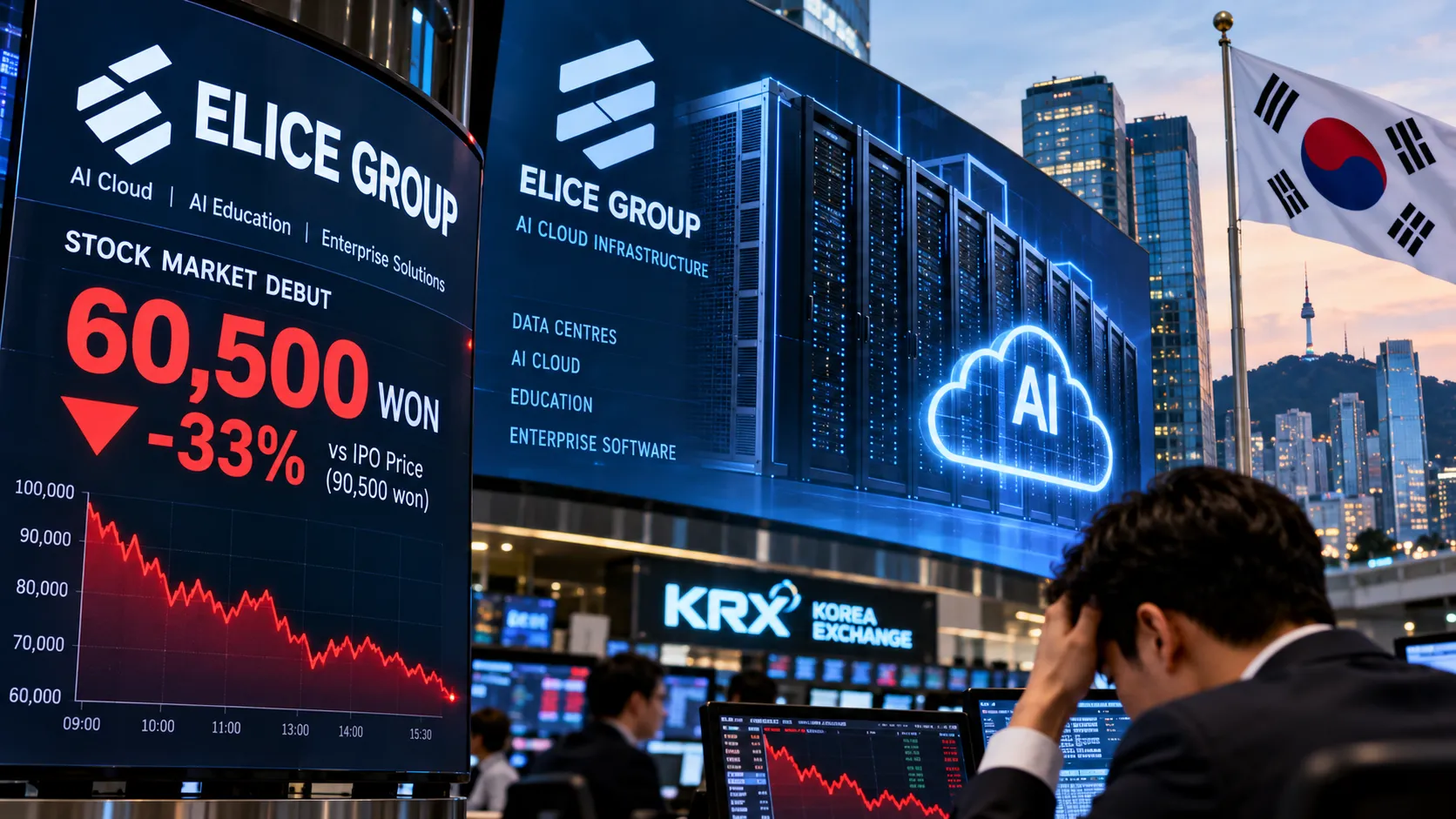
A much-anticipated artificial intelligence listing in South Korea has turned into a cautionary tale for the global AI trade. Shares of Elice Group, a provider of AI cloud services and AI-based education and business software, plunged on their stock market debut on Tuesday, October 20, closing at 60,500 won, about 33% below the initial public offering price of 90,500 won, Reuters reported.
The slump made Elice the worst debut in South Korea for a company raising more than $100 million, according to data from Dealogic. The company had raised 201.1 billion won, or about $150 million, in an IPO priced on October 6, and was valued at about 674 billion won, or roughly $508 million, at the end of its first day of trading.
The collapse came despite strong demand during the IPO process. Institutional orders totalled 388.84 times the shares offered, a level of oversubscription that would normally point to a strong debut.
A data centre bet
Elice planned to spend most of its IPO proceeds on portable modular data centres and related infrastructure, positioning itself to benefit from rising demand for AI computing. The company's business had been growing rapidly. Its revenue in the first half of the year tripled to 34 billion won, and it swung to an operating profit of 10 billion won from a loss of 3.5 billion won a year earlier.
Its largest shareholder is chief executive and co-founder Kim Jae Won, with a 34.6% stake. Other major shareholders include Altos, with 24.45%, and state-owned Korea Development Bank, with 6.45%.
Yet investors appeared reluctant to pay up for a company whose growth plans depend on building data centre capacity at a time when confidence in AI infrastructure has been shaken.
A warning for AI listings
"The poor debut is certainly a warning for upcoming AI listings," said Ipek Ozkardeskaya, a senior analyst at Swissquote.
Kim Hak-joon, an analyst at Kiwoom Securities, summed up the uncertainty: "Everyone is not sure how much demand for AI there will be."
Investor concerns centre on whether the vast sums being spent on AI infrastructure will generate adequate returns. Higher interest rates, driven by persistent inflation, have made the debt used to finance data centres more expensive. S&P Global has estimated that large technology companies may have more AI-linked liabilities than are currently known, adding to unease about the sector's financial risks. Investors are increasingly focusing on whether AI infrastructure companies have signed customer contracts and committed revenue, rather than simply projected demand.
A broader chill on AI infrastructure
Elice's debut is part of a wider retreat from AI infrastructure listings. Australia's Firmus, backed by Nvidia, has shelved its IPO. Blackstone-backed data centre operator AirTrunk has postponed a planned Singapore listing, and SB Energy, a SoftBank unit, has delayed its US share sale.
On the day of Elice's debut, South Korea's Kospi index fell 3.73% to its lowest close since April 7, and on Wall Street, AI cloud providers CoreWeave and Nebius each fell more than 5%.
The sell-off in Korean markets has been particularly severe in recent weeks. The Kospi is heavily weighted towards memory chip makers Samsung Electronics and SK hynix, whose shares soared earlier in the year on AI demand before sliding amid concerns about Chinese competition and the sustainability of AI spending.