A Bengaluru startup betting that the next big entertainment format will fit into a few minutes on a phone screen has won backing from one of Hollywood's oldest studios.
EloElo Group, the parent of microdrama platform Story TV, said on Wednesday, November 4, that it had raised $80 million (about ₹660 crore) in a Series C round co-led by Hornbill Capital and NBCUniversal. MIT Investment Co, Play Ventures, Kalaari Capital, Waterbridge Ventures and Griffin Gaming Partners also took part, the company said.
A person with direct knowledge of the matter told Reuters that the round values EloElo at $500 million. The company said the latest round brings its total funding to $130 million.
What the money is for
EloElo said it will use the new capital for three purposes: producing more original content, launching its microdramas in international markets, and investing further in Dolphin AI, its in-house agentic AI creative suite.
The combination is deliberate. Microdramas are serialised stories told in episodes that often last only a minute or two, designed to be watched vertically on a smartphone. Typically each episode ends on a cliffhanger that encourages viewers to unlock the next instalment. They demand a high volume of content produced quickly and cheaply. AI tools that can accelerate scripting, editing, dubbing and localisation can therefore become a decisive cost advantage, especially for a company planning to take Indian-produced stories to audiences in other languages and countries.
"A billion people now reach for the phone before any other screen," founder and chief executive Saurabh Pandey said in a statement. He added that the company intends to lead the shift to consumer AI-driven content "from India".
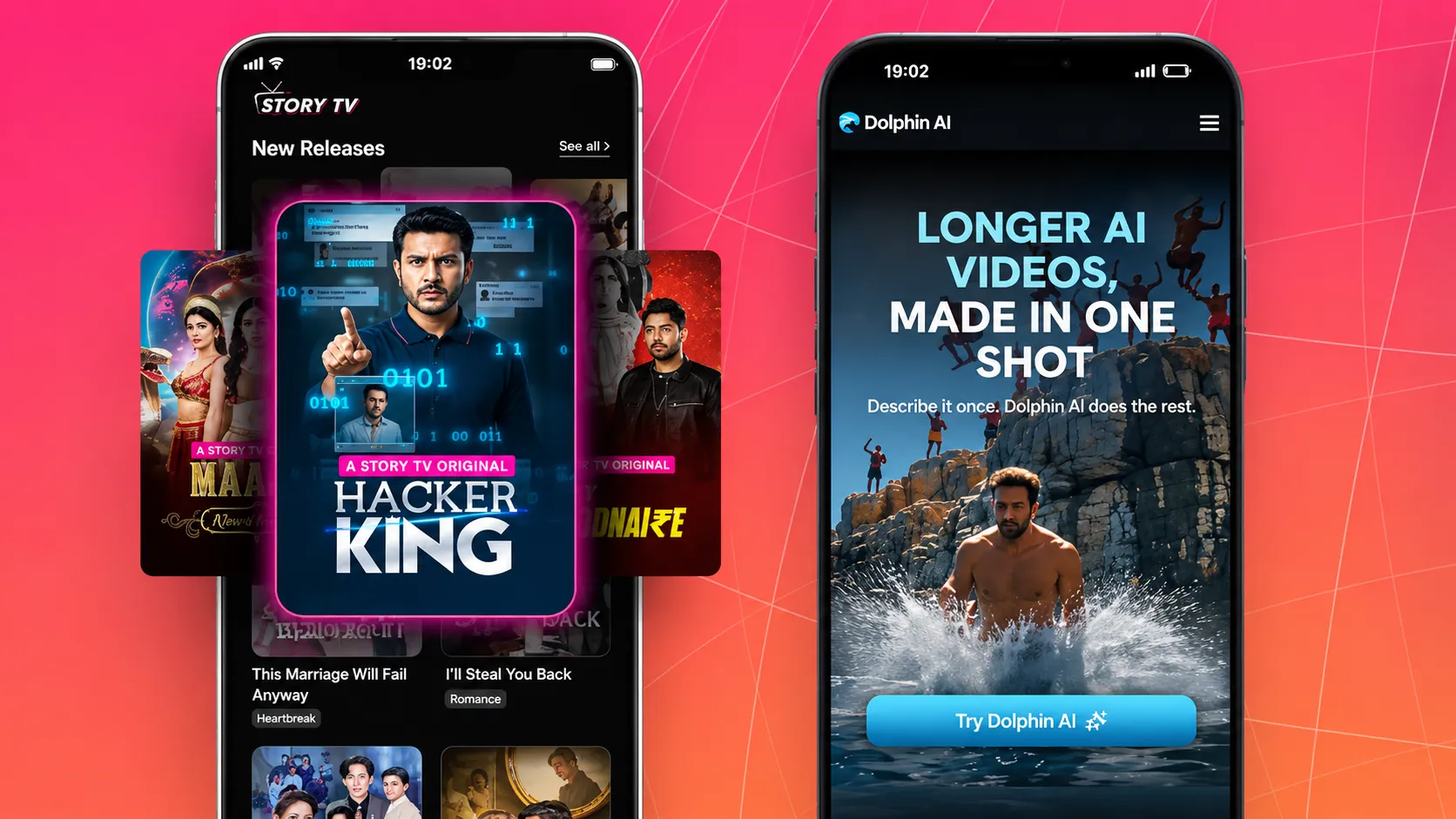
Why microdramas are attracting big money
Microdramas began as a phenomenon in China, where short serialised dramas built a multibillion-dollar industry on mobile apps and mini-programmes. The format has since spread rapidly across Southeast Asia, the United States and other markets. Apps compete on a steady stream of romance, revenge, family-feud and rags-to-riches plots, and many generate revenue through pay-per-episode unlocks, subscriptions and advertising.
The scale of the opportunity is now attracting mainstream media and investment money. Research and advisory group Omdia estimates that microdramas will generate $14 billion in worldwide revenue by the end of 2026, making the format one of the fastest-growing in global content.
India is a natural battleground. The country has hundreds of millions of smartphone users, cheap mobile data and an enormous appetite for melodrama in every major language. For many Indian viewers, especially outside the largest metros, the phone is the primary and often the only screen. Daily soap operas have long commanded massive television audiences, and microdramas compress the same emotional hooks into a mobile-first package.
NBCUniversal's participation is the headline
The most notable feature of the round is the presence of NBCUniversal as a co-lead. The Comcast-owned group is one of the world's largest film and television companies, and its participation is an important validation of both the format and EloElo's execution.
For a global studio, an investment in an Indian microdrama platform offers a window into how younger audiences consume stories, as well as a potential channel for testing formats, characters and intellectual property in a fast-moving, data-rich environment. For EloElo, a studio partner brings credibility with talent, advertisers and international distribution partners as it expands abroad.
Participation from MIT Investment Co, the investment arm that manages the Massachusetts Institute of Technology's endowment, adds an institutional dimension, while gaming-focused investors such as Play Ventures and Griffin Gaming Partners reflect the overlap between microdramas and mobile gaming in user acquisition, monetisation and retention.
From live streaming to stories
EloElo is not a new name in India's consumer internet landscape. The company built its early business around interactive and creator-driven entertainment in regional languages, catering to audiences in smaller towns and cities. Story TV represents a shift towards scripted, serialised content, while Dolphin AI points to an ambition to become as much a technology company as a content company.
That dual identity will be central to its valuation story. Content businesses are often valued conservatively because hits are unpredictable and production costs are high. Technology platforms that can repeatedly lower the cost of producing and personalising content, and that own direct relationships with millions of paying users, can command higher multiples.
Risks on the road ahead
The microdrama boom also carries risks. Competition is intense, with Chinese-backed apps, global platforms and a crowd of Indian startups all vying for the same audiences and creative talent. User acquisition costs can be high, and many apps rely heavily on paid marketing to bring viewers in.
The pay-per-episode model, while lucrative, has drawn scrutiny in some markets over pricing transparency. AI-generated content raises questions about quality, originality and the rights of writers and performers. These issues are already prominent in Hollywood and are likely to become more pressing in India as the technology spreads.
International expansion will test whether stories made in India can travel. Indian films and series have found significant overseas audiences, particularly among the diaspora and in markets with cultural affinity. Microdramas, however, demand localisation at speed, which is precisely the problem EloElo hopes Dolphin AI can solve.
A signal for Indian consumer tech
The round stands out in a funding environment where investors remain cautious about consumer internet businesses. Indian startup funding has slowed from the peaks of 2021, and investors are increasingly focused on revenue quality and profitability.
An $80 million Series C at a $500 million valuation, with a global studio as co-lead, suggests that investors see microdramas as a genuine category with durable economics rather than a passing fad.
For India's creator economy, the deal is also a reminder that the country can be a source of content and technology for global audiences, not just a large market for international platforms. If EloElo can turn Story TV into a global brand while keeping its production costs low with AI, it could become one of the most interesting media-technology companies to emerge from India this decade.
The next milestones to watch will be the markets EloElo enters first, the scale of its original-content slate, and whether its partnership with NBCUniversal goes beyond capital into co-productions or distribution.