FundingLatest Deals5 MIN READ

Ema Raises $77 Million Led by Bengaluru’s Creaegis as ‘AI Employees’ Take Aim at Enterprise Software and Services

Ema, founded by Surojit Chatterjee and Souvik Sen, has raised a $77 million Series B led by Bengaluru-based Creaegis, with Accel, Section 32 and Prosus increasing their stakes, taking total funding to $140 million.

By Nisha Omkumar · Author24 September 2026New
Ema Raises $77 Million Led by Bengaluru’s Creaegis as ‘AI Employees’ Take Aim at Enterprise Software and Services

Ema, a startup that uses teams of artificial-intelligence agents to automate corporate processes across human resources, information technology and finance, has raised $77 million in a Series B funding round, TechCrunch reported on Wednesday, September 23.

The round was led by Bengaluru-based venture firm Creaegis, with existing investors Accel, Section 32 and Prosus increasing their stakes. The financing brings Ema’s total funding to $140 million and more than quadruples its valuation from its previous round in 2024, according to TechCrunch. Ema declined to disclose its latest valuation.

The round consisted entirely of primary equity, with no debt or secondary transactions, the company confirmed to TechCrunch — meaning all of the money goes into the business rather than to existing shareholders.

Founders with big-tech pedigrees

Ema was founded in 2023 by Surojit Chatterjee, a former executive at Google and Coinbase, and Souvik Sen, previously an executive at Okta. Both are based in the San Francisco Bay Area.

The founders are part of a large and influential community of Indian-origin technology leaders in Silicon Valley, and the choice of an Indian lead investor for the round underlines the growing two-way flow of capital and talent between India’s startup ecosystem and the US.

‘AI employees’

Ema’s core product is what it calls “AI employees” — systems that coordinate multiple AI agents to carry out multi-step business processes across a company’s existing applications, rather than handling a single task at a time, TechCrunch reported.

In practice, that might mean an AI employee that handles an entire HR workflow — answering employee questions, updating records and initiating approvals — or one that manages IT support requests, investigates issues and executes routine fixes across multiple systems.

Chatterjee sees that model eventually reducing companies’ reliance on traditional software products, including those sold as software-as-a-service, according to TechCrunch. The argument is that if AI agents can perform work directly across existing systems, companies may need fewer specialised applications and fewer outsourced service contracts.

Traction

Ema says it has more than 50 active enterprise deals and over 1 million active enterprise users, and that it has handled more than 5 million actions and queries, TechCrunch reported. Its customers include NTT DATA, Hitachi and ADP.

The quadrupling of Ema’s valuation since 2024 comes as enterprise buyers have moved beyond pilots of generative AI towards production deployments, with agent platforms increasingly evaluated on measurable outcomes such as resolution times, cost per task and employee productivity.

For vendors like Ema, those outcome-based metrics are central to justifying enterprise contracts, and to demonstrating that agents can reliably handle multi-step work across the messy reality of legacy corporate systems.

Those customer names are notable. NTT DATA and Hitachi are major Japanese technology and services groups, while ADP is one of the world’s largest providers of payroll and HR services. Adoption by companies of that scale suggests that Ema’s approach is being tested in complex, enterprise-grade environments.
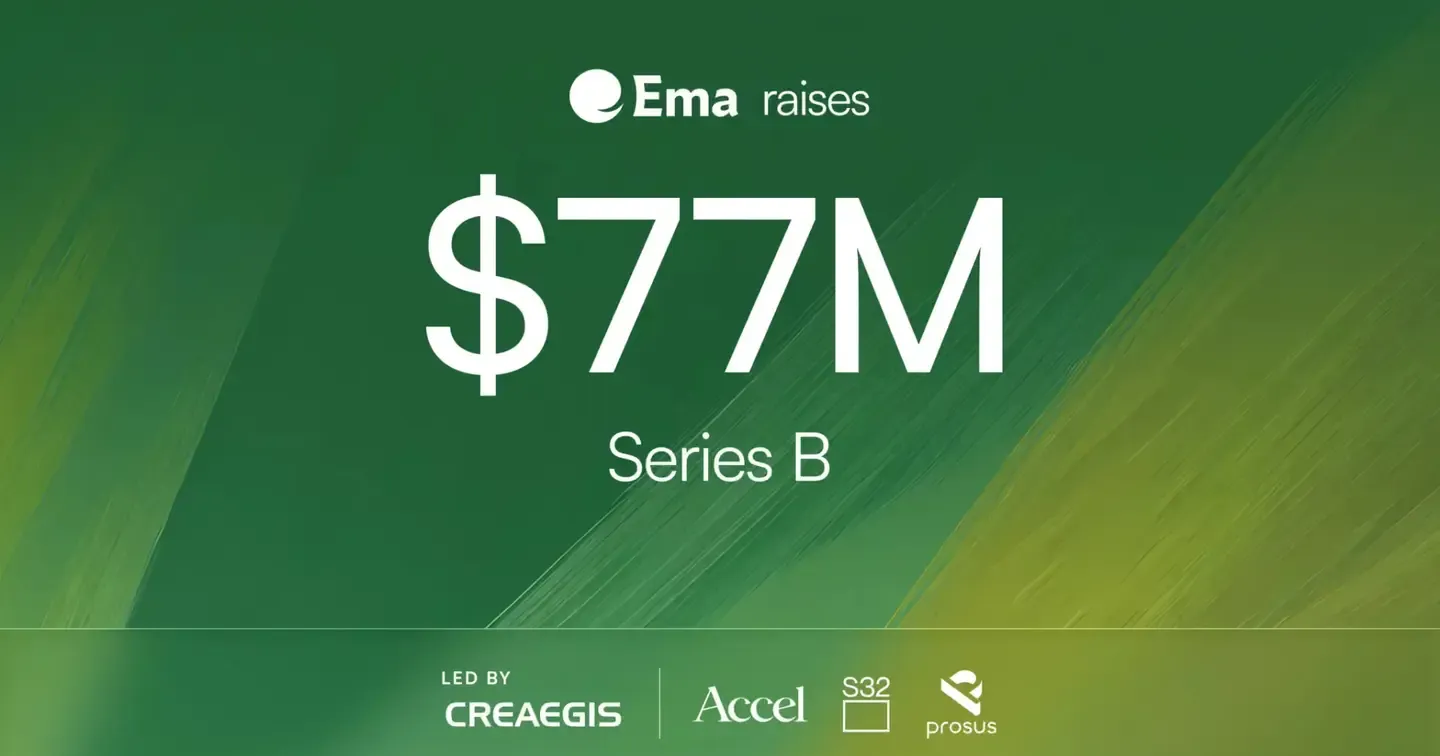
image.png

Taking on software and services

Ema’s ambition places it at the intersection of two large markets: enterprise software and IT services. The company aims to take on more of the work traditionally handled by both, according to TechCrunch.


Ema is betting that coordinated teams of AI agents can take on work long sold as software licences or outsourced services contracts.
TIGI Funding Desk

That positioning is significant for India. Indian IT services companies have built a global industry on providing people-intensive services such as application support, business-process outsourcing and IT operations. If AI agents can perform a growing share of that work, the business models of traditional services providers will need to evolve.

At the same time, the shift creates opportunities. Services companies can partner with or deploy agentic platforms to deliver work more efficiently, and Indian engineering talent is well placed to build, customise and manage AI agent systems for global clients.

Why Creaegis?

Creaegis is a Bengaluru-based investment firm that backs technology-led businesses. Its decision to lead a large round in a US-headquartered AI company reflects the increasing willingness of Indian investors to participate in global technology deals, particularly those with strong connections to India through founders, engineering teams or customers.

For Ema, an Indian lead investor may also bring relationships with Indian enterprises and services companies — potential customers and partners in a market where the company’s technology could have a significant impact.

For Creaegis, the deal is also a statement of intent: Indian capital is increasingly willing to lead, not merely follow, in competitive global AI rounds.

A crowded and fast-moving field

Ema operates in one of the most competitive areas of the AI market. Large technology companies are embedding agents into their productivity and business platforms, enterprise-software vendors are adding agentic capabilities to existing products and a wave of startups is building agent platforms for specific functions.

Ema’s differentiation lies in its focus on coordinating multiple agents across existing enterprise applications to complete end-to-end processes. Whether that approach can scale across diverse enterprise environments — and deliver measurable productivity gains — will determine its long-term position.

Security and governance will also be important. As agents gain access to sensitive corporate systems, enterprises are increasingly focused on identity, permissions and auditability for non-human actors — a concern that vendors in this space must address to win large deployments.

What the money will do

With $77 million in fresh primary capital, Ema is positioned to expand its engineering, sales and customer-success operations and to deepen its product across more business functions. The substantial valuation increase since 2024 indicates that investors see strong momentum, but it also raises expectations for continued growth.

The bigger picture

Ema’s raise is part of a broader wave of investment in agentic AI — software that can take actions, not just generate text. Investors are betting that agents will move from experimentation to production across large enterprises, transforming how work in HR, IT, finance and other functions is performed.

For the global Indian technology community, Ema’s story combines several important threads: Indian-origin founders building at the frontier of AI in Silicon Valley, Indian capital leading a major global round and a technology that could reshape the industries on which much of India’s technology economy has been built.

Investors and customers alike will now be watching whether Ema can turn its enterprise momentum into durable, recurring revenue at global scale.

TagsEmaAI AgentsAgentic AISeries BCreaegisAccelProsusSection 32Surojit ChatterjeeSouvik SenEnterprise SoftwareSaaSIndian DiasporaStartup Funding

Reader reviews

Sign in to rate and review this article.
Loading reviews…