EQT Corporation, the largest natural gas producer in the United States, has agreed to acquire rival Range Resources in an all-stock deal that will create a combined company with an enterprise value of more than $50 billion, deepening consolidation in the American shale industry.
Under the terms announced on 26 October, Range shareholders will receive 0.987 EQT shares for each Range share they own. After the transaction, EQT shareholders will own about 73 per cent of the combined company and Range shareholders about 27 per cent.
Range Resources shares rose about 16 per cent on the news, while EQT shares traded roughly 1 per cent lower.
A Giant in Appalachia
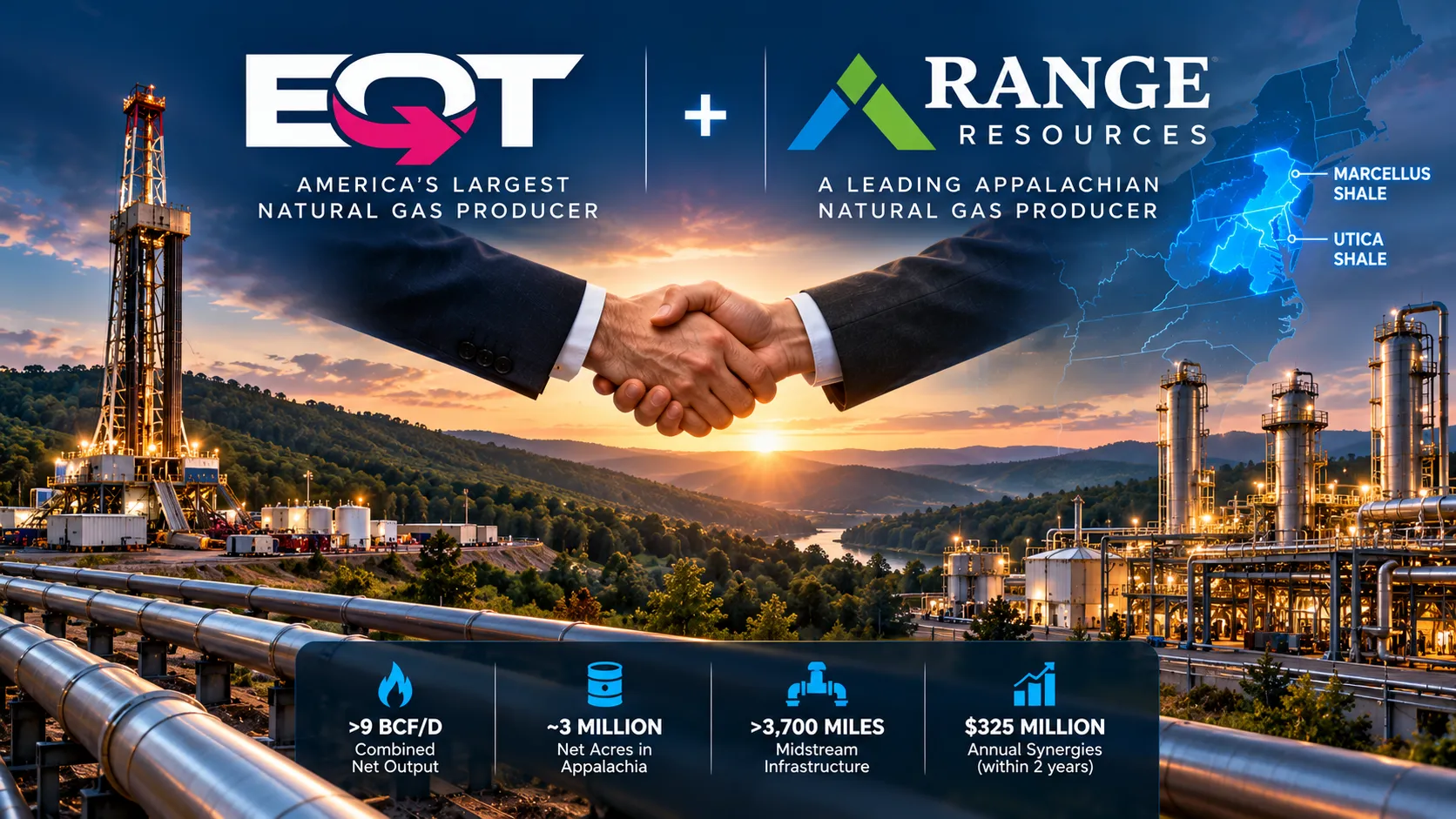
Both companies operate in the Appalachian Basin, home to the Marcellus and Utica shale formations, which together form the most prolific natural gas region in the United States. The combination will create a producer with net output of more than 9 billion cubic feet equivalent per day, more than 30 years of drilling inventory across nearly 3 million net acres, and over 3,700 miles of midstream pipeline infrastructure.
EQT expects the deal to generate $325 million in annual synergies within two years, with a long-term pathway to more than $600 million. The company projects about $20 billion in cumulative free cash flow over five years at recent futures prices and expects the combined business to break even on unlevered free cash flow at gas prices below $2 per million British thermal units.
The combined company is expected to maintain credit metrics consistent with a BBB rating at closing.
Leadership and Governance
EQT's executive team, led by chief executive Toby Rice, will run the combined company from its headquarters in Canonsburg, Pennsylvania. Two Range representatives, including Range chief executive Dennis Degner, will join EQT's board when the deal closes.
Rice described the combined group as "a company uniquely positioned for the next era of natural gas". Degner said the transaction "will enhance Range shareholders' ability to participate in a constructive long-term natural gas and NGL macro outlook".
Both boards have unanimously approved the merger, which is expected to close in the first quarter of 2027, subject to regulatory clearances and approval by the shareholders of both companies.
Why Gas Producers Are Consolidating
The deal is the latest in a wave of mergers in the US oil and gas industry. Producers have combined to gain scale, lower costs, secure drilling inventory and strengthen their balance sheets, while investors have pushed for capital discipline and higher shareholder returns rather than aggressive production growth.
EQT itself has grown through acquisitions, including its purchase of Equitrans Midstream in 2024, which brought pipeline assets under its control and created an integrated gas business. Adding Range's acreage and production will further extend its dominance in Appalachia.
The Demand Story
The merger reflects growing optimism about long-term demand for US natural gas. Exports of liquefied natural gas have expanded rapidly, with new terminals on the Gulf Coast increasing America's capacity to ship gas to Europe and Asia. Europe, in particular, has turned to US LNG to replace Russian pipeline gas, and recent disruption in the Middle East has heightened demand for diversified supplies.
Domestic electricity demand is also rising, driven by the construction of data centres to support artificial intelligence, the electrification of industry and transport, and the reshoring of manufacturing. Natural gas-fired power plants are expected to supply a large share of the additional electricity, as they can provide reliable power around the clock.


