FundingFintech5 MIN READ

Saudi Fintech erad Raises $22 Million Series A Led by MEVP After Deploying $133 Million to Gulf SMEs

Riyadh-based erad, which offers Shariah-compliant working capital to small businesses with approvals in about 48 hours, has raised a $22 million Series A led by MEVP to expand across the Gulf and into capital-intensive sectors.

By Shaym Kumar · Author29 September 2026New
Saudi Fintech erad Raises $22 Million Series A Led by MEVP After Deploying $133 Million to Gulf SMEs

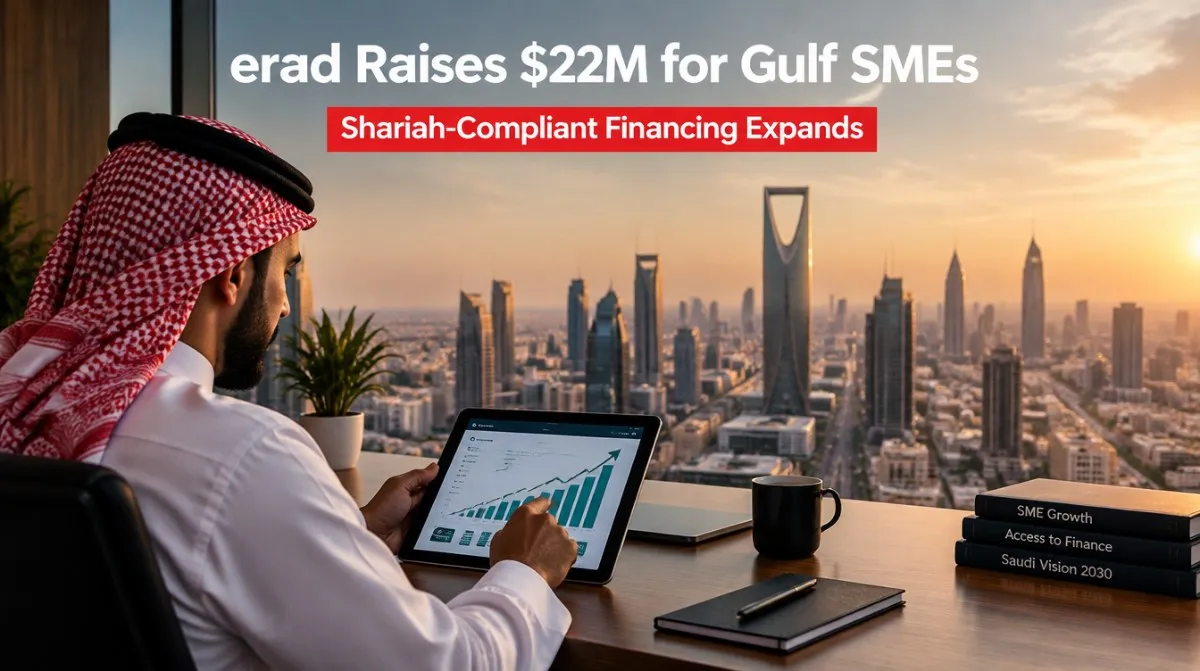
erad, a Riyadh-based financial technology company that provides working capital to small and medium-sized enterprises (SMEs), has raised $22 million in a Series A round led by MEVP, one of the Middle East's longest-established venture capital firms. The round, worth about SAR 78.75 million, was announced on 28 September 2026.

The deal adds to a wave of fintech investment in Saudi Arabia, where government reforms and a push to diversify the economy away from oil have created strong demand for new forms of business finance.

A crowded cap table

Alongside MEVP, the round attracted a wide group of new investors: 500 Global, Saudi Venture Capital (SVC), S60 Ventures, ANB Capital, Conjunction Capital and Araya Ventures. Existing backers Khwarizmi Ventures, Nuwa Capital, Aljazira Capital, Oraseya Capital and Joa Capital also participated.

The presence of SVC, a government-backed fund of funds and direct investor, and of the investment arms of Saudi banks such as ANB Capital and Aljazira Capital signals support from both the state and the traditional financial sector. That matters for a lending business, which depends on regulatory goodwill and access to funding lines as much as on equity capital.

What erad does

Founded in 2022 by Salem Abu-Hammour, Faris Yaghmour, Abdulmalik Almeheini and Youssef Said, erad provides Shariah-compliant working-capital financing to SMEs. Businesses can access facilities of up to SAR 10 million, and the company uses AI-driven underwriting to reach decisions quickly, with an average approval time of about 48 hours.

Shariah compliance is central to the product. Many business owners in Saudi Arabia and the wider Gulf prefer or require financing that avoids interest-based structures and follows Islamic finance principles, often through sale-based or partnership-based arrangements. Designing products that meet those requirements while remaining fast and flexible is a key part of erad's proposition.

Speed is the other. Traditional bank lending to small businesses can take weeks or months and often requires collateral that young companies lack. For a business waiting to be paid by a large customer or needing to buy inventory for a new contract, that delay can be the difference between growth and failure.

The numbers so far

erad says it has deployed $133 million in cumulative financing to SMEs and has received $1 billion in total financing requests. It reports eight-fold year-on-year growth in Saudi Arabia. The company currently operates in Saudi Arabia and the United Arab Emirates.

The gap between requests received and financing deployed illustrates both the scale of unmet demand and the discipline of the underwriting process. A lender that approved every request would grow faster but accept far more risk.

The SME financing gap

Co-founder Salem Abu-Hammour described the opportunity in terms of a structural imbalance.

"SMEs represent approximately 50% of regional GDP, yet face a financing gap that limits their growth," he said.

The imbalance is well documented. Across the Gulf, banks have historically focused on large corporations, government-related entities and retail customers, and SMEs have received a small share of total bank lending. Saudi Arabia's Vision 2030 programme sets explicit goals to increase the contribution of SMEs to the economy and to expand their access to finance, and the Kingdom has established dedicated institutions, including the SME authority Monsha'at, to support the sector.

“SMEs represent approximately 50% of regional GDP, yet face a financing gap that limits their growth.”
— Salem Abu-Hammour, Co-Founder, erad

Fintech lenders have emerged as one of the main ways of closing that gap. Using data from invoices, bank accounts, point-of-sale systems and e-commerce platforms, they can assess the creditworthiness of businesses that lack the financial history or collateral banks require.

image.png

Where the new money goes

erad plans to use the Series A capital in three ways. It will introduce new financing products for capital-intensive sectors, including industrial companies, logistics providers and manufacturers. It will expand further across the Gulf Cooperation Council region. And it will grow its technology and commercial teams.

The move into capital-intensive sectors is significant. Manufacturing and logistics are priority industries under Saudi Arabia's economic diversification plans, supported by large government investments in industrial zones, ports and transport networks. Businesses in these sectors often need larger and longer-term financing than a typical trade or services SME, which will test erad's underwriting models and funding capacity.

Equity and debt

For lending fintechs, equity capital is only part of the story. The money that is actually lent to customers typically comes from debt facilities provided by banks, funds and other institutional lenders. Equity strengthens the company's balance sheet, allowing it to secure larger debt lines and absorb losses.

The participation of bank-affiliated investors in the round could help erad secure those facilities on favourable terms. Its ability to grow lending volumes in the coming years will depend heavily on how successfully it expands its debt funding alongside its equity base.

The regional fintech boom

Saudi Arabia has become the fastest-growing venture market in the Middle East, with fintech consistently attracting the largest share of funding. The Saudi Central Bank has introduced regulatory sandboxes and licensing frameworks for new financial services, and the government's Fintech Strategy sets targets for the number of fintech companies operating in the Kingdom.

Competition among SME lenders is increasing, with a number of fintech companies offering invoice financing, revenue-based financing and buy-now-pay-later products for businesses. Differentiation will come from underwriting quality, cost of capital and the ability to serve specific sectors well.

Relevance for India

India faces a similar challenge. Its tens of millions of micro, small and medium enterprises have long struggled to obtain formal credit, and a large community of Indian businesses operates across the Gulf. Indian fintech lenders have pioneered many of the data-driven underwriting approaches now used in the Middle East, and investors and founders in both regions increasingly exchange ideas and talent.

What to watch

The next milestones for erad will be the launch of its sector-specific products, expansion into additional GCC markets and the size of the debt facilities it secures to fund growth. Loan performance will be the ultimate test. Rapid growth in lending is only valuable if borrowers repay, and the first real downturn will show how resilient AI-driven underwriting proves to be.

For now, erad's Series A is another indication that investors see SME finance as one of the most attractive opportunities in the Gulf's fast-changing economies.

TagseradMEVPSaudi ArabiaFintechSME FinancingWorking CapitalShariah-Compliant Finance500 GlobalSaudi Venture CapitalGCCUAESeries AAlternative LendingVision 2030Middle East Startups

Reader reviews

Sign in to rate and review this article.
Loading reviews…