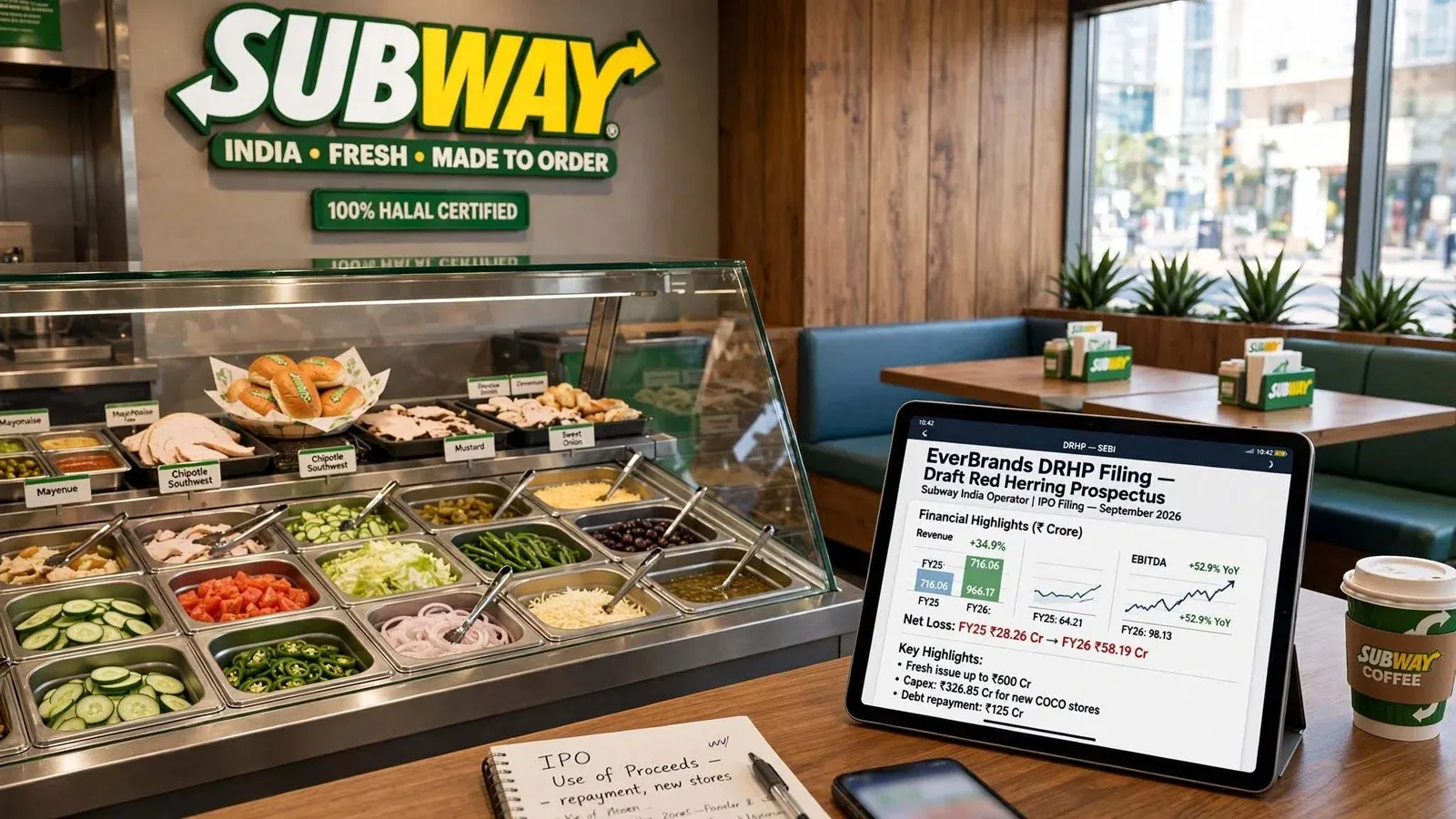
EverBrands India, the company that operates Subway restaurants in India, has filed its draft red herring prospectus with the Securities and Exchange Board of India for an initial public offering of up to ₹600 crore, adding a major quick-service restaurant name to the country's crowded listing pipeline.
The proposed offer is structured entirely as a fresh issue of shares, with no offer for sale by existing shareholders. That means all proceeds, after expenses, will flow into the company rather than to selling investors. EverBrands may also raise up to ₹120 crore through a pre-IPO placement, in which case the size of the fresh issue would be reduced accordingly.
The filing, disclosed on 29 September 2026, gives investors their first detailed look at the economics of one of India's largest international restaurant franchises. It also arrives at a delicate moment for the sector, as quick-service chains grapple with slower growth in discretionary spending and rising competition from local brands and delivery-first kitchens.
How the money will be used
According to the draft papers, EverBrands plans to use ₹125 crore to repay or prepay borrowings and ₹326.85 crore to open new company-owned Subway outlets. The remainder will be used for general corporate purposes, a standard provision in Indian offer documents.
The weighting towards expansion is significant. More than half of the proposed proceeds are earmarked for new stores, signalling that management sees ample room to grow the Subway footprint in India. The debt repayment component should also ease interest costs, which can weigh heavily on restaurant businesses with high fixed expenses for rent, staff and equipment.
Scale of the network
EverBrands currently runs 678 company-owned Subway outlets and oversees 330 franchise-owned outlets across India, bringing the total network to more than 1,000 restaurants. Beyond Subway, the company operates coffee businesses under the Lavazza and F&H brands, giving it a presence in India's fast-growing café segment.
The mix of company-owned and franchised stores matters for investors. Company-owned outlets bring in the full revenue of each restaurant but also carry the full cost and risk. Franchised outlets generate lower revenue in the form of fees and royalties but require far less capital. EverBrands' plan to open more company-owned stores suggests it believes the returns on direct ownership justify the investment, though it also means the business will remain capital intensive.
Growth with losses
The financial picture is one of rapid growth accompanied by widening losses. In FY26, EverBrands' revenue rose 34.9% to ₹966.17 crore. Over the same period, its net loss widened to ₹58.19 crore. The pattern is common among restaurant operators in expansion mode, where new stores take time to mature and pre-opening costs, rent and depreciation depress reported earnings.
Investors will be keen to understand store-level economics in more detail: how long new outlets take to break even, how same-store sales are trending, and whether average order values are rising. These metrics have become central to how public markets value listed restaurant companies in India, several of which have seen their shares come under pressure as growth slowed after the post-pandemic rebound.
A tougher market for quick-service restaurants
India's quick-service restaurant sector has long been seen as a structural growth story, supported by urbanisation, a young population and rising incomes. Listed operators of global brands, such as Jubilant FoodWorks, which runs Domino's in India, Devyani International and Sapphire Foods, which operate KFC and Pizza Hut outlets, and Westlife Foodworld, which operates McDonald's restaurants in western and southern India, have all expanded aggressively over the past decade.
But the past two years have been more challenging. Many operators have reported subdued same-store sales growth as middle-class households tightened spending on eating out. Food delivery platforms have also changed consumer behaviour, while cloud kitchens and regional chains compete aggressively on price. For EverBrands, which sells a product that is positioned as a healthier alternative to burgers and pizza, the question is whether that positioning can translate into sustained demand in a price-sensitive market.
Subway's global parent has also undergone significant change. The US-based sandwich chain was acquired by private equity firm Roark Capital in 2024, and its international business has increasingly relied on large master franchisees to drive growth in key markets. EverBrands' performance in India offers a test of that model.
## The café opportunity
The coffee businesses may prove to be an underappreciated part of the EverBrands story. India's café market has expanded quickly in recent years as younger consumers adopt coffee culture and as workspaces, malls and highways create demand for quality beverages on the go. International names such as Starbucks, through its joint venture with Tata Consumer Products, have competed with homegrown chains including Third Wave Coffee, Blue Tokai and Café Coffee Day.
Lavazza, the Italian coffee roaster, gives EverBrands a premium brand in that contest. Cafés tend to generate higher gross margins than food-heavy formats because beverages are cheaper to produce, although rents in prime locations can erode those gains. If EverBrands can combine Subway's reach with a profitable café format, it could present investors with a more diversified growth story than a single-brand franchisee.
The draft prospectus will likely provide greater detail on how the coffee operations contribute to revenue and profitability. Analysts will want to know whether the café business is a meaningful growth engine or a smaller adjunct to the core sandwich franchise.
Valuation questions
The draft papers do not specify a price band, which will be set closer to the launch. Listed peers in the sector have traded at wide ranges of valuation depending on growth, brand strength and profitability. Loss-making operators have found it harder to command premium multiples, particularly when same-store sales are soft. EverBrands will need to persuade institutional investors that its losses are a temporary consequence of expansion rather than a sign of structural weakness in unit economics.
Next steps
The filing now enters SEBI's review process, which typically takes several weeks to a few months. If approved, EverBrands will need to choose its timing carefully. India's primary market has been busy, with a steady stream of new-age technology, financial services and consumer companies seeking listings, but secondary market volatility and sustained selling by foreign investors could influence both demand and valuation.
For investors, EverBrands offers exposure to one of the few truly national quick-service restaurant networks in India, combined with a growing café business. The trade-off is clear: faster growth funded by public capital, in exchange for tolerance of losses until new stores mature. How the market prices that trade-off will say much about how India's public investors now view consumer growth stories that have yet to turn a profit.