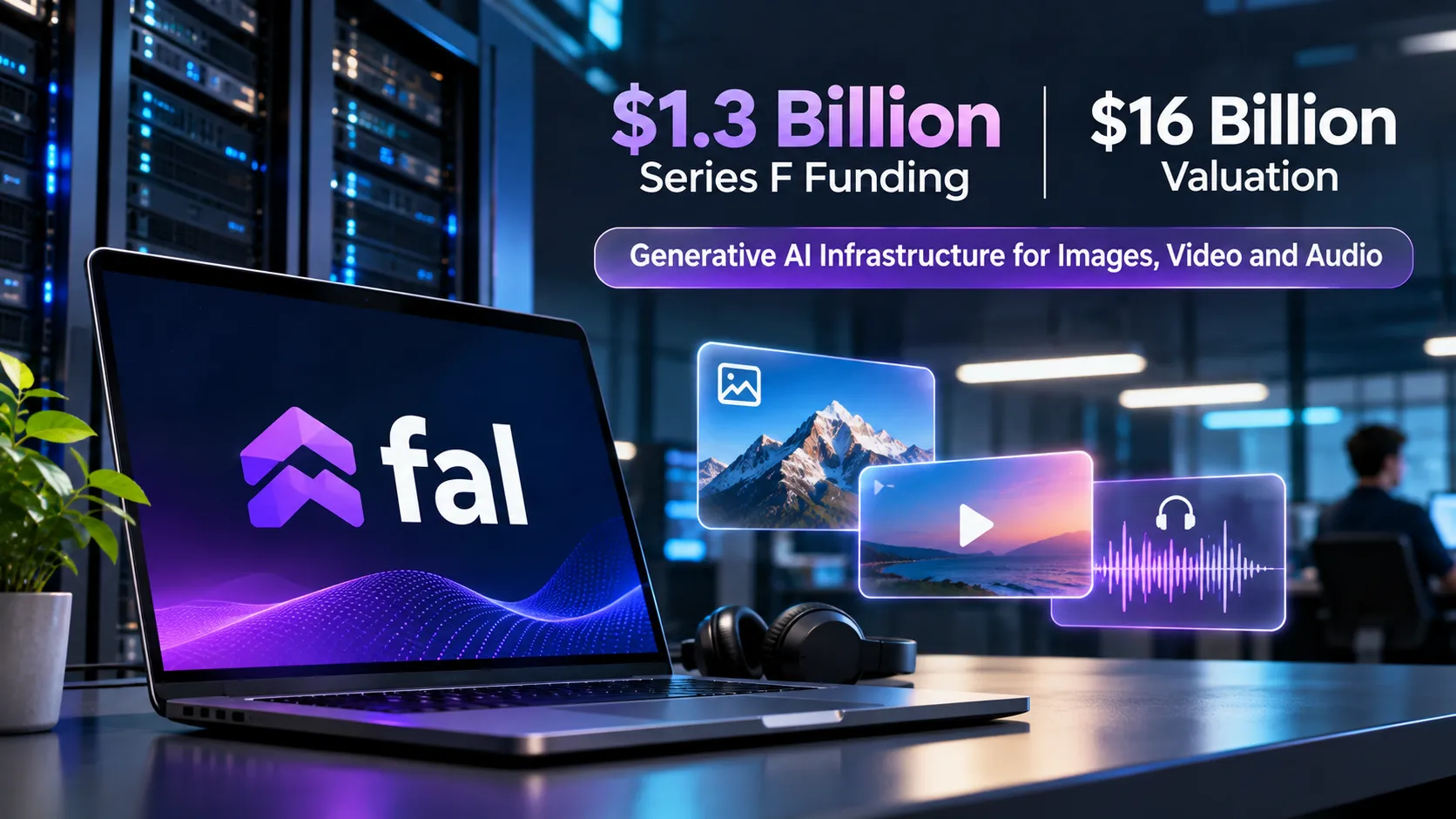
Fal, a startup that provides the infrastructure developers use to run generative AI models for images, video and audio, has raised $1.3 billion in a Series F funding round at a valuation of $16 billion. The round is one of the largest venture investments in AI infrastructure this year.
The round was led by Bessemer Venture Partners. Nvidia, Sound Ventures, HOF Capital and T. Rowe Price also took part. Talia Goldberg, a partner at Bessemer, will join Fal's board.
The company announced the round on Tuesday, November 3. At the same time, Fal disclosed that it had raised a separate $350 million Series E in April, led by Sequoia at a valuation of $8 billion. The two rounds together total $1.65 billion and show that Fal's valuation has doubled in about seven months. In total, the company has raised more than $1.9 billion.
A platform for generative media
Fal provides a platform that lets developers and businesses run generative AI models without building and managing their own infrastructure. Customers can access a wide range of models for creating images, videos, audio and other media through Fal's interface.
The platform focuses on speed and efficiency. Generative media models, particularly those that create video, require large amounts of computing power. Fal has developed technology to run these models quickly and cost-effectively, so its customers can build products that generate media in real time or close to it.
Fal's customers include major technology and media companies such as Adobe, Canva, Shopify and Amazon. These companies use the platform to power generative features in their own products, from image editing tools to marketing content generation.
Rapid revenue growth
Fal's annualised revenue has passed $800 million, according to the company. That puts it among the fastest-growing AI infrastructure companies.
The company employs about 185 people, which means revenue per employee is very high by industry standards. The lean structure reflects the leverage of its infrastructure business, in which a small team can serve a large and growing volume of customer demand.
Rapid revenue growth has been a key factor in investors' willingness to back the company at a high valuation. In the current AI market, investors have been prepared to pay large premiums for companies that demonstrate strong revenue traction.
The founders
Fal was founded in 2021 by Burkay Gür and Görkem Yurtseven. Gür previously worked at Coinbase and Oracle, where he gained experience in building large-scale technology infrastructure. Yurtseven previously worked at Amazon.
The founders initially focused on data infrastructure before shifting to generative media as the AI boom accelerated. That pivot positioned Fal to benefit from the rapid growth in demand for image and video generation that followed the release of powerful generative models.
Why investors are betting big
The size of the round reflects investor confidence in the long-term demand for generative media. As AI models for images, video and audio become more capable, businesses are integrating them into a wide range of products and workflows, from advertising and e-commerce to entertainment and design.
Infrastructure companies like Fal sit in a favourable position in this market. Rather than betting on any single AI model, they provide the platform through which many models are deployed. As usage grows, so does demand for infrastructure.
Nvidia's participation is notable. The chipmaker has invested in many AI startups, both to support the ecosystem that uses its graphics processing units (GPUs) and to gain insight into emerging applications. Fal's business depends on access to large amounts of GPU computing power, which makes Nvidia a strategically important partner.
T. Rowe Price's involvement, meanwhile, signals interest from large public-market investors. Such investors often take stakes in late-stage private companies ahead of a potential IPO.
Competition in AI inference
Fal operates in a competitive market for AI inference infrastructure. Inference is the process of running trained AI models to generate outputs, as distinct from training the models in the first place. As AI adoption grows, inference is becoming a larger share of total AI computing demand.
One of Fal's main rivals, Fireworks AI, has been valued at about $17.5 billion. Other competitors include cloud providers that offer their own AI inference services, as well as other specialised startups.
Fal's focus on generative media sets it apart from competitors that focus more on text-based language models. Media generation, particularly video, places different demands on infrastructure, and Fal has built its platform around those needs.
Women in venture: Talia Goldberg
The round also adds Talia Goldberg to Fal's board. Goldberg is a partner at Bessemer Venture Partners and one of the most prominent women investors in technology. She has led investments in a range of consumer and enterprise technology companies and has been recognised on several lists of top venture capitalists.
Her appointment to the board of one of the fastest-growing AI infrastructure companies highlights the growing role of women investors in shaping the AI industry, at a time when the sector has faced criticism over a lack of diversity.
The AI funding boom
Fal's round is part of a broader surge in investment in AI companies in 2026. Venture capital firms, technology companies and public-market investors have poured money into AI startups at every stage, from early-stage model developers to infrastructure and application companies.
Valuations have risen rapidly, raising questions about whether some companies will be able to grow into them. Fal's valuation of $16 billion is about 20 times its annualised revenue. That is high by traditional standards, but not unusual in today's AI market.
The costs of AI are significant. Infrastructure companies must spend heavily on computing resources to serve their customers, and their margins can be affected by the price and availability of GPUs. Fal's ability to manage those costs while growing rapidly will be important for its long-term success.
Relevance for India
Generative media is a rapidly growing area in India, where businesses are using AI to create marketing content, product images and video at scale. Indian startups and enterprises are among the users of AI infrastructure platforms like Fal.
India is also home to a large community of developers and AI engineers, many of whom build products on platforms like Fal. The Indian diaspora is well represented in the AI industry in the United States, including at infrastructure companies and among investors.
As generative AI tools become more widely available, they are creating opportunities for Indian creators, agencies and businesses to produce content more efficiently. The infrastructure provided by companies like Fal is a key enabler of that shift.
What the money will fund
Fal is expected to use the new capital to expand its computing infrastructure, invest in research and development, and grow its team. Scaling infrastructure to meet rapidly growing demand requires significant investment in GPUs and data-centre capacity.
The company may also expand its range of supported models and services, and invest in tools that make it easier for developers to build generative media applications.
Outlook
Fal's rapid rise reflects the extraordinary growth of generative AI and the demand for the infrastructure that powers it. With more than $1.9 billion raised and annualised revenue above $800 million, the company is well positioned to compete in one of the most dynamic areas of technology.
The key challenges will be maintaining its growth rate, managing infrastructure costs and staying ahead of well-funded competitors. If it succeeds, Fal could become one of the defining infrastructure companies of the generative AI era.


