The US Federal Reserve is set to announce its latest interest rate decision on Wednesday, October 28, at the end of a two-day meeting that has kept global markets on edge.
Investors widely expect the central bank to hold rates steady after raising them last month, its first increase in three years, according to the Associated Press and CNBC. The decision will be announced at 2 pm in Washington, late on Wednesday night in India.
Why the Fed raised rates
The Fed's decision to raise rates last month marked a significant shift. After cutting rates in previous years as inflation eased, the central bank reversed course as energy prices surged and inflation pressures returned.
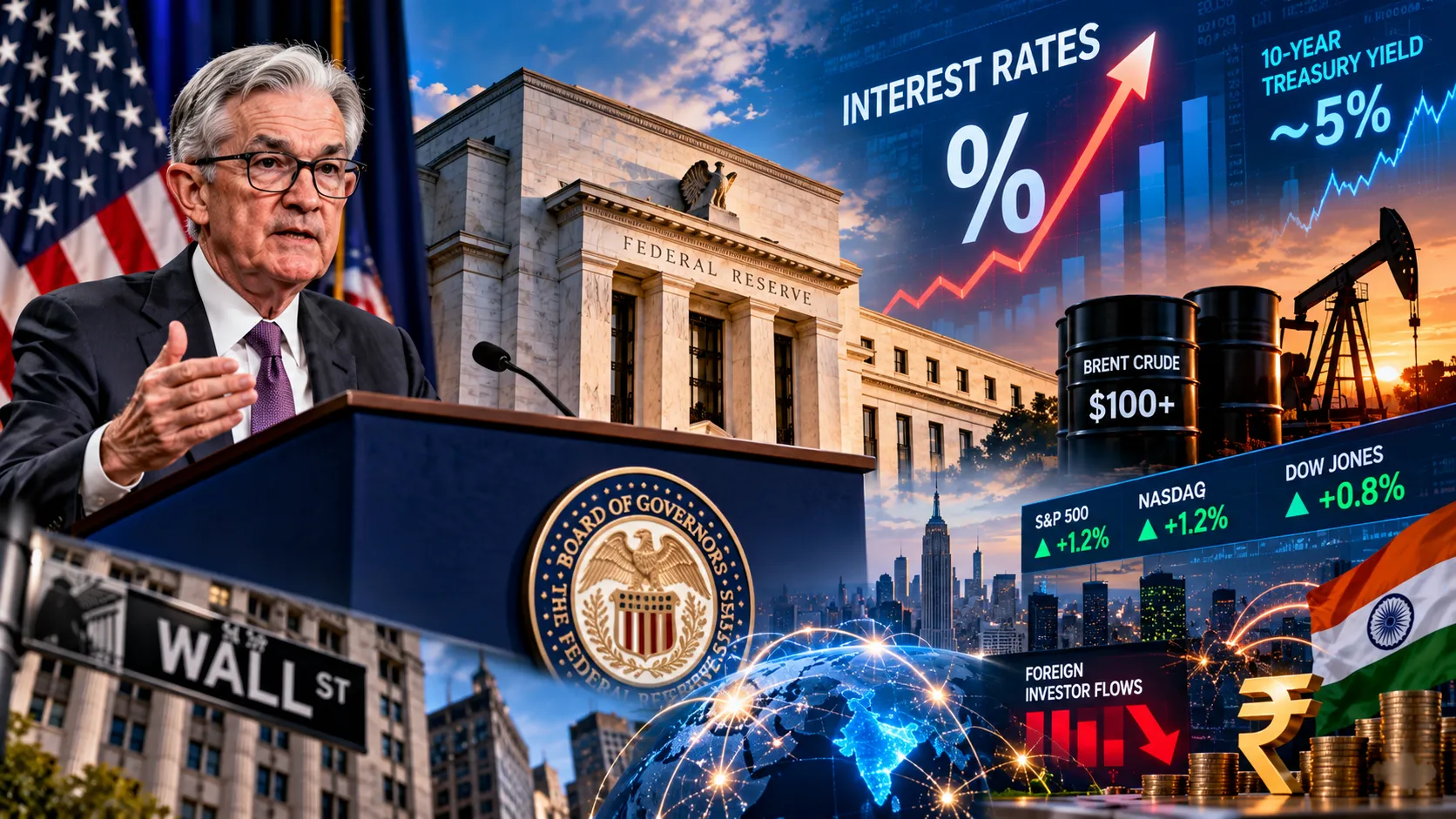
Conflict in West Asia has pushed Brent crude above $100 a barrel for much of the autumn, raising fuel, transport and production costs. Those increases have fed through to consumer prices, and the Fed has signalled concern that higher inflation could become entrenched.
The US economy has also remained resilient. Consumer confidence improved in October, defying economists' expectations of a decline, and strong consumer spending has supported growth despite higher borrowing costs.
Yields near 5%
The 10-year Treasury yield has climbed to around 5%, its highest level in years. It eased slightly to 4.99% on Tuesday, helped by a 1.2% fall in Brent crude to $109.41 a barrel.
High yields raise borrowing costs across the economy, from mortgages and car loans to corporate debt. They also make US government bonds more attractive to global investors, strengthening the dollar and drawing capital away from other markets.
What markets will watch
With a hold widely expected, the focus will be on the Fed's statement and the press conference that follows. Investors will look for signals on several questions.
First, whether the Fed sees further rate increases as likely. A hawkish tone, suggesting more hikes ahead, could push yields and the dollar higher. A more balanced message could ease pressure on markets.
Second, how the Fed assesses the inflationary impact of oil prices. If policymakers view the energy shock as temporary, they may be more patient. If they worry that it is spreading to broader prices and wages, they may lean towards further tightening.
Third, the Fed's view of the labour market and economic growth. Signs of slowing could argue for caution on further increases.
Central banks diverge
The Fed's decision comes as central banks around the world take different approaches. The Reserve Bank of New Zealand surprised markets on Wednesday by keeping its rate unchanged at 2.75%, when many had expected an increase.
The European Central Bank and Bank of Japan are also due to announce decisions this week. Central banks face a difficult trade-off between controlling energy-driven inflation and supporting economies that are being squeezed by high costs.
The market backdrop
Wall Street enters the decision in a buoyant mood. AI stocks led a rally on Tuesday, lifting the Nasdaq 1.2% and pulling the S&P 500 within about 1.2% of its record. Results from Microsoft and Alphabet are due after the market closes on Wednesday, adding to the potential for volatility.
What it means for India
For India, the Fed's decision matters through several channels. Higher US interest rates and a stronger dollar tend to draw foreign capital away from emerging markets. Foreign portfolio investors have been heavy sellers of Indian equities this year, with record year-to-date outflows, though they turned buyers on Tuesday, purchasing ₹4,240 crore of shares.
A hawkish Fed could put renewed pressure on the rupee, which has been weak because of high oil prices. That would raise the cost of imports and complicate the Reserve Bank of India's efforts to manage inflation.
Indian companies with dollar-denominated debt would face higher repayment costs if the rupee weakens, while exporters, including IT services and pharmaceutical companies, would benefit from a weaker currency.
The RBI's dilemma
The Reserve Bank of India faces its own balancing act. High oil prices raise inflation risks, but growth also faces headwinds. If the Fed signals further tightening, the RBI may come under pressure to keep its own rates higher for longer to support the rupee and prevent capital outflows.
The Fed's dilemma
The Fed's challenge is a classic one in an energy shock. Higher oil prices raise inflation in the short term, which argues for tighter policy. But they also act as a tax on consumers and businesses, slowing growth, which argues for caution. Central banks generally try to look through temporary energy price spikes, focusing on underlying inflation, but they become more concerned when energy costs feed into wages, services prices and inflation expectations.
The decision to raise rates last month suggests the Fed judged those second-round effects to be a meaningful risk. Whether it continues on that path will depend on incoming data on inflation, wages and growth.
Bond markets in focus
Bond investors will react quickly to any signal about the path of rates. If the Fed indicates that it is likely to raise rates further, short-term Treasury yields could rise and the yield curve could shift. If it suggests a pause is likely to last, yields could ease, supporting stock valuations and reducing pressure on emerging market currencies.
The global context
Central banks in many countries face the same oil-driven inflation challenge. The European Central Bank and Bank of Japan are also expected to announce decisions this week, and their choices will be compared with the Fed's. Divergence among major central banks can drive currency movements, as investors move money towards higher-yielding currencies, which in turn affects trade and capital flows for emerging markets such as India.
What comes next
Whatever the Fed decides, its message will shape markets for weeks. A patient tone could support a continued rally in stocks and a recovery in emerging markets. Signals of more hikes could trigger volatility, particularly in markets sensitive to capital flows and currency movements.
Investors will also watch US economic data in the coming weeks, including inflation and employment figures, for clues about the Fed's next steps. Whatever the outcome, the decision will be followed by a press conference in which the Fed chair will answer questions on the outlook, and markets are likely to react sharply to any unexpected signals about the path of interest rates. Indian investors will see the market's response when trading opens on Thursday morning.