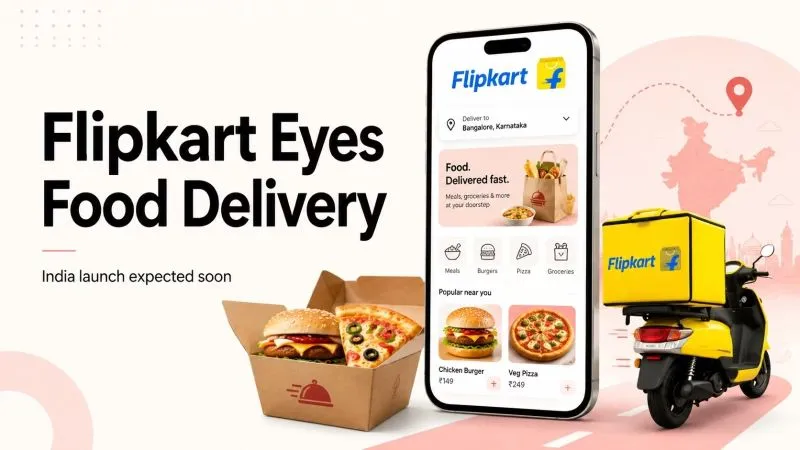
Flipkart has started testing a food delivery service internally called Eat In among its own employees in Bengaluru, according to people familiar with the pilot, in a move that signals the ecommerce major's interest in a market currently dominated by Zomato and Swiggy. The trial, reported on September 9, is understood to be limited to a controlled employee rollout rather than a public launch, a typical first step Indian internet companies take before deciding whether to commit meaningful capital to a new vertical.
Flipkart's potential entry into food delivery would mark one of the most consequential competitive moves in Indian internet commerce in recent years. The category has already consolidated around two dominant players, Zomato-owned platforms and Swiggy, both of which have spent heavily over the past decade building delivery-rider networks, restaurant partnerships and quick-commerce dark-store infrastructure that would be expensive and slow for a new entrant to replicate from scratch.
For Flipkart, however, the strategic logic is not difficult to follow. Its parent group has increasingly leaned into super-app ambitions, bundling ecommerce, payments, travel and now potentially food delivery under a single customer relationship, mirroring approaches taken by regional peers in Southeast Asia and China. A successful food delivery offering could also deepen daily engagement with Flipkart's app, a metric that matters increasingly as ecommerce platforms compete not just on price and selection but on how often customers open the app in the first place.
Any full-scale entry would still face formidable execution hurdles, including building last-mile delivery density, securing restaurant partnerships in a market where exclusivity arrangements are common, and convincing consumers already loyal to entrenched apps to switch habits. Analysts covering the space have noted that food delivery in India remains a thin-margin, logistics-heavy business, and previous attempts by well-capitalised entrants to challenge the incumbents have had mixed success, underscoring the difficulty of the category even for companies with deep pockets.
The employee pilot approach itself is instructive: by testing internally first, Flipkart can iterate on operational logistics, restaurant onboarding processes and app experience without the reputational risk of a public rollout that underperforms. It also allows the company to gather real usage data before committing to the capital-intensive dark-store and rider-network investments that a nationwide food delivery push would eventually require.
Whether Eat In evolves into a full public product or remains a contained experiment will likely depend on how the pilot performs over the coming months, and on broader strategic decisions at group level about capital allocation across Flipkart's expanding portfolio of consumer businesses. Either way, the very fact that India's largest homegrown ecommerce platform is exploring the category is likely to be closely watched by both incumbents and investors tracking consolidation trends across Indian internet commerce.
Should Flipkart eventually commit to a full public launch, the move would also carry implications for India's gig-economy delivery workforce, given the scale of rider and logistics infrastructure a nationwide food-delivery rollout would require. Existing players have already built extensive rider networks over the better part of a decade, meaning any credible new entrant would need either an aggressive hiring and incentive strategy or a partnership-based approach leveraging existing logistics infrastructure within the broader group.
Industry watchers will also be parsing how a Flipkart entry might affect restaurant partner economics, an area where existing platforms have faced periodic friction with restaurant owners over commission structures. A new, well-capitalised entrant could either intensify commission competition in restaurants' favour or add further platform-side pressure, depending on the pricing strategy Flipkart ultimately adopts should the pilot progress toward a public launch.
Flipkart's broader ecommerce rivals, including Amazon India, have so far largely stayed out of food delivery directly, making any eventual Flipkart move into the category a distinctive strategic bet relative to how other large horizontal ecommerce platforms in India have chosen to compete for consumer wallet share and daily engagement.


