Flipkart Group, India's largest e-commerce company by sales, grew revenue by nearly a fifth in the year to March 2026 while narrowing its losses only slightly, according to consolidated financial statements that offer the clearest view yet of the Walmart-owned group's economics after its move back to India.
Revenue from operations rose 18.2 per cent to ₹1,45,880 crore in fiscal 2026, from ₹1,23,451 crore a year earlier, according to filings reported by Entrackr. Including other operating income and non-operating income, total revenue reached about ₹1,46,700 crore.
The net loss narrowed by about ₹178 crore, or 2.1 per cent, to ₹8,468 crore, from ₹8,646 crore in fiscal 2025. At the operating level the improvement was more pronounced: the EBITDA loss shrank 21.5 per cent to ₹5,891 crore from ₹7,504 crore, taking the EBITDA margin to minus 4.04 per cent.
A First Full Picture After the Reverse Flip
The fiscal 2026 numbers consolidate 25 subsidiaries under Flipkart Internet, including the core Flipkart marketplace, fashion platform Myntra and travel portal Cleartrip. The consolidation follows the group's long-planned "reverse flip", which shifted its domicile from Singapore back to India, and the amalgamation of its Singapore entities with Flipkart Internet in March 2026.
That restructuring is widely seen as a precondition for an eventual Indian stock market listing, which Walmart has signalled for several years. A single consolidated Indian entity gives prospective investors one set of accounts to evaluate and aligns the company with Indian listing rules.
Where the Money Came From
The breakdown of revenue reveals a business whose sources of income are shifting.
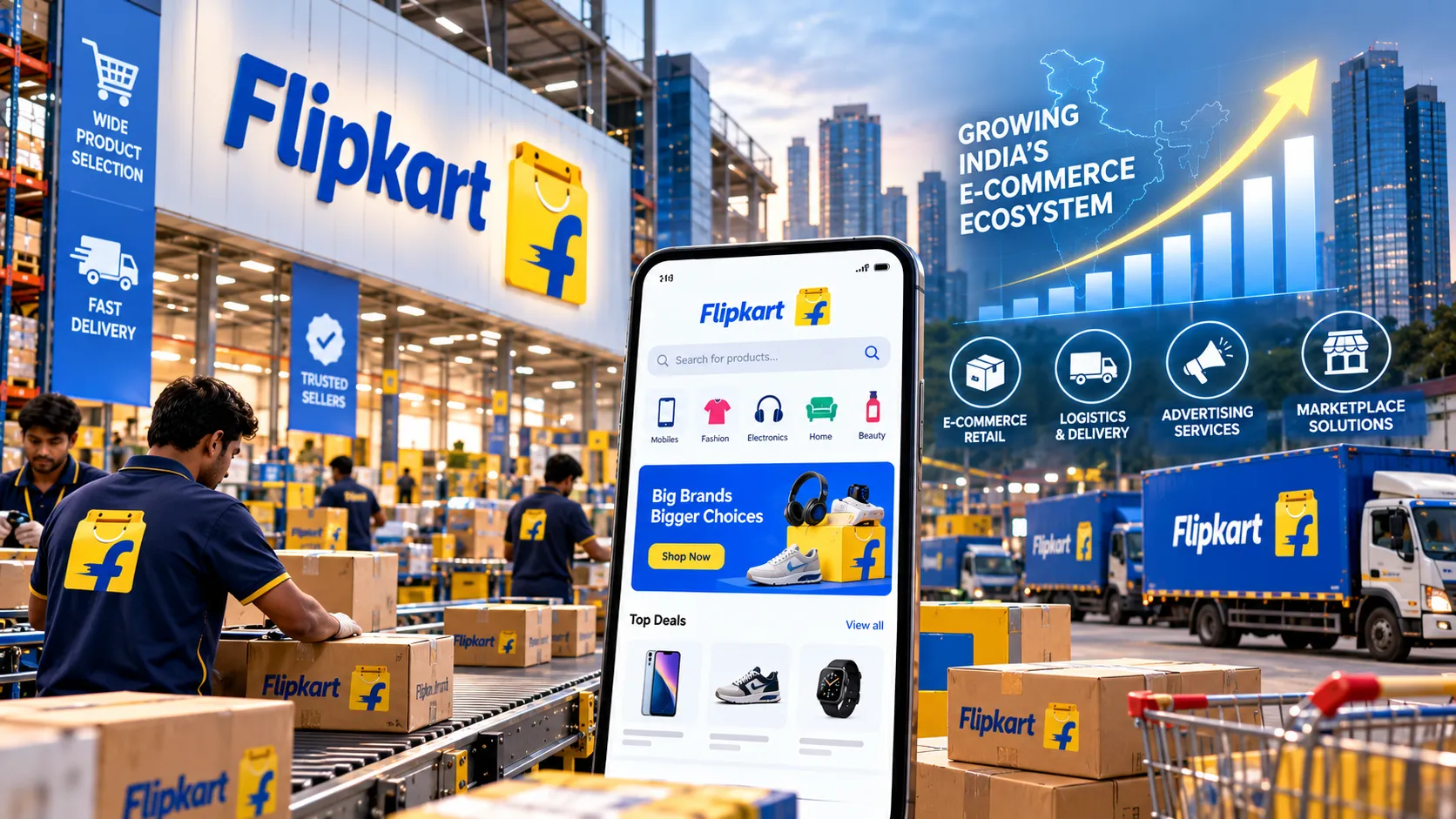
Sale of traded goods remained the largest component, rising 12.8 per cent to ₹1,04,850 crore. But the most striking growth came from logistics, warehousing and shipping services, which more than doubled to ₹23,059 crore from ₹9,580 crore, an increase of roughly 2.4 times. The surge reflects Flipkart's push to monetise its delivery network, including services for third-party sellers and the integration of logistics previously housed elsewhere in the group.
Advertising was the other bright spot. Revenue from advertisement services grew 30.7 per cent to ₹9,597 crore from ₹7,343 crore. Retail media, in which brands pay to promote products inside shopping apps, has become one of the most profitable lines of business for e-commerce platforms worldwide, and Flipkart's growth mirrors the trajectory of Amazon's advertising arm.
By contrast, marketplace and collection services fell 43.9 per cent to ₹6,719 crore from ₹11,967 crore. The decline may partly reflect reclassification of revenue streams after the restructuring, as well as changes in the commission structure Flipkart charges sellers. Taken together, logistics and advertising now account for close to a quarter of operating revenue.
Costs Still Outrun the Top Line
On the expense side, Flipkart spent ₹1,54,781 crore in fiscal 2026, up 16 per cent from ₹1,33,400 crore. Cost of materials, the largest item, rose 17 per cent to ₹1,15,118 crore, accounting for about 74 per cent of total expenses.
Transportation costs grew faster than revenue, rising 28.9 per cent to ₹15,154 crore, which is consistent with the expansion of logistics services and the growing weight of fast delivery. Advertising and promotional spending rose a modest 4.7 per cent to ₹4,941 crore, while employee benefit costs were nearly flat at ₹8,376 crore, including ₹2,922 crore of share-based compensation.
The company spent ₹1.06 for every rupee of operating revenue, an improvement from ₹1.08 a year earlier. Return on capital employed remained deeply negative at minus 39.04 per cent.
The Quick Commerce Factor
The results arrive as Indian e-commerce is being reshaped by quick commerce, the 10-to-30-minute delivery model popularised by Blinkit, Swiggy Instamart and Zepto. Flipkart entered the segment with its Minutes service and has been expanding dark stores in major cities, an expensive build-out that weighs on margins in the short term.
Quick commerce has shifted consumer expectations and pushed every major platform to invest in faster fulfilment. Flipkart's higher transport costs and its expanding logistics revenue both reflect that competitive pressure.
At the same time, Flipkart faces intensifying competition from Amazon India, Reliance's JioMart, Meesho in value e-commerce, and a growing number of brand-owned direct-to-consumer channels.
What It Means for an IPO
For Walmart, which acquired a controlling stake in Flipkart in 2018 in what was then the largest e-commerce deal in history, the fiscal 2026 numbers offer mixed signals ahead of a potential listing.
On the positive side, revenue is growing at a healthy clip for a business of its size, EBITDA losses are falling faster than net losses, and higher-margin businesses such as advertising and logistics are scaling quickly. On the other hand, the group remains firmly loss-making, return on capital is negative, and the reduction in net loss was marginal.
Indian public markets have shown appetite for loss-making technology companies with credible paths to profitability, as listings by Zomato, now Eternal, and Swiggy have demonstrated. But investors have also become more discerning, rewarding companies that show steady progress towards positive cash flow.
The Seller's Perspective
For the hundreds of thousands of sellers who list products on Flipkart, the shift in revenue mix carries practical implications. A fall in marketplace commissions alongside rapid growth in advertising and logistics revenue suggests that sellers are increasingly paying for visibility and fulfilment services rather than simply for access to the platform. That model has become standard across global e-commerce, where marketplaces earn a growing share of their income by selling promotional placements and delivery services to merchants.
For small and medium-sized sellers, the trend can raise the effective cost of doing business online, as competition for prominent placement intensifies during peak periods such as the festive season. For larger brands, the advertising tools offer more precise ways to reach shoppers. How Flipkart balances the interests of sellers, brands and consumers will shape both its growth and its regulatory relationships, given the scrutiny that e-commerce marketplaces have faced from India's competition regulator and trader associations over pricing and preferential treatment.
The Bigger Picture
Flipkart remains a bellwether for Indian consumer internet. Its scale, with revenue approaching ₹1.5 lakh crore, makes it one of the largest privately held companies in the country, and its performance offers a read on consumer demand, digital adoption and the economics of online retail.
The fiscal 2026 accounts show a company that is diversifying its income and tightening operations, but still spending heavily to defend its position in a fiercely competitive market. The next test will be whether the growth in advertising and logistics can carry Flipkart to profitability quickly enough to support a public listing on terms that satisfy both Walmart and Indian investors.