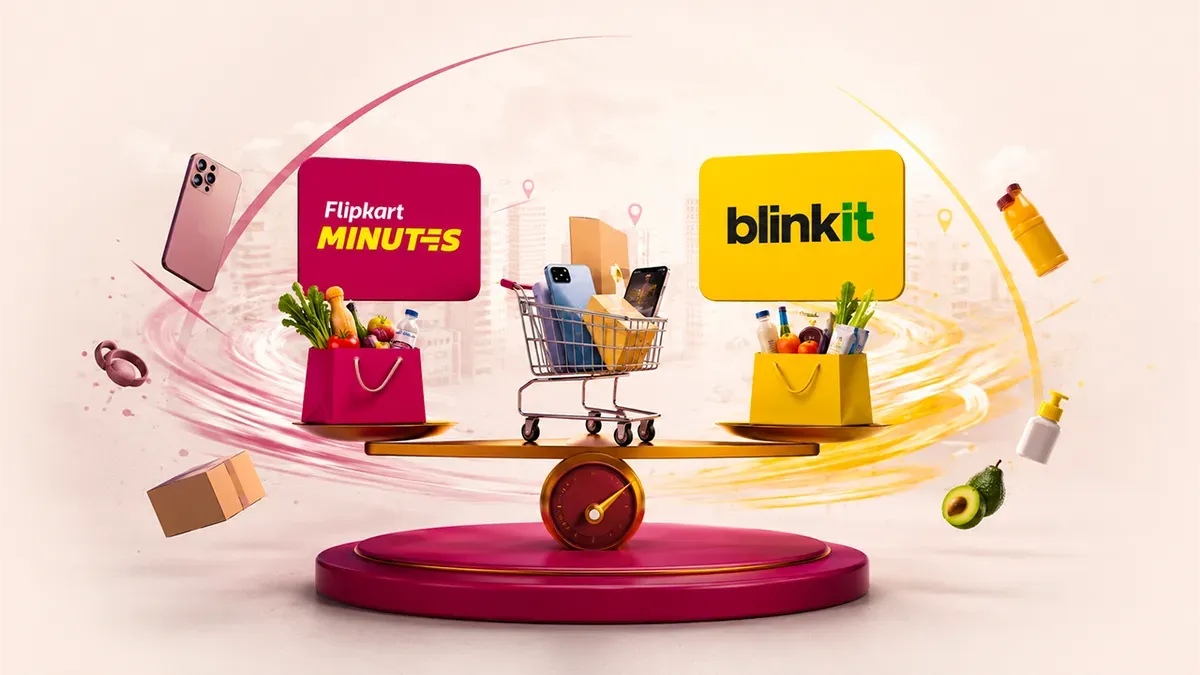
Flipkart's quick-commerce platform Minutes is seeing order values move close to those of market leader Blinkit, aided by its established strength in mobile phones and electronics, according to a UBS report cited by Entrackr on September 4, 2026.
Excluding mobile phones, Minutes' net order value stands at around ₹500 to ₹530, marginally below Blinkit's average net order value of ₹518 as of the June 2026 quarter (Q1 FY27). However, once mobile phones are included in the calculation, Minutes' order value surpasses Blinkit's, reflecting Flipkart's long-established strength and seller relationships in mobiles and electronics — a category mix that has become a bigger contributor to Minutes' overall portfolio over the past year.
According to UBS, Minutes now operates more than 1,000 dark stores across roughly 120 to 130 cities, with individual stores averaging 800 to 1,000 orders a day; stores that have been operational for five to six months, considered "mature," process around 1,200 to 1,500 orders daily.
UBS estimates Minutes could add another 1,000 dark stores by mid-2027 or ahead of Flipkart's Big Billion Days sale in 2027, potentially taking its network to around 2,000 stores and further narrowing its infrastructure gap with Blinkit — though the brokerage notes the rollout pace will depend on individual market performance and the availability of supporting backend infrastructure. Minutes' advertising revenue is broadly comparable with other leading quick-commerce platforms, per UBS, while its gross margins are improving but remain below Blinkit's levels, with store and city maturity expected to remain key drivers of its margin trajectory going forward.
The broader quick-commerce sector is entering a more capital-intensive phase, according to the same UBS report: both Blinkit and Swiggy Instamart have raised their capital expenditure guidance per dark store to around ₹2.5 crore, up sharply from roughly ₹1 crore estimated nearly two years ago, as store formats grow from a typical 2,000 to 3,000 square feet toward more than 5,000 square feet — a 60 to 100 percent increase in average store size over the past one to two years, aimed at supporting wider assortments spanning electronics, beauty, fashion, medicines and home products.
Competition in the category continues to intensify beyond Flipkart and Blinkit. Amazon Now currently operates around 500 to 600 dark stores and processes 4 to 5 lakh orders a day, according to UBS, with plans to expand its fulfilment network to 300 cities and potentially reach 1,000 stores by the end of 2026. Zepto has proposed deploying ₹1,629 crore from its IPO proceeds to build 1,904 dark stores by FY30, while Swiggy has said Instamart's existing network can support more than twice its current gross order value. UBS expects India's overall quick-commerce opportunity to reach $40 billion by 2030 as platforms expand well beyond groceries.
On user reach, Blinkit continues to lead the category decisively: its share of tracked monthly active users stood at 38 percent in July 2026, up 31 basis points month-on-month and 375 basis points year-on-year, with Blinkit's monthly active users growing 57 percent year-on-year compared with 15 to 16 percent growth for Zepto, while Swiggy Instamart's standalone app held a 9.5 percent share of tracked monthly active users.
Flipkart has also been broadening what Minutes sells: in August 2026, the platform entered premium grocery and speciality food with its private-label brand Pykd, offering products such as cheese, coffee, kombucha, ramen, ghee and oils, initially piloted in Bengaluru, alongside plans to bring on more premium third-party brands to compete with offerings such as Blinkit Gourmet and Swiggy Instamart's Noice.
For investors and industry watchers, the narrowing order-value gap between Minutes and Blinkit — even as Blinkit retains a commanding lead in daily order volume and user reach — suggests Flipkart's quick-commerce push is gaining genuine commercial traction rather than simply scaling store count, setting up a closely contested battle for share in India's fast-expanding quick-commerce market over the next 12 to 18 months.