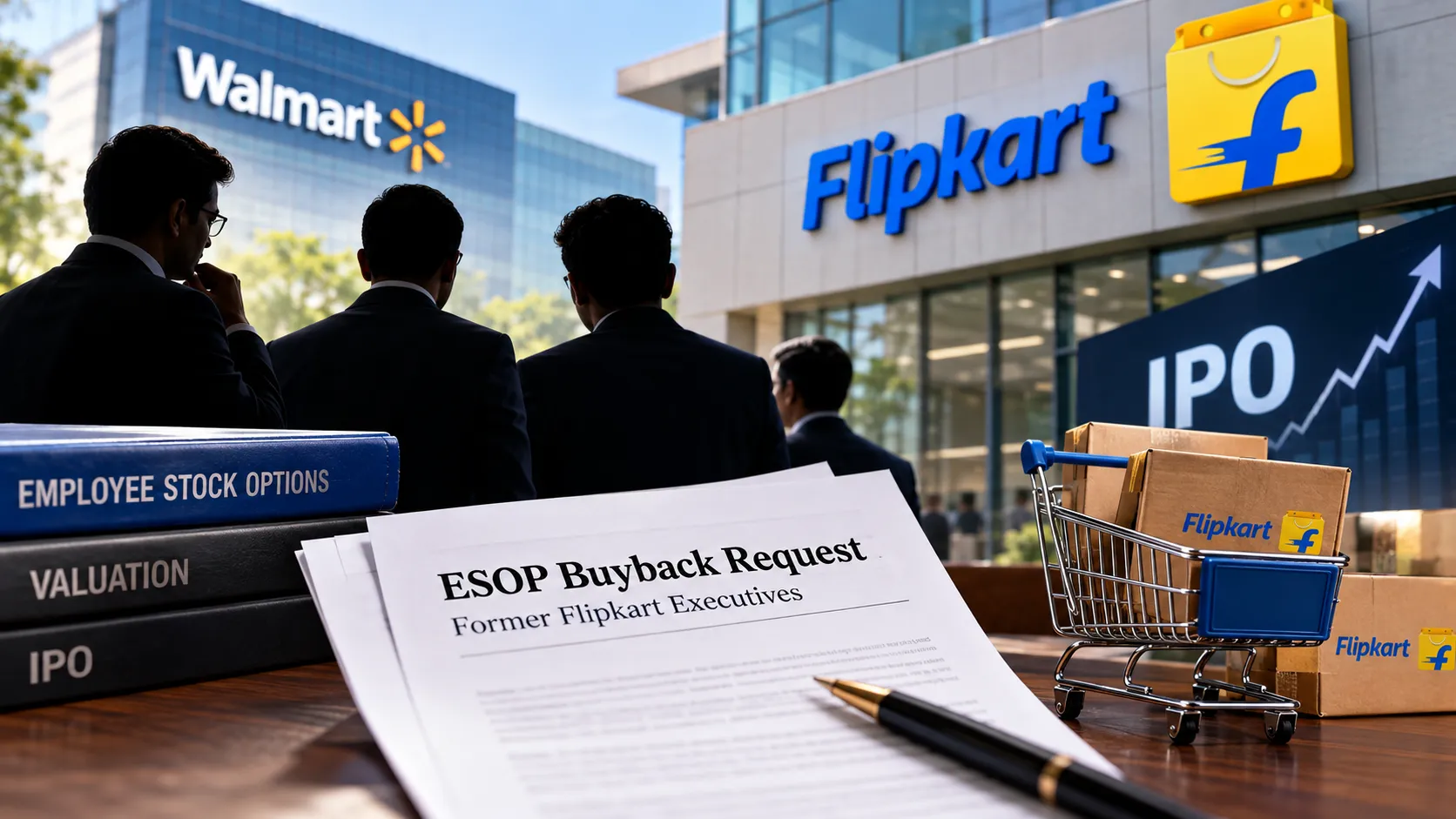
A group of former senior Flipkart executives, including former chief executive Mukesh Bansal and former chief business officer Ankit Nagori, has asked Walmart to buy back their vested employee stock options, arguing that uncertainty over the ecommerce company's long-delayed stock market listing has left them with no way to cash in.
The group, which also includes former chief financial officer Sanjay Baweja, wrote to Walmart's board, whose members include Flipkart group chief executive Kalyan Krishnamurthy, seeking a full exit for their vested options, the Economic Times reported. Inc42 carried the report on 7 October.
Walmart said it would look into the concerns. “We appreciate the perspective of all employees—current and former—and value their feedback,” a company spokesperson said. “As with anything raised, we take it seriously and look into the matter.”
Options granted a decade ago
The former executives are seeking what they describe as “fair treatment” for options granted 10 to 15 years ago, during the period when Flipkart grew from a Bengaluru online bookseller into India's largest ecommerce company. Their central argument is that leaving the company should not cut them off from the value of stock they earned while working there.
“This is not merely a request for goodwill,” the letter said, according to the reports, framing the demand as a matter of the value employees were promised when they accepted options as part of their pay.
The people involved are among the best-known names from Flipkart's growth years. Bansal founded fashion retailer Myntra, which Flipkart acquired in 2014, and went on to run Flipkart's commerce business before leaving. He and Nagori, who had also held senior roles at Flipkart, later co-founded fitness company Cure.fit, now known as cult.fit. Baweja served as Flipkart's chief financial officer for about two years.
Inc42 said it had contacted Flipkart, Walmart, Bansal and Baweja for comment and had not received responses at the time of publication.
Current staff got a window; former staff did not
The request follows a buyback that excluded people who had left. In July 2026, Walmart ran the second tranche of a stock buyback programme for current Flipkart employees, a transaction that reportedly valued the company at about $38.2 billion. Eligible employees could sell only up to 5% of their vested options, and former employees were not offered any route to sell.
Flipkart is now considering a larger programme for current staff. NewsBytes reported on 1 October that the company was weighing a fresh plan under which eligible employees could sell 20% to 25% of their vested shares next year, aimed at those whose options vested three to five years ago. The same report said some former employees had discussed approaching Walmart for clarity.
Employee stock options give staff the right to buy company shares at a fixed price once they vest, usually after a set period of service. At a listed company, vested options can be exercised and the shares sold on the market. At a private company such as Flipkart, there is no open market, so holders depend on buybacks or approved secondary sales to turn the options into cash.
ESOPs are a large part of how Indian startups attract senior talent, particularly at companies that pay less in cash than multinational employers. When Walmart bought a controlling stake in Flipkart in 2018 for about $16 billion, the deal turned many employees into paper millionaires, and Flipkart has run several buybacks since then. Without a listing, however, sales depend on the company or its owner offering to buy.
The pressure has been building. Flipkart has seen a series of senior departures in recent months, including vice presidents Prathyusha Agarwal and Aakriti Chandra, according to reports citing Moneycontrol. Weeks earlier, senior vice president Gunjan Bhartia and vice president Amer Hussain had resigned, while Myntra chief executive Nandita Sinha and group chief financial officer Sriram Venkatraman had stepped down and Ankit Jain had moved to rival Swiggy Instamart.
NewsBytes linked some of those exits to uncertainty over the IPO and the limited options for employees to sell their holdings. For people who joined in the expectation of a listing within a few years, each delay pushes back the moment when years of deferred compensation can be realised.
An IPO without a date
Flipkart has moved its holding company back to India from Singapore so that it can list on Indian exchanges, but it has not set a timetable. Reports indicate the listing has been pushed back to 2028 as the company concentrates on profitability, with a target of breaking even on an EBITDA basis by the end of FY27. Walmart is reportedly seeking a valuation of about $50 billion when Flipkart goes public.
Walmart has said the listing remains part of its plans. The IPO “remains an active part of our strategic roadmap”, the company said, adding that it would proceed “when the timing is right.”
Flipkart's finances are improving but are not yet in profit. For FY25, Flipkart Internet, the marketplace arm, cut its consolidated net loss by 36.7% to ₹1,494.2 crore, while total income rose 14% to ₹20,807.4 crore, Inc42 reported. FY26 figures have not yet been disclosed. The company is also expanding its quick commerce business, Flipkart Minutes, which a UBS projection cited by Inc42 expects to reach 2,000 dark stores by mid-2027, and is reportedly exploring food delivery and event ticketing.
Those plans require capital, which shapes how Walmart weighs any buyback. Money spent repurchasing options from former staff is money not spent on new businesses, and Walmart has so far chosen to offer liquidity in small, controlled amounts to current employees whose retention it still needs.
For Walmart, the request raises a question of precedent. Buying out a small group of senior former executives would be relatively easy to finance, but it could prompt similar demands from the much larger pool of former employees who also hold vested options. Refusing risks damaging goodwill among alumni whose networks shape how Flipkart is seen by future hires, many of them founders and investors in India's startup sector today.
The issue extends beyond Flipkart. Many Indian startups that granted generous options during the funding boom are now delaying listings, leaving current and former staff holding stock they cannot easily sell. How Walmart responds will be watched closely by founders, employees and investors as a signal of what ESOPs at private Indian companies are really worth before an IPO.