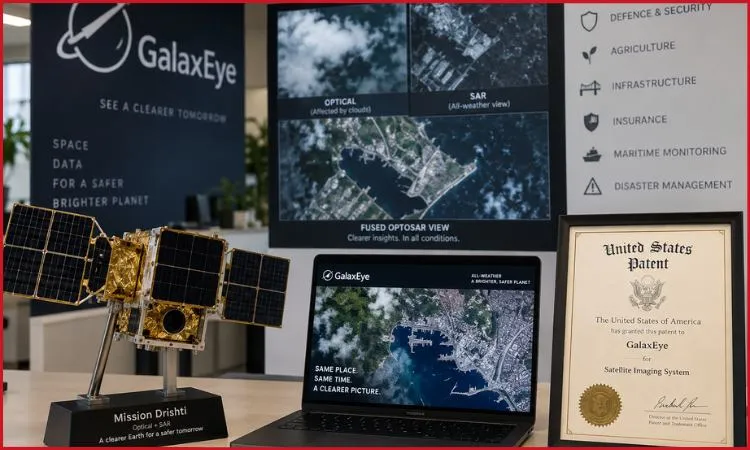
GalaxEye, the Bengaluru-based space-technology startup building multi-sensor Earth-observation satellites, has secured a United States patent for the core architecture behind its OptoSAR system, the company said on September 8, 2026. The patent protects a method for synchronising optical and synthetic aperture radar, or SAR, sensors on a single satellite platform so that both data streams capture aligned observations of the same location at the same moment — a technical challenge that has limited the usefulness of combined optical-radar imaging elsewhere in the industry.
Optical satellite imagery offers high-resolution, human-interpretable pictures of the Earth's surface but is blocked by cloud cover and unusable at night. SAR, by contrast, can see through clouds and operate regardless of daylight, but produces data that is harder to interpret without specialised processing. Most Earth-observation constellations today rely on either one sensor type or the other, forcing customers in agriculture, disaster response, defence and infrastructure monitoring to stitch together data from separate satellite operators with different orbital passes and timestamps — introducing delays and inconsistencies that limit real-time decision-making.
GalaxEye's patented approach seeks to close that gap by capturing optical and SAR data from the same satellite in near-simultaneous fashion, allowing the two datasets to be fused with far greater positional and temporal accuracy than is possible when combining imagery from separate missions. For applications such as flood mapping, crop-stress detection or maritime surveillance, where conditions can change within hours, the ability to layer a radar view for structural detail against an optical view for surface context — captured at effectively the same moment — represents a meaningful technical advantage.
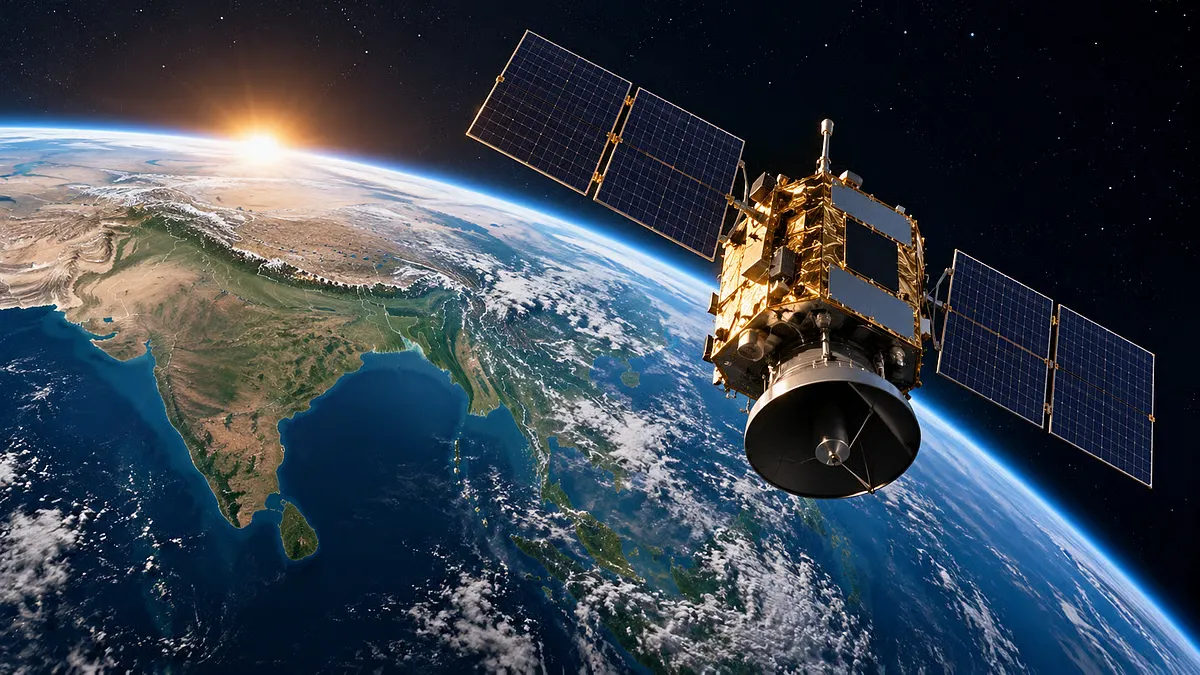
The patent grant arrives as India's private space sector experiences one of its strongest funding and validation cycles yet, with multiple Bengaluru-headquartered satellite companies raising large rounds through 2026 to build out imaging and communications constellations. Intellectual-property protection in core sensor architecture is increasingly viewed by investors as a proxy for defensibility in a sector where launch costs have fallen sharply but competition for government and commercial imaging contracts has intensified correspondingly. A granted US patent, in particular, signals that GalaxEye's technical approach has cleared a rigorous prior-art review in the world's largest and most competitive satellite-imaging market.
GalaxEye was founded in 2021 by a team drawn from the Indian Institute of Technology Madras and has positioned itself as a builder of what it calls all-weather, all-time imaging satellites — a category the company argues is underserved relative to the broader Earth-observation market's growth. The company's roadmap includes plans to scale its own constellation using the OptoSAR architecture, targeting customers across defence, disaster management, insurance and agricultural monitoring who require dependable imaging regardless of weather or time of day.
For India's wider deeptech and spacetech ecosystem, the patent underscores a shift already visible in recent funding activity: Indian space startups are increasingly competing not just on cost or launch cadence but on original sensor and systems engineering that can be protected and licensed globally. As India's private space sector continues to attract both domestic and international capital — evidenced by a wave of Series C-stage raises among Bengaluru-based satellite companies through 2026 — intellectual property emerging from Indian labs and engineering teams is beginning to travel well beyond the domestic market, a milestone the sector's earliest founders have long pointed to as a marker of genuine technological maturity.