FundingAnalysis5 MIN READ

General Motors Will Move Its Listing From the NYSE to Nasdaq on November 17, Opening the Door to the Nasdaq-100

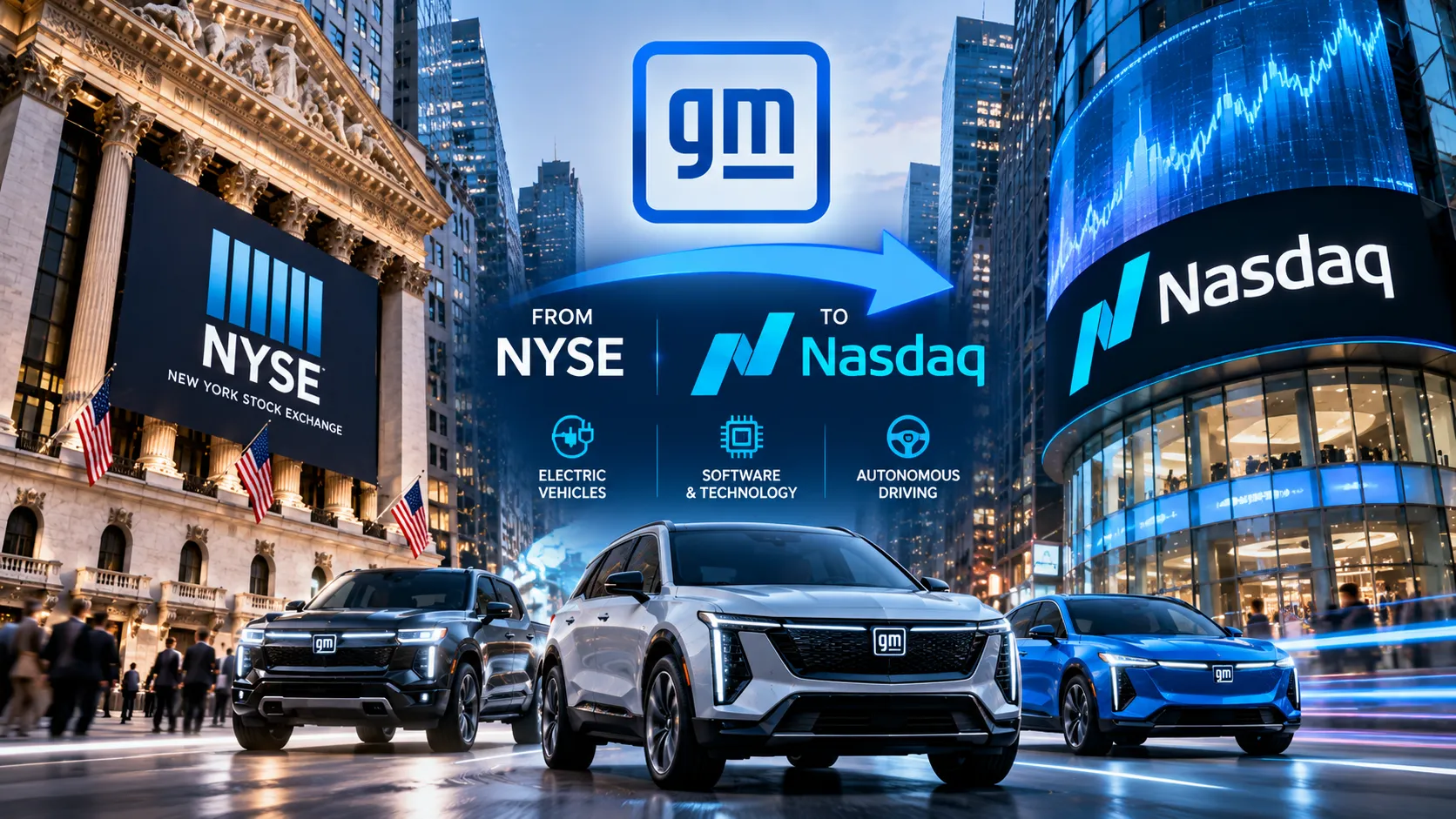
General Motors will transfer its stock listing from the New York Stock Exchange to the Nasdaq Global Select Market, with trading on Nasdaq expected to begin on November 17, 2026. The move makes the carmaker eligible for the Nasdaq-100 index, which could bring buying from index funds, and its shares rose 5.5% on October 27.

By Shaym Kumar · Author28 October 2026New

One of America's oldest industrial companies is swapping the trading floor of Wall Street for the exchange best known for technology stocks.

General Motors said on Tuesday, October 27, that it will transfer its common stock listing from the New York Stock Exchange to the Nasdaq Global Select Market. GM shares will continue to trade on the NYSE through the market close on November 16, 2026, and are expected to begin trading on Nasdaq on November 17. The ticker symbol will remain GM.

GM shares rose 5.5% on Tuesday after the announcement, according to the Associated Press.

Why GM is moving

"GM's customer-focused, technology-driven strategy is creating value for our stockholders," said Paul Jacobson, GM's executive vice president and chief financial officer. He said Nasdaq is a natural home for the company's listing as it grows, and thanked the NYSE for its long-standing partnership.

The company said a Nasdaq listing makes it eligible for potential inclusion in the Nasdaq-100 index, which tracks the 100 largest non-financial companies listed on Nasdaq. No action is required from existing shareholders.

The Nasdaq-100 prize

Inclusion in the Nasdaq-100 can have significant benefits for a company's shares. The index is tracked by large exchange-traded funds, most notably the Invesco QQQ Trust, as well as other funds and investment products. When a company is added, those funds must buy its shares, creating demand.

The Nasdaq-100 is also closely associated with technology and growth companies, and inclusion can raise a company's profile among investors focused on innovation. For GM, which has been positioning itself as a technology company in areas such as electric vehicles, software and autonomous driving, that association has strategic appeal.

A carmaker reinventing itself

GM, led by chief executive Mary Barra, has invested heavily in electric vehicles, battery technology and software. The company has also been developing advanced driver assistance and autonomous driving systems, including plans to extend hands-free and eyes-off driving capabilities across its vehicles.

The company has argued that its software and technology investments will create new revenue streams, such as subscriptions and services, which could justify a higher valuation than traditional carmakers typically receive.

Investors have historically valued carmakers at low multiples of earnings, reflecting their cyclicality and capital intensity. Technology companies, by contrast, tend to command higher valuations. A Nasdaq listing will not by itself change GM's business, but it signals how the company wants to be perceived.
5443c5bf-23e7-47ac-923e-3363929282f0.png

The exchange rivalry

The NYSE and Nasdaq compete intensely for listings, both for initial public offerings and for transfers of existing companies. Exchanges earn fees from listings and benefit from the prestige of hosting major companies.

In recent years, a number of large companies have switched between the two exchanges. Nasdaq has promoted its appeal to technology-oriented companies and the visibility of the Nasdaq-100, while the NYSE emphasises its trading model and heritage.

GM's move is a notable win for Nasdaq, given the carmaker's size and its century-long history as an icon of American industry.

Peer reactions

Tesla, which has long been listed on Nasdaq and is a member of the Nasdaq-100, rose 3% on Tuesday, while Ford edged higher, according to 24/7 Wall St. The movement in auto stocks reflected broader market gains and interest in the sector.


“GM's customer-focused, technology-driven strategy is creating value for our stockholders.”
— Paul Jacobson, Executive Vice President and CFO, General Motors

What it means for India

GM exited manufacturing and sales in India in 2017, ending a long but unprofitable presence in the market. It sold its Talegaon plant in Maharashtra to Hyundai. However, GM maintains a large technical centre in Bengaluru, one of its biggest engineering operations outside the United States, which works on software, vehicle engineering and digital technologies.

The company's push into software-defined vehicles and autonomous technology relies in part on engineering talent in India, so its technology ambitions have relevance for Indian engineers and the country's automotive software ecosystem.

Indian listings abroad

GM's move also highlights how companies think strategically about where they list. In India, companies choose between the National Stock Exchange and BSE, while some Indian companies have considered overseas listings. The government has also been working on rules to allow Indian companies to list directly on foreign exchanges, including through the GIFT City international financial centre.

GM's transformation story

GM has undergone a significant transformation over the past two decades. After a government-backed bankruptcy restructuring in 2009, the company streamlined its brands, exited unprofitable markets including Europe and India, and refocused on its most profitable segments, particularly trucks and SUVs in North America. It has used profits from those vehicles to fund investments in electric vehicles and technology.

The company has also returned significant capital to shareholders through share buybacks, reducing its share count and supporting its stock price. Its decision to switch exchanges reflects a desire to align its market identity with its technology ambitions.

Index inclusion rules

The Nasdaq-100 includes the largest non-financial companies listed on Nasdaq, ranked by market value, and is reviewed annually, with additional changes when companies leave the index. Being listed on Nasdaq is a precondition for inclusion, so GM's move makes it eligible but does not guarantee a place. Its large market value could make it a strong candidate.

What it means for shareholders

For existing GM shareholders, the switch requires no action, as their shares will automatically trade on Nasdaq from November 17. The main potential benefit is the prospect of index inclusion, which could increase demand for the shares. Some analysts view exchange switches as largely symbolic, while others argue that index eligibility can have a meaningful effect on a company's investor base and liquidity.

What comes next

GM's shares will begin trading on Nasdaq on November 17. The next step will be whether, and when, the company is added to the Nasdaq-100, which depends on the index's rules and annual reconstitution schedule.

For investors, the listing switch is symbolic of GM's effort to redefine itself as a technology-driven company. Whether the market rewards that ambition will ultimately depend on the company's ability to deliver growth in electric vehicles, software and autonomous driving. The move will also be watched by other large companies weighing a change of exchange, since a successful transition and index inclusion for GM could encourage further switches between the NYSE and Nasdaq. Both exchanges are likely to continue competing aggressively for the listings of large established companies as well as new IPOs.

TagsGeneral MotorsGMNasdaqNYSEstock exchange listingNasdaq-100Paul JacobsonMary Barraindex fundsETFsInvesco QQQautomakerselectric vehiclesautonomous drivingTeslaFordUS stocksstock exchangescapital marketsinvestors

Reader reviews

Sign in to rate and review this article.
Loading reviews…
