An investment firm built on the fortune of one of India's IT pioneers has helped write one of the largest early-stage cheques in robotics history.
Genesis AI, a robotics company based in Paris with a US presence in San Carlos, California, has raised $500 million in a Series A round at a post-money valuation of $3.5 billion, according to Tech Startups, which reported the deal announced on Tuesday, November 17.
The round was co-led by Premji Invest, the investment arm of Wipro founder Azim Premji, along with Khosla Ventures and Eclipse. Nvidia, French public investment bank Bpifrance, AMD Ventures, Samsung Next and Durable Capital Partners also participated.
Meet Eno
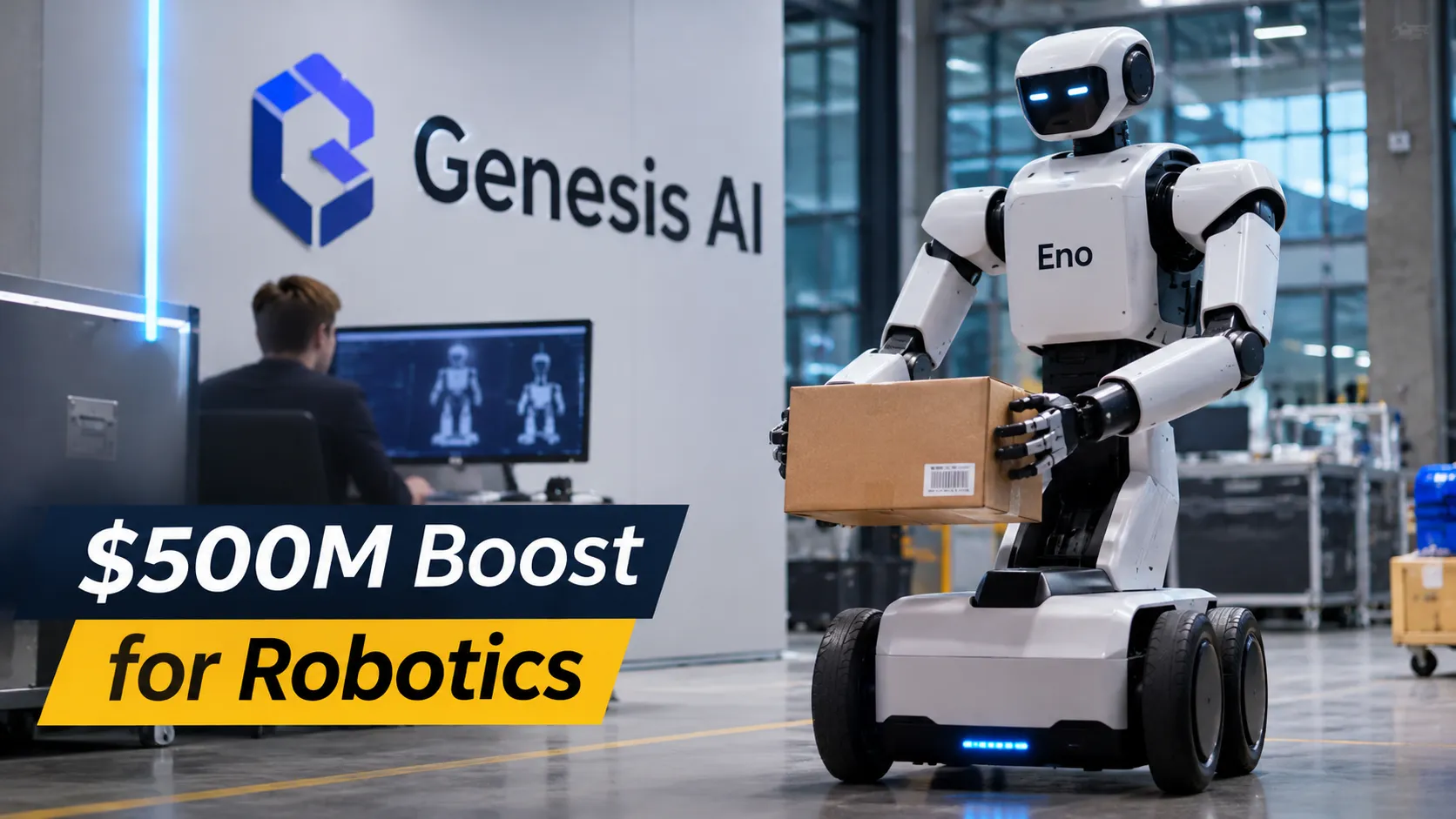
Genesis AI is developing Eno, a general-purpose robot built on a wheeled platform with folding body segments and hands capable of manipulating objects, according to Tech Startups. Rather than focusing on a single task, the robot is designed to perform a wide range of activities in different environments.
The company develops its hardware, control models, simulation tools and AI training systems together, an integrated approach that it believes will allow faster progress than relying on separate suppliers.
Early commercial traction
Genesis AI has begun early customer tests and has a partnership with LG CNS, the IT services arm of South Korea's LG Group, focused on manufacturing and logistics, according to Tech Startups. A broader customer rollout is targeted for 2027.
Manufacturing and logistics are seen as promising early markets for general-purpose robots, because tasks are repetitive, environments are structured and labour shortages are acute in many countries.
Why a $500 million Series A
A Series A of this size is extraordinary. Typical Series A rounds are measured in tens of millions of dollars. The size reflects the high costs of robotics development, which include building hardware, collecting data, training AI models and running large-scale simulations, as well as investors' enthusiasm for physical AI.
Robotics companies have attracted record investment over the past two years. Startups such as Figure AI, Physical Intelligence, Skild AI and 1X have raised large rounds at high valuations, and established companies including Tesla, Nvidia and Google have invested heavily in robotics.
The Nvidia factor
Nvidia's participation reflects its strategy of supporting companies that use its chips and software. Nvidia has developed platforms for robotics, including simulation tools and foundation models for robots, and sees physical AI as a major growth opportunity. Its interim chief executive, Colette Kress, highlighted strong demand across customer segments this week as Nvidia reported $115.8 billion in quarterly revenue.
Premji Invest's global ambitions
Premji Invest, which manages capital from the philanthropic endowment of Azim Premji, has become one of India's most influential investors. It has backed Indian companies across consumer, financial services, healthcare and technology, and has increasingly invested in global AI companies.
This week, it also participated in a $53 million round for Dreamteam, an AI-native CRM startup founded by former Freshworks executives. Its co-lead role in Genesis AI signals its ambition to back leading AI companies globally, not just in India.
Returns from Premji Invest's investments support the Azim Premji Foundation, which works in education and other social causes in India, giving its investment activity a philanthropic dimension.
Europe's robotics push
Genesis AI's success is also a win for Europe's technology ecosystem. France has sought to position itself as a leader in AI, with companies such as Mistral AI attracting large investments. Bpifrance's participation reflects the French government's support for domestic AI champions.
European policymakers have expressed concern about the continent falling behind the United States and China in AI and robotics, and large funding rounds for European startups are seen as evidence that the gap can be narrowed.
The challenges
Building a general-purpose robot is one of the hardest problems in technology. Robots must perceive their surroundings, plan actions, manipulate objects of varying shapes and materials, and operate safely around people. Despite rapid progress, no company has yet deployed general-purpose robots at large scale.
Cost is another challenge. Robots must be affordable and reliable enough for businesses to justify replacing or supplementing human workers. Achieving this will require advances in hardware manufacturing, battery technology and AI.
The data question
Training robots requires large amounts of data showing how tasks are performed. Companies use a mix of simulation, teleoperation and video of humans. This week, Bengaluru-based Humyn Labs raised $47 million to collect real-world data for robotics companies, highlighting the global supply chain forming around physical AI.
What it means for India
India could play several roles in the robotics boom: as a source of engineering talent, as a supplier of training data and as a market for robots in manufacturing and logistics. Indian investors' growing participation in global AI rounds also shows how Indian capital is becoming part of the international technology ecosystem.
Simulation as a shortcut
Training robots in the real world is slow and expensive, so companies increasingly rely on simulation, where virtual robots can practise millions of tasks in computer-generated environments. Advances in simulation and AI have made it possible to transfer skills learned virtually to physical robots more effectively, accelerating development.
Genesis AI's integrated approach, combining simulation with hardware and AI training, is designed to take advantage of this trend.
Labour shortages drive demand
Ageing populations and labour shortages in countries such as Japan, South Korea, Germany and the United States are increasing demand for automation. Manufacturers and logistics companies struggle to fill jobs that are physically demanding or repetitive, making general-purpose robots an attractive prospect if they can be made reliable and affordable.
Analysts say the size of recent robotics rounds also reflects the enormous capital required to manufacture robots at scale. Building production lines, securing component supply chains and supporting customers in the field require far more money than developing software, making robotics one of the most capital-intensive areas of the AI boom.
Industry observers say 2027 could prove a pivotal year for general-purpose robotics, as several well-funded companies move from pilot projects to broader commercial deployments and customers begin to judge whether the machines can deliver reliable returns on investment.
What comes next
Genesis AI will use the funding to advance Eno and prepare for its 2027 customer rollout. Its progress in early deployments with partners such as LG CNS will be watched as a test of whether general-purpose robots can move from demonstrations to commercial reality.