FundingMarket Data Women5 MIN READ

Glenmark's Profit Falls 57% to ₹264 Crore Against a Blockbuster Base, but Its Underlying Business Grows About 20%

Glenmark Pharmaceuticals reported a 56.8% fall in consolidated net profit to ₹264 crore for the September quarter, as revenue declined 29.8% to ₹4,247 crore against a year-earlier base inflated by its out-licensing deal for cancer drug ISB 2001, and an exceptional loss of ₹283 crore. Like-for-like revenue grew about 20%, and the company said it remains on track to meet its FY27 guidance.

By Shaym Kumar · Author6 November 2026New
Glenmark's Profit Falls 57% to ₹264 Crore Against a Blockbuster Base, but Its Underlying Business Grows About 20%

Glenmark Pharmaceuticals reported a steep fall in quarterly profit, but the decline masked solid growth in its underlying business, as the company lapped an exceptional year-earlier quarter boosted by a major licensing deal for one of its experimental cancer drugs.

The Mumbai-based drugmaker posted a consolidated net profit of ₹264 crore for the July-September quarter, the second quarter of the 2026-27 financial year, down 56.8% from ₹610 crore a year earlier, according to Business Standard, citing results announced on Thursday, November 5. Revenue fell 29.8% to ₹4,247 crore from ₹6,047 crore, although it rose 5.7% from ₹4,018 crore in the previous quarter.

On a like-for-like basis, revenue grew about 20% from a year earlier, according to Business Standard.

Why the numbers fell

The year-earlier quarter included substantial income from Glenmark's out-licensing deal for ISB 2001, an experimental cancer drug developed by its innovation unit, which inflated revenue and profit for that period. Business Standard noted that North America revenue in the latest quarter included deferred out-licensing income for ISB 2001.

The latest quarter also included an exceptional loss of ₹283 crore, compared with ₹1,385 crore a year earlier, according to Business Standard. Reports by AnnualReportAI and others linked the charge to a US antitrust litigation settlement. Glenmark has faced long-running litigation in the United States related to alleged price-fixing in the generic drug industry, and has agreed to settlements with several plaintiffs.

Adjusted profit after tax, excluding exceptional items, was ₹485 crore, according to Business Standard.

EBITDA was ₹864 crore, with a margin of about 20%, compared with ₹2,360 crore and a 39% margin a year earlier, according to IANS.

Segment performance

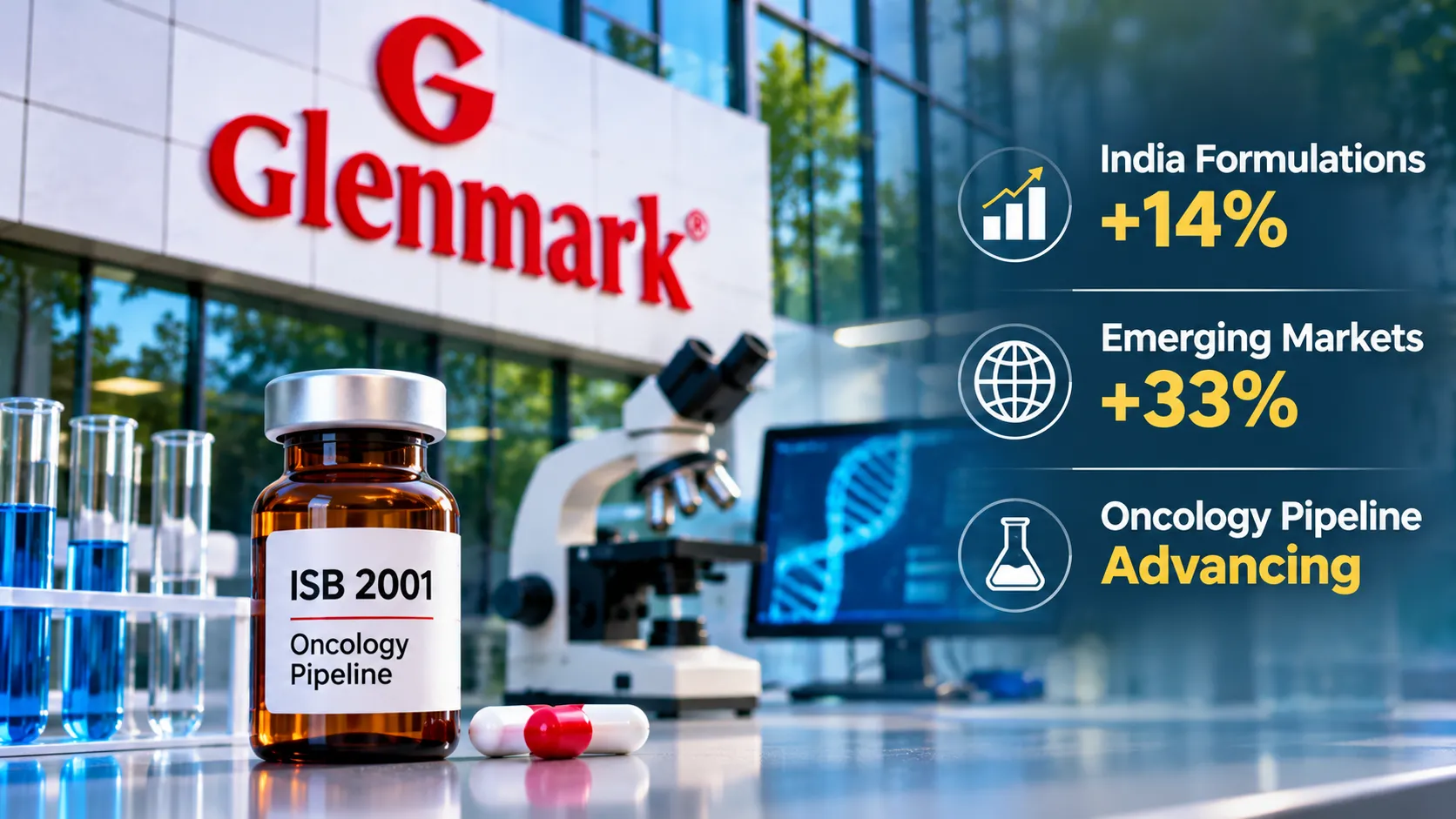
Glenmark's core businesses performed well. India formulations revenue rose 14% to ₹1,327 crore, according to Business Standard. Emerging markets revenue jumped 33.2% to ₹877 crore, and Europe grew 6.2% to ₹792 crore.

North America revenue was ₹1,209 crore. Excluding deferred out-licensing income recognition for ISB 2001, the core North American business grew about 31%, according to Business Standard.

On track for guidance

Chairman and managing director Glenn Saldanha said the company "remained on track to deliver its FY27 guidance, supported by continued growth in India," according to Business Standard. The company said its underlying business "remained resilient" despite the lower reported earnings, according to IANS.

Glenmark has previously set a target EBITDA margin of 21% to 22% for the 2026-27 financial year.

The innovation pipeline

Glenmark has been building an innovative drug pipeline through Ichnos Glenmark Innovation, its research unit focused on cancer and immunology. ISB 2001, a novel antibody being developed for multiple myeloma, a blood cancer, was out-licensed in a deal that brought Glenmark significant upfront payments and potential future milestone payments and royalties.

Phase 1 data for ISB 2001 has been selected for an oral presentation at the 2026 American Society of Hematology Annual Meeting, one of the most important conferences for blood cancer research, according to Business Standard. The company also plans to file an investigational new drug application for another candidate, ISB 2301, by the end of the year, and expects the first launch from its partnered innovative oncology pipeline by the end of the 2026-27 financial year, according to IANS.

The development of innovative drugs represents a significant strategic shift for Indian pharmaceutical companies, which have historically focused on generic medicines. Successful innovation can generate much higher margins and returns, but it is costly and risky.

“Glenmark's headline profit fell sharply, but strip out last year's licensing windfall and the business grew about 20%.”
— TIGI Markets Desk
77634e68-532c-4264-9df2-eb52e0f781cf.png

The generics business

Glenmark's core business remains branded generics in India and emerging markets, and generic drugs in the United States and Europe. The US generics market has been challenging for Indian drugmakers in recent years, because of intense price competition and regulatory scrutiny by the US Food and Drug Administration. Glenmark's 31% growth in its core North American business suggests improving performance in that market.

The company's India business benefits from its strong position in therapeutic areas such as dermatology and respiratory medicine.

Market reaction

Glenmark's shares closed 0.65% lower at ₹2,485.50 on the BSE before the results were announced, according to IANS. Investors will look beyond the headline decline to the underlying growth and the progress of the innovation pipeline.

The Indian pharma sector

India's pharmaceutical industry, often called the "pharmacy of the world," is one of the largest suppliers of generic medicines globally. Indian drugmakers face several challenges, including US tariff threats, pricing pressure and regulatory scrutiny, but they also have opportunities in specialty medicines, biosimilars, contract manufacturing and innovative drugs.

The shift towards innovation, exemplified by Glenmark's oncology pipeline, could help Indian companies move up the value chain and compete with global drugmakers.

Litigation risk

The US antitrust litigation over generic drug pricing has affected several drugmakers, including Indian companies. Settlements remove uncertainty but can result in significant charges. Investors will watch for any further legal developments.

Building an innovation engine

Glenmark's strategy of developing innovative medicines through Ichnos Glenmark Innovation sets it apart from many Indian drugmakers. The unit focuses on oncology, particularly antibody-based therapies for blood cancers, an area of high unmet medical need and significant commercial potential. The out-licensing of ISB 2001 demonstrated that Indian companies can develop assets attractive to global pharmaceutical companies.

Out-licensing allows Glenmark to share the high costs and risks of late-stage development and commercialisation with larger partners, while retaining upside through milestone payments and royalties.

Emerging markets strength

Glenmark's emerging markets business, which grew 33.2% in the quarter, includes operations in Russia, Latin America, Africa and Asia. These markets offer strong growth for branded generics, as rising incomes and expanding healthcare access increase demand for medicines. Glenmark's established presence in these regions gives it a diversified revenue base that reduces dependence on the competitive US market.

For investors, Glenmark represents a mix of a steady branded generics business in India and emerging markets, a recovering US business and a higher-risk, higher-reward innovation pipeline. How the market values each of these components will shape the stock's performance as the company moves towards its first innovative drug launch.

What comes next

Investors will watch Glenmark's progress towards its FY27 guidance, the ISB 2001 data at the American Society of Hematology meeting in December and the first launch from its oncology pipeline. The company's ability to grow its core business while advancing its innovation strategy will be key to its valuation.

TagsGlenmark PharmaceuticalsGlenn SaldanhapharmaIndian pharmaceuticalsISB 2001Ichnos Glenmark InnovationoncologyAbbVieQ2 FY27 resultsUS genericsantitrust settlementIndia formulationsemerging marketsEuropedrug developmentASH meetingIndian stockshealthcarebiotechinvestors

Reader reviews

Sign in to rate and review this article.
Loading reviews…

