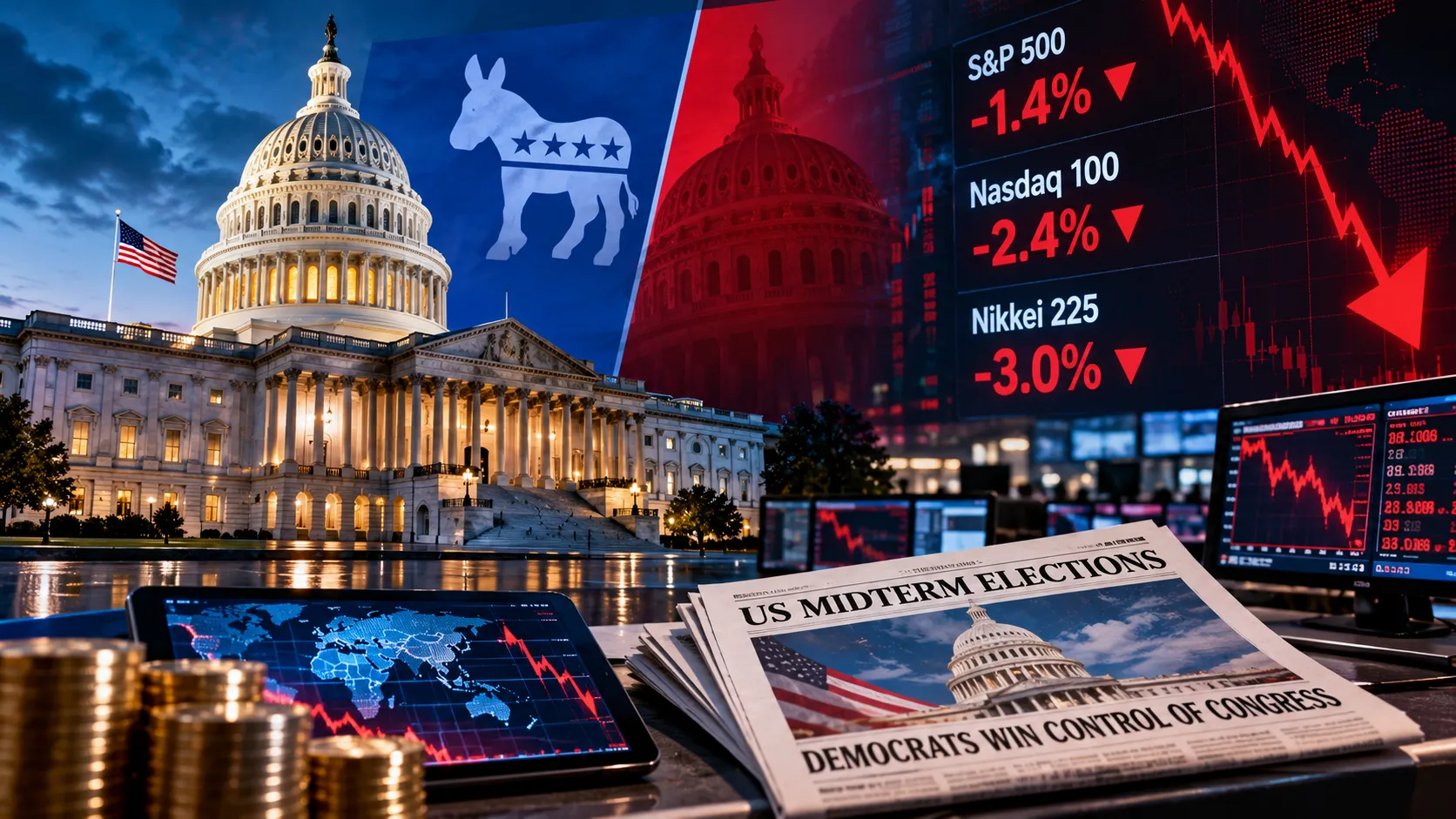
Global financial markets lurched lower on Wednesday, November 4, as results from the US midterm elections showed Democrats winning control of both chambers of Congress. The outcome surprised parts of Wall Street with its scale and triggered a sharp but partly reversed sell-off in stock futures and Asian equities.
Contracts on the S&P 500 fell as much as 1.4% overnight before paring losses to trade about 0.4% lower at 12:55 a.m. in New York, Bloomberg reported. Nasdaq 100 futures, which had dropped as much as 2.4%, recovered to trade about 0.5% lower. Japan's benchmark stock index slid more than 3% as early results showed a strong Democratic performance, The National reported.
US Treasuries rallied as investors sought safety, with the benchmark 10-year yield falling about seven basis points to 4.89%. The dollar weakened against major currencies.
How the night unfolded
The market reaction moved in step with the vote count. US stock futures had been rising early in the evening, supported by AMD's strong earnings, which eased some concerns about the durability of the AI trade. As polls closed and results began to arrive, the mood shifted.
Democrat Jon Ossoff's re-election in Georgia was one of the first significant race calls, Reuters reported. As further early Senate wins came in for Democrats, prediction markets moved sharply towards a Democratic sweep, and futures reversed course. By the early hours of Wednesday in New York, Democrats had won control of both the House and the Senate, according to Bloomberg.
"For traders, the distinction between a narrow Democratic majority and a commanding victory is critical," Chris Weston, head of research at Pepperstone, had said before the results became clear.
In Asia, equity benchmarks gave up early gains. Investors there had initially bought beaten-down technology stocks after AMD's results, but the election news quickly overwhelmed that optimism.
Why markets reacted the way they did
A shift in congressional control matters for markets because it changes what legislation can pass and how the administration's agenda will be scrutinised. With Congress and the White House now controlled by different parties, investors are weighing how legislation on trade, taxation, spending and regulation may change. Some market participants also flagged potential implications for technology regulation and data-centre policy.
Ahead of the vote, some on Wall Street had expressed concern that a large Democratic Senate majority could bring tighter limits on data centres. That would weigh on artificial intelligence stocks, which have driven much of the market's gains in recent years. Data centres have become a contentious local issue across the United States, with community opposition partly driven by concerns over rising utility bills as facilities consume enormous amounts of electricity.
Individual stocks seen as exposed to the political shift moved sharply. AI-linked stocks, including Tesla and Space Exploration Technologies Corp. (SpaceX), fell in post-market trading, Bloomberg reported, because the election outcome may have major implications for companies controlled by Elon Musk, a prominent Republican donor.
Not everyone sees a lasting shock
Several analysts cautioned against reading too much into the overnight moves.
"It's a little early, but at the end of the day I think a lot of this was factored into markets," one analyst told Reuters, adding that while some volatility was likely, it was nothing out of the ordinary compared with past election nights. Others questioned how much of the sell-off reflected the election and how much reflected the AI-related nervousness that has gripped markets for several weeks.
Some argued the outcome could even prove dollar-positive at the margin, if markets perceive greater independence for the Federal Reserve under a divided government. Others noted that, historically, US stocks have tended to perform well in the months after midterm elections, as political uncertainty fades.
The backdrop: a market already on edge
The election landed on a market that was already fragile. US stocks had been under pressure through October, particularly technology and AI-related names. The Nasdaq-100 had fallen into correction territory, roughly 10% below its high. Investors have been questioning whether the enormous sums being spent on AI infrastructure will generate adequate returns, and how much further valuations can stretch.
On Tuesday, before the results, the S&P 500 had closed up 0.36% and the Nasdaq 0.83% as chip stocks rebounded, while the Dow fell 0.38% after Apple warned that rising memory costs would squeeze its margins.
What it means for India
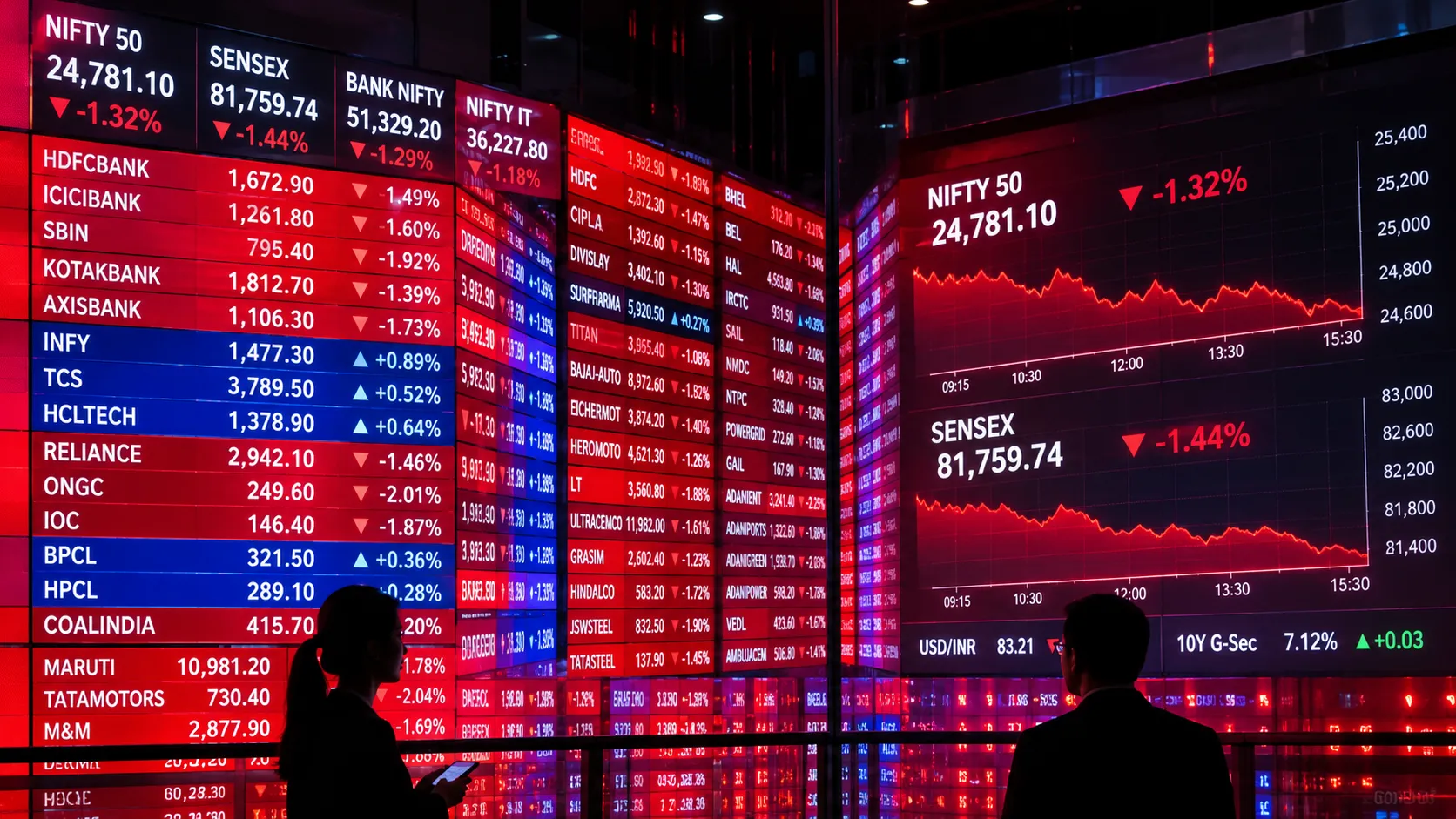
For Indian markets and investors, US political shifts transmit through several channels. A weaker dollar and lower US Treasury yields can, in principle, make emerging markets more attractive to foreign portfolio investors, which could support Indian equities and the rupee. The rupee has been under significant pressure in recent weeks amid high oil prices and foreign outflows.
But a risk-off mood in global markets typically hurts emerging markets in the short term, as investors pull back from riskier assets. Indian IT stocks, which depend heavily on US technology spending, are sensitive to any sign that US policy could slow corporate investment.
Trade policy is another key variable. Indian exporters will be watching whether the new balance of power in Washington changes the direction of US tariff policy, although any practical effect will depend on how legislation and negotiations unfold.
Indian equities had already had a difficult run in the days before the vote. Benchmark indices fell as surging crude prices, linked to tensions in the Gulf, and foreign selling weighed on sentiment, and mid- and small-cap stocks recorded their worst week in about 20 months. Foreign portfolio investors will watch the rupee closely after it weakened past 95 to the dollar in recent sessions. Against that backdrop, a sustained weakening of the dollar would offer some relief to emerging-market currencies, but a broader global risk-off move would add to the pressure.
What to watch next
Markets will now focus on the final shape of the new Congress, statements from the White House and congressional leaders on economic priorities, and how the Federal Reserve reads the political and economic landscape. Upcoming US inflation data, corporate earnings and AI spending announcements will continue to drive day-to-day moves.
For global investors, Wednesday's session was a reminder that politics can still jolt markets dominated by the AI narrative. Whether the overnight sell-off becomes a deeper correction or a brief tremor will depend on whether policy uncertainty escalates or, as many analysts expect, gives way to the familiar post-election pattern of markets refocusing on earnings and economic fundamentals.