FundingMarket Data Women5 MIN READ

Gold Holds Near $4,145 as Traders Bet Heavily on a December Fed Rate Hike

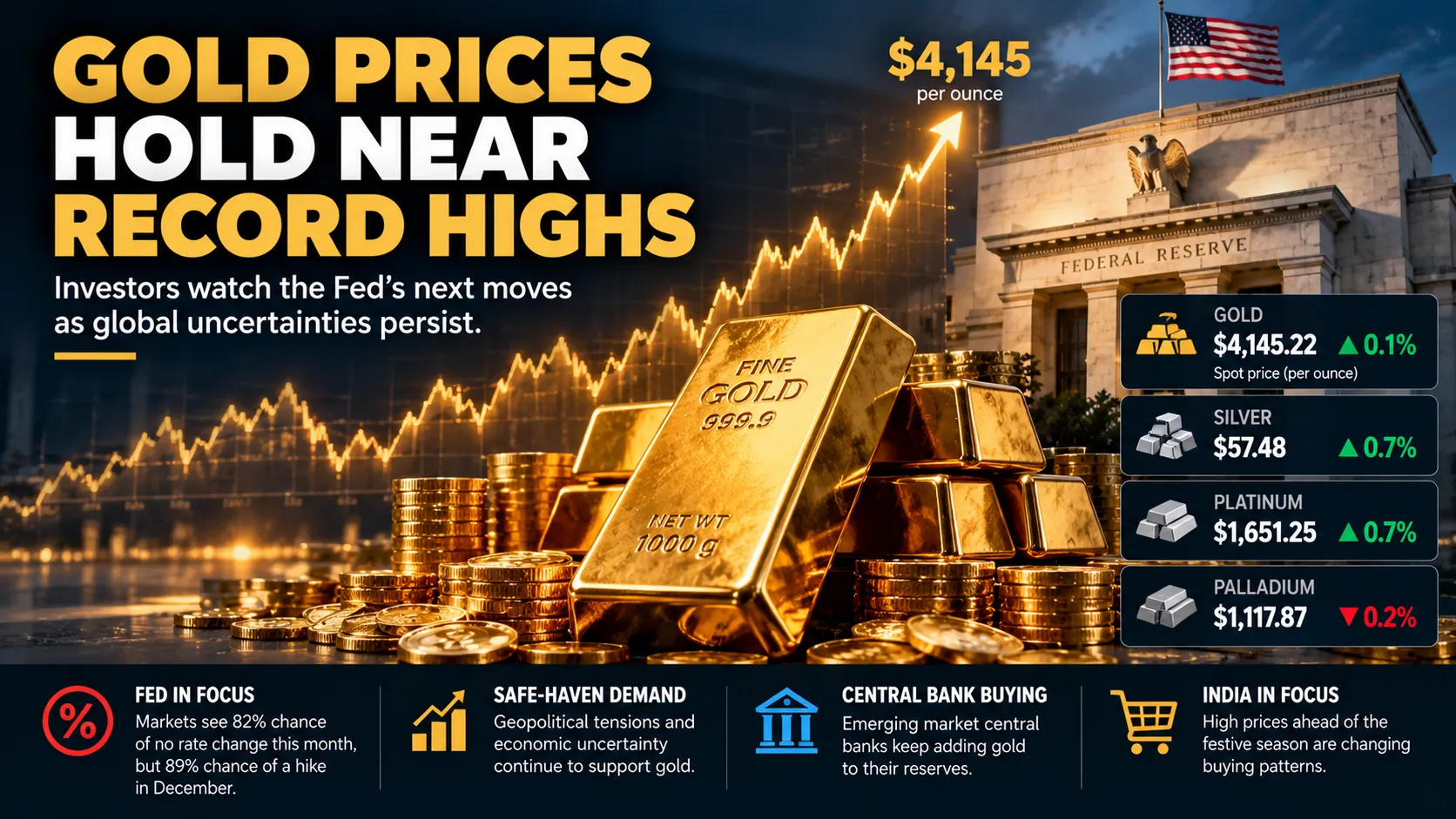
Spot gold traded around $4,145 an ounce on October 20, little changed, as traders priced an 89% chance of a US Federal Reserve rate hike in December while expecting no move at the October 27-28 meeting. Silver rose to $57.48, and analysts warned a big market move is likely whatever the Fed decides.

By Shaym Kumar · Author20 October 2026New
Gold Holds Near $4,145 as Traders Bet Heavily on a December Fed Rate Hike

Gold prices held steady near record territory on Tuesday, October 20, as investors weighed the outlook for US interest rates ahead of a Federal Reserve meeting that markets expect to be uneventful, and a December meeting that many now expect will bring a rate increase.

Spot gold was up 0.1% at $4,145.22 an ounce as of 03:47 GMT, according to Reuters, while US gold futures for December delivery rose 0.1% to $4,164.70. Earlier in the Asian session, other reports put spot gold slightly lower, around $4,119, underlining the narrow range in which the metal has been trading.

Silver rose 0.7% to $57.48 an ounce, platinum gained 0.7% to $1,651.25, and palladium slipped 0.2% to $1,117.87.

The Fed in focus

The direction of US monetary policy is the dominant influence on gold right now. According to the CME FedWatch tool, traders see an 82% chance that the Federal Reserve will leave rates unchanged at its October 27-28 meeting. But they put the odds of a rate hike in December at 89%.

That expectation reflects persistent inflation in the United States. Consumer prices rose 3.7% in September from a year earlier, up from 3.4% in August, as high energy costs and other pressures kept inflation well above the Fed's 2% target. Fed Chair Kevin Warsh has given little guidance on the path ahead, after the central bank raised rates in September.

Higher interest rates typically weigh on gold, because the metal pays no interest and becomes less attractive relative to bonds and deposits when yields rise. A stronger dollar, which often accompanies higher US rates, also makes gold more expensive for buyers using other currencies.

"The interesting dynamic is that there's going to be a big move, no matter what the Fed does," said Kyle Rodda, an analyst at Capital.com. He suggested that an initial reaction to rates being held unchanged could support gold.

Why gold remains near record highs

Despite the prospect of higher rates, gold has remained at historically elevated levels above $4,000 an ounce. Several factors have supported prices.

Geopolitical tensions have kept demand for safe-haven assets strong. Conflict in the Middle East, attacks on shipping in the Strait of Hormuz, the war in Ukraine and political unrest in parts of Europe have all encouraged investors to hold gold as protection against uncertainty.

Central banks have been major buyers. Over the past several years, central banks in emerging markets, including China, India, Turkey and Poland, have added large amounts of gold to their reserves, seeking to diversify away from the US dollar.

Concerns about government debt and inflation have also supported gold. Bond yields in the United States, Germany and Japan have reached multi-decade highs this year, reflecting worries about large fiscal deficits. Some investors see gold as a hedge against the risk that governments will tolerate higher inflation to manage their debts.

Wider market backdrop

Gold's steadiness came amid volatility in other markets. Asian stocks fell sharply on October 20, with South Korea's Kospi down 3.6%, as investors awaited earnings from major technology companies including Meta and Tesla that will test the strength of the AI investment boom. On Wall Street the previous day, chip stocks had rebounded, ending their longest losing streak since 2008.

“The interesting dynamic is that there's going to be a big move, no matter what the Fed does.”
— Kyle Rodda, Capital.com

Oil prices remained elevated, with Brent crude near $110 a barrel, and Bitcoin traded around $81,400. Analysts said gold continues to attract investors seeking stability amid swings in equities and cryptocurrencies.

4ef5f02d-c863-474d-9ffd-e751719918c0.png

What it means for India

India is one of the world's largest consumers of gold, and prices have a direct impact on households, jewellers and the economy. The festive season, which includes Dhanteras and Diwali in the coming weeks, is traditionally the peak period for gold buying in India, when many families purchase jewellery and coins as auspicious investments.

High prices have changed buying patterns. Many consumers have shifted towards lighter jewellery, smaller purchases or gold-backed financial products such as exchange-traded funds and digital gold. Others are exchanging old jewellery for new pieces rather than buying additional gold. Demand for lab-grown diamond jewellery has also risen as an alternative.

High gold prices have fuelled a boom in gold loans, as households can borrow more against the jewellery they already own. Bajaj Finance, which reported second-quarter results on October 19, said its gold loan book roughly doubled from a year earlier. Banks and specialised lenders have also expanded aggressively in the segment.

The rupee's weakness has added to the domestic price of gold, since India imports almost all the gold it consumes. Gold imports contribute significantly to India's trade deficit, which policymakers watch closely.

Gold's remarkable run

Gold has been one of the best-performing major assets over the past few years. Its rise above $4,000 an ounce reflects a combination of factors that have built up over time: heavy central bank buying, persistent inflation, geopolitical shocks, concerns about government debt and strong demand from investors seeking diversification.

Gold-backed exchange-traded funds have attracted inflows as investors seek easy exposure to the metal. In Asia, demand for physical gold, including bars, coins and jewellery, remains strong despite high prices. Some analysts argue that gold's role as a hedge against monetary and geopolitical uncertainty has become more important in a world of high debt, fragmented trade and rising tensions between major powers.

What to watch

The Federal Reserve's October meeting and its accompanying statement will be the next major test for gold. Any signal about the likelihood of a December hike could move prices sharply. US inflation data, the strength of the dollar and developments in the Middle East will also be important.

For Indian buyers, the coming festive weeks will show whether high prices dampen traditional demand or whether cultural attachment to gold continues to outweigh cost concerns. For global investors, gold's resilience near record levels, even as rate hikes loom, is a sign of how much uncertainty remains in the world economy.

Gold's behaviour over the coming weeks will also offer clues about how investors view the wider economic outlook. A continued rise despite higher interest rates would suggest that concerns about geopolitics, debt and inflation are outweighing the traditional drag from rising yields. A sharp fall, by contrast, could indicate that markets believe central banks are regaining control over inflation, reducing the need for hedges.

Tagsgold pricegoldsilverplatinumFederal ReserveFed rate hikeinterest ratesUS inflationKevin Warshcommoditiesprecious metalssafe havenCME FedWatchIndia goldgold loansrupeeDiwaliDhanterascentral banksinvesting

Reader reviews

Sign in to rate and review this article.
Loading reviews…

