FundingAnalysis5 MIN READ

Goldman Sachs Cuts Its Kospi Target 25% to 9,000 but Says Korean Stocks Priced at Four Times Earnings Are the Cheapest Since 2006

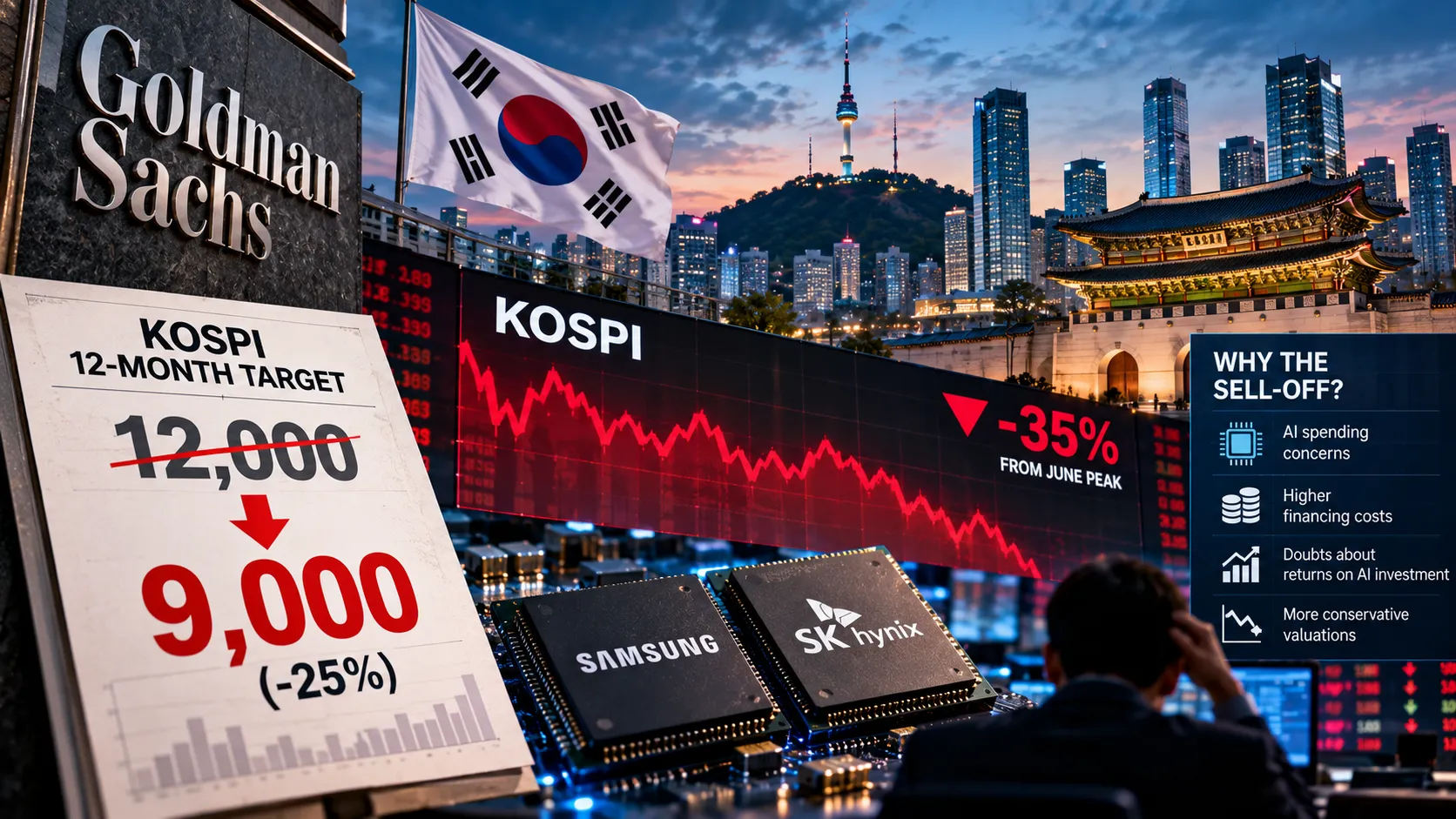
Goldman Sachs has cut its 12-month target for South Korea's Kospi by 25% to 9,000 from 12,000 after the index fell more than 35% from its June peak, but its strategists, including Timothy Moe, say the new target still implies more than 60% upside. The Kospi trades at about four times forward earnings, a level unseen across 18 major markets since 2006.

By Shaym Kumar · Author26 October 2026New
Goldman Sachs Cuts Its Kospi Target 25% to 9,000 but Says Korean Stocks Priced at Four Times Earnings Are the Cheapest Since 2006

Goldman Sachs has slashed its forecast for South Korean stocks after a dramatic collapse in the market, but the Wall Street bank is sticking to its view that Korean equities are deeply undervalued and poised for a strong rebound.

Goldman strategists, including Timothy Moe, cut their 12-month target for the benchmark Kospi index by 25% to 9,000 from 12,000, according to reports on October 25 and 26. The bank had raised its target to 12,000 in June and maintained it through the initial stages of a global sell-off in AI-related stocks.

Despite the cut, the new target implies more than 60% upside from current levels, a measure of how far the market has fallen.

A dramatic fall

The Kospi has fallen more than 35% from its June peak, one of the steepest declines for a major stock market in recent years. It fell a further 1.6% on Monday, October 26, and is down nearly 20% for October alone.

The sell-off has been driven by concerns about artificial intelligence. Korea's stock market is heavily weighted towards semiconductor companies, particularly Samsung Electronics and SK hynix, the world's two largest memory chip makers. Their shares surged earlier this year on booming demand for high-bandwidth memory used in AI data centres.

Goldman said the sell-off reflected heavy AI infrastructure spending, rising financing costs, doubts about returns on AI investment and more conservative equity valuations.

Cheapest in two decades

Goldman's central argument is valuation. The Kospi's 12-month forward price-to-earnings ratio is about four times, a level not seen across 18 major markets since 2006, according to the bank. Korean stocks now trade at roughly half the valuation of Indonesian equities.

"The market is pricing an excessively negative outlook for fundamentals into stock prices," Goldman said.

The bank estimated that current semiconductor stock prices imply a 65% drop in the sector's earnings in 2027, a scenario it described as overly pessimistic. Even companies outside the memory chip sector, which make up about half of the index, trade at a forward price-to-earnings ratio of about 7.6 times.

Where Goldman sees value

Goldman favours several themes in the Korean market: power and industrial companies, which benefit from investment in energy infrastructure and AI data centres; companies improving corporate governance; businesses that would benefit from a recovery in domestic demand; and companies riding the global spread of Korean popular culture, from music and television to cosmetics and food.

The governance theme reflects the Korean government's "Value-up" programme, which encourages companies to improve shareholder returns, increase dividends and buy back shares to address the so-called "Korea discount," the long-standing tendency for Korean stocks to trade at lower valuations than peers in other developed markets.
3a7b8ea2-0f70-4d2d-b55f-e7f3cf20aca1.png

The memory chip cycle

Memory chips are notoriously cyclical. Prices and profits can swing dramatically as supply and demand shift. During booms, chip makers invest heavily in new capacity, which can lead to oversupply and price collapses when demand slows.

The AI boom created exceptional demand for high-bandwidth memory, allowing Samsung and SK hynix to earn record profits. Investors now fear that a slowdown in AI spending could lead to a sharp downturn in memory prices, though Goldman's analysis suggests the market may be overestimating the severity of any decline.


“The market is pricing an excessively negative outlook for fundamentals into stock prices.”
— Goldman Sachs strategists

SK hynix reports third-quarter results on Wednesday, October 28, and is reportedly considering a special dividend of about 16 trillion won, roughly $12 billion, funded by gains from the sale of its stake in Japanese chipmaker Kioxia. The company said no decision has been made.

Lessons for investors

The Kospi's swing from a target of 12,000 to 9,000 within months illustrates how quickly sentiment can change in markets driven by a single theme. Investors who bought Korean stocks at the peak of the AI enthusiasm have suffered heavy losses.

At the same time, history suggests that buying when valuations are extremely low can be rewarding, if fundamentals eventually prove more resilient than feared. Goldman's call is essentially a bet that the market has overreacted.

What it means for India

For Indian investors, the Korean sell-off has implications for regional fund flows. Earlier this year, some global emerging market funds reduced exposure to India in favour of Korea and Taiwan, attracted by the AI-driven rally in chip stocks. With Korean stocks now much cheaper, those funds face a choice between buying the dip in Korea or rotating back towards markets such as India.

India has limited direct exposure to the memory chip cycle, but high oil prices remain a significant headwind for its markets. Foreign investors have withdrawn ₹48,056 crore from Indian equities in October.

Wider AI doubts

The Korean sell-off is part of a broader reassessment of AI investments. Apollo Global Management's chief economist argued in a recent note that AI has so far delivered "zero financial payoff" to companies outside the technology sector, adding to questions about whether massive AI spending will generate adequate returns.

How Goldman's call has evolved

Goldman's Kospi forecasts have swung with the market. In June, as Korean stocks soared on AI optimism, the bank raised its target to 12,000, a record outlook reflecting expectations of a prolonged semiconductor supercycle. The subsequent collapse has forced a reassessment, but the bank's core thesis, that Korean earnings power is underappreciated, remains intact.

Strategists across Wall Street have had to revise their views as AI-related volatility has whipsawed markets. Forecasting index levels a year ahead is inherently uncertain, and targets are best read as statements about the direction and drivers of returns rather than precise predictions.

What comes next

Goldman's revised forecast sets a benchmark for whether Korean stocks can recover. Key catalysts include earnings from Samsung and SK hynix, signs of continued AI investment by major technology companies, and progress on corporate governance reforms.

If memory chip demand holds up better than feared, Korean stocks could rebound sharply from current depressed valuations. But if AI spending slows significantly, the market could remain under pressure despite looking cheap, and investors will be watching each new data point for clues about which scenario is unfolding. Other global banks have also adjusted their views on Korean equities, and the divergence of opinions underscores the uncertainty. Some strategists remain cautious until there is clearer evidence that AI-related memory demand is stabilising, while others argue that valuations already discount a severe downturn in chip earnings.

TagsGoldman SachsKospiSouth Korea stocksTimothy MoeSamsung ElectronicsSK hynixmemory chipssemiconductorsAI stocksvaluationsprice to earningsemerging marketsKorea discountcorporate governanceValue-upK-cultureAsian marketsstock market crashAI spendinginvestors

Reader reviews

Sign in to rate and review this article.
Loading reviews…
