SAN FRANCISCO, Oct 8 — Google has launched an AI agent within Gemini that can plan and carry out work on behalf of users, beginning with businesses, as the race among technology giants to move from chatbots to autonomous digital assistants accelerates.
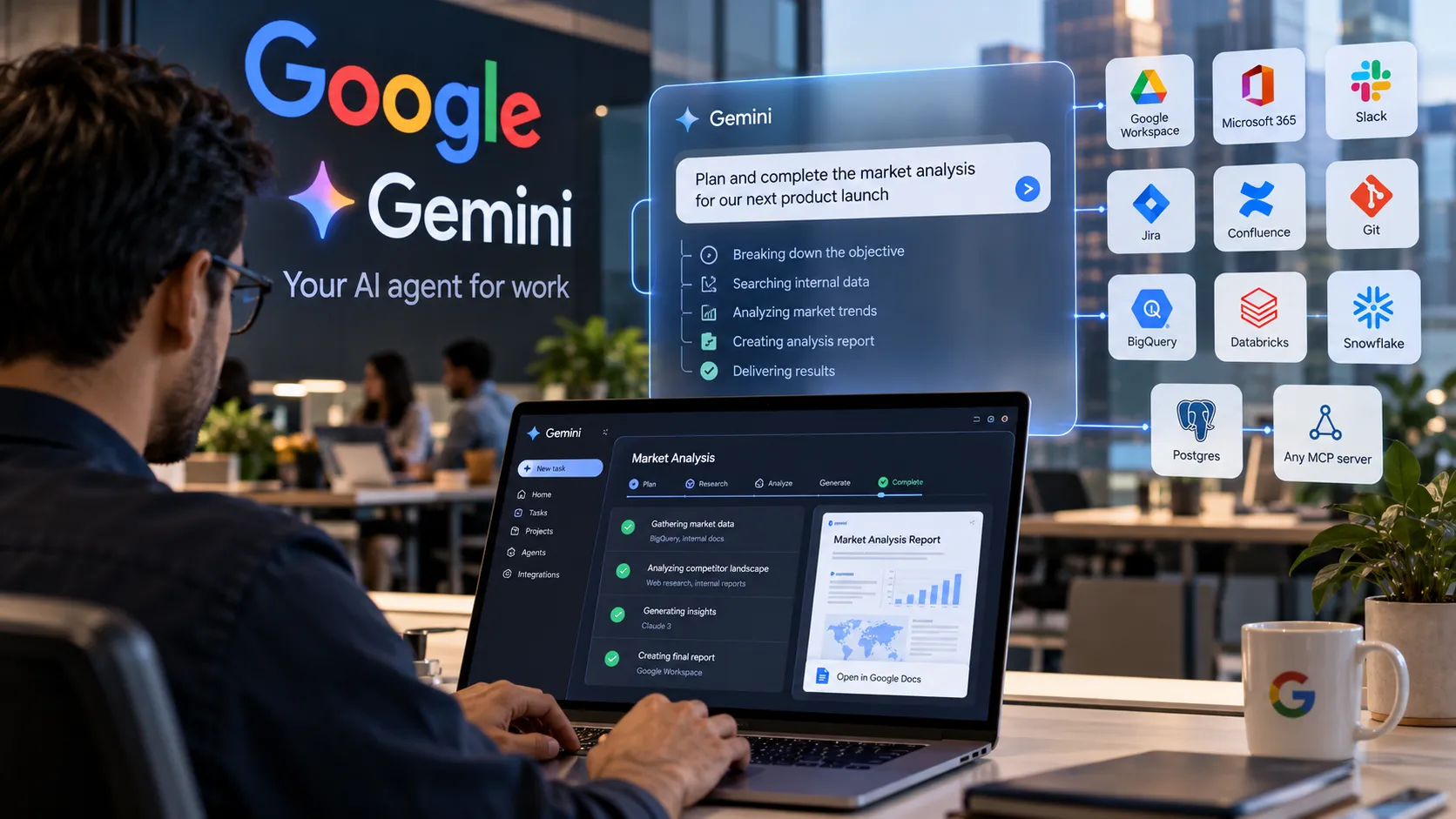
The agent, unveiled at a Google Cloud event on Thursday, provides a single interface through which employees can ask questions and assign tasks. Rather than simply responding to prompts, it can break down objectives into steps, use tools and skills, connect to a company's internal systems and complete work over time.
Google said it would roll out the agent to businesses first and bring it to consumers later. Chief executive Sundar Pichai said the enterprise-first approach allows the company to address "harder problems around security, scale, and performance" before a wider launch.
Key facts at a glance
• Launch: agentic AI in Gemini, unveiled at a Google Cloud event, businesses first
• Scale: more than 1 billion Gemini monthly active users; nearly 90% of Fortune 100 companies use Gemini Enterprise
• Models: automatic model selection, with third-party options starting with Anthropic's Claude
• Integrations: Google Workspace, Microsoft 365, Slack, Jira, Confluence, Git, BigQuery, Databricks, Postgres, Snowflake and any MCP server
• Identity: the agent gets its own Workspace account and an attributed audit trail
• Cost controls: multi-model orchestration, smart routing, real-time spend caps
• Early testers: On, Shopify, PayPal
Scale behind the launch
Google is building from a large base. Pichai said Gemini now has more than 1 billion monthly active users, and that nearly 90% of Fortune 100 companies use Gemini Enterprise, the company's AI offering for businesses.
That reach gives Google a significant advantage in distributing agentic capabilities. Many large companies already use Google Workspace for email, documents and collaboration, and Google Cloud for data and infrastructure. An agent that works across those tools — and with competitors' products — could quickly become part of everyday workflows.
Objectives, not instructions
Thomas Kurian, chief executive of Google Cloud, said users can give the agent "objectives, not just instructions". In practice, that means an employee could ask the agent to prepare a market analysis, organise a project or resolve a customer issue, and the agent would plan the necessary steps, gather information from relevant systems and produce the output.
By default, the agent selects the most suitable AI model for each task. Users can also choose models manually, including third-party models — starting with Anthropic's Claude — with plans to add open-source and other private models later. That flexibility reflects a recognition that enterprises increasingly want to use different models for different jobs rather than committing to a single provider.
Users can attach files, folders and project collections that combine documents and skills. A "tasks inbox" shows the agent's reasoning, how it delegates work to sub-agents, which skills it loads, the code it runs and its progress — an important feature for businesses that need to understand and verify what AI systems are doing.
Connected to the enterprise
The agent integrates with a broad set of business tools, including Google Workspace, Microsoft 365, Slack, Jira, Confluence, Git, BigQuery, Databricks, Postgres and Snowflake. It can also connect securely to any server using the Model Context Protocol (MCP), an open standard for linking AI systems to data sources and tools, whether those servers sit inside or outside a company's network.
Support for Microsoft 365 and Slack is significant. It signals that Google is designing the agent to work in mixed technology environments rather than only within its own ecosystem — a pragmatic choice given how many enterprises use tools from multiple vendors.
The agent is available across iOS, Android, Windows and Mac, through a command-line interface, and inside Google Workspace, Microsoft 365, ServiceNow and Slack.
An AI colleague with its own identity
One of the more striking features is that the agent receives its own Workspace account, complete with an email address and its own context. It understands team membership, time zones, approvers and calendar commitments. Employees can bring it into work by tagging it, emailing it, sharing content with it or adding it to a group chat.
Crucially, its actions are recorded in an audit trail attributed to the agent rather than to a human user. For businesses concerned about accountability and compliance, that distinction matters: it allows organisations to track what the AI did, when and on whose behalf.
Managing cost and risk
Google also introduced flexible spending controls, including multi-model orchestration, smart routing and real-time spending caps, to help businesses manage the cost of running AI agents. As companies deploy agents more widely, compute costs can rise quickly, and finance teams want predictability.
Early testers include sportswear brand On, Shopify and PayPal. Gemini Enterprise customers named by Google include BNP Paribas, Bradesco, Merck, Orange Spain, Santee Cooper, SOMPO, Ulta Beauty and Wesfarmers.
The enterprise-first logic
Launching with businesses first also gives Google a clearer route to revenue. Enterprises are more willing than consumers to pay for productivity gains, and they provide structured environments — defined teams, approval chains and permission systems — in which agents can be deployed with guardrails. Lessons learned in those settings around reliability, security and cost control can then shape the consumer version, where the range of tasks and the expectations of users are far broader.
A crowded agent market
Google's launch comes amid a wave of agent releases across the industry, including Meta's Muse, messaging-based agents such as Instinct, and ChatGPT's recently launched Dots. Each company is betting that the next phase of AI will be defined not by conversations but by delegated work — writing code, scheduling meetings, booking travel and managing business processes.
Google did not disclose pricing, a specific date for general availability or a timeline for the consumer rollout.
For enterprises in India — where Google has a large customer base and where IT services companies are building AI practices for global clients — the launch raises both opportunities and questions. Agents that automate knowledge work could boost productivity, but they also challenge business models built on large teams performing routine tasks. For leaders across the global Indian diaspora working in technology, the shift from AI assistants to AI colleagues is no longer theoretical. It is arriving in the tools they use every day.