Google is preparing to put artificial intelligence chips into orbit. The company's first Project Suncatcher satellite, a refrigerator-sized prototype named MVP, is scheduled to launch on 1 October 2026 aboard a SpaceX Falcon 9 rocket from Vandenberg Space Force Base in California, as part of the Transporter-18 rideshare mission.
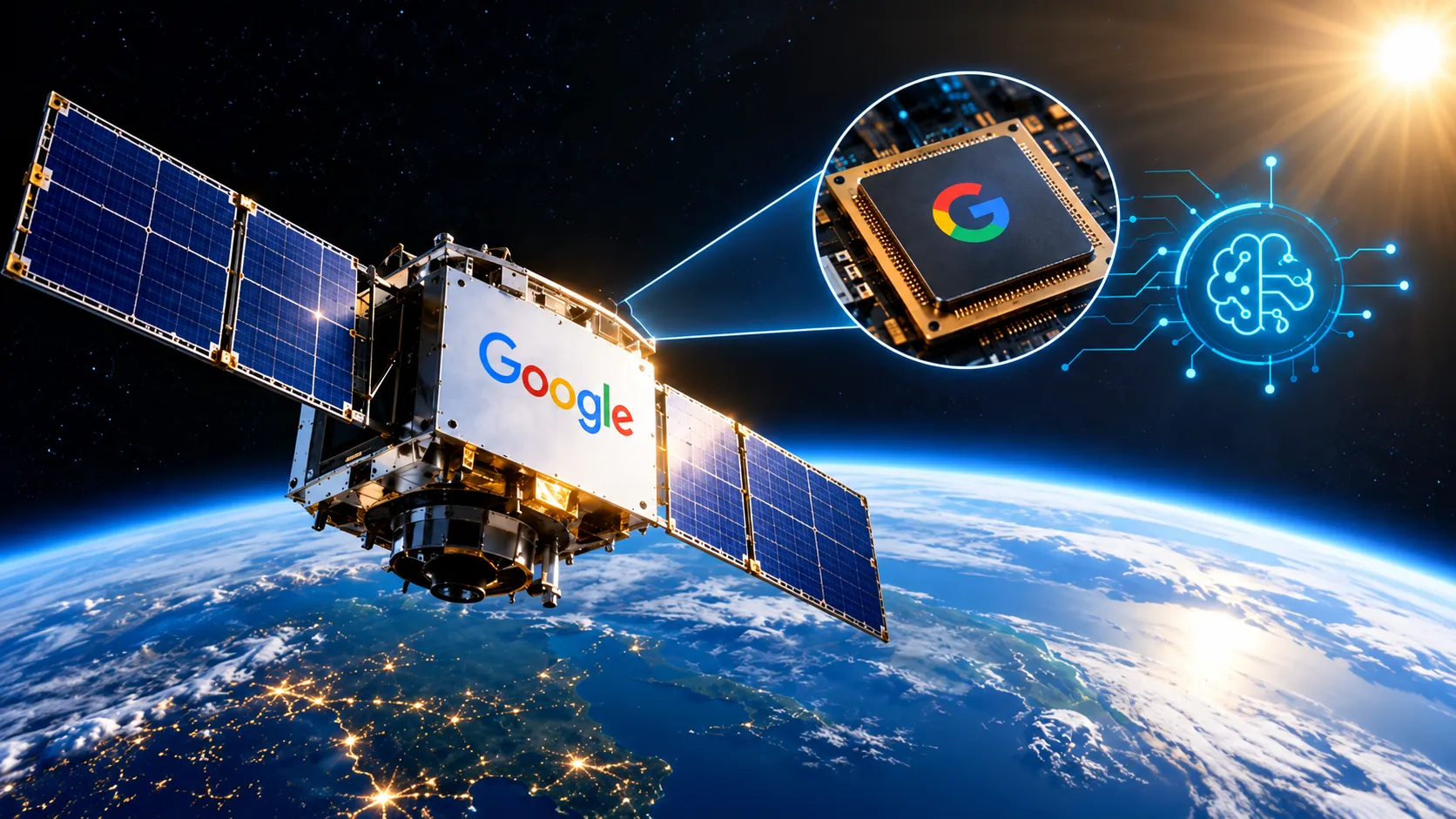
The spacecraft carries four of Google's Trillium-generation tensor processing units (TPUs), the custom chips the company uses to train and run its AI models. They will be powered by solar arrays rated at about 1 kilowatt. The computing power on board is roughly equivalent to a single standard Google Cloud TPU v6e-4 slice, about the same as one server in a conventional data centre.
The mission is deliberately modest. Its purpose is not to provide useful computing capacity, but to test whether commercial AI chips can survive and operate in space.
Why put a data centre in space
The idea behind Project Suncatcher is driven by the enormous and growing energy demands of AI. Data centres that train and run large AI models consume vast amounts of electricity, and technology companies are struggling to secure enough power and grid connections on Earth to meet demand.
In orbit, solar panels can generate power almost continuously in the right orbits, without clouds or night-time interruptions, and at higher intensity than on the ground. Space also offers effectively unlimited room for expansion, without competing for land or local electricity supplies.
Google's long-term design envisions clusters of 81 satellites flying in close formation within a one-kilometre radius at an altitude of about 650 kilometres, linked together by free-space laser communications to function as a single computing system.
The engineering challenges
Space is a hostile environment for electronics, and the October mission is designed to test three major challenges.
The first is launch. Google says a trip to low Earth orbit brings sustained acceleration loads of up to 10 times the force of gravity on the spacecraft, and that individual components can experience even greater forces of 50 to 100 g.
The second is radiation. Outside the protection of Earth's atmosphere, electronics are exposed to charged particles that can corrupt data or damage chips over time. Google says its Trillium TPUs survived a dose in a proton beam test greater than what a five-year space mission would deliver, an encouraging result for commercial silicon that was not designed for space.
The third is heat. In the vacuum of space there is no air to carry heat away, so chips must be cooled using heat pipes and radiators that dissipate heat as infrared radiation. Managing heat from power-hungry AI chips is one of the hardest problems for any orbital data centre.
"This first launch is about seeing what works, identifying points of failure, and applying those findings to future missions," Google said.
Built with Planet Labs
The satellite was built in partnership with Planet Labs, the Earth-imaging company that operates one of the world's largest fleets of satellites. Planet provides the spacecraft platform, while Google supplies the computing payload.
The next step is planned for 2027, when Google says it will fly a pair of TPU satellites with Planet to test the high-bandwidth laser links between spacecraft that any real orbital computing cluster will depend on.
The economics are still uncertain
The biggest question is cost. For orbital data centres to compete with those on the ground, the cost of launching hardware into space must fall dramatically. Analyses of Google's design suggest launch prices would need to reach around $200 per kilogram, compared with roughly $1,500 to $2,900 per kilogram today.
That depends on fully reusable heavy-lift rockets, such as SpaceX's Starship, achieving low costs at high launch frequency. Analysts at research firm Futurum have estimated that orbital computing could address a very large market by the 2030s if launch costs collapse, but the timeline remains highly uncertain.
Other technical constraints may also limit early usefulness. Some analysts have questioned how much useful computing can be done in short bursts while satellites move through different lighting and thermal conditions, and how reliably hardware can be maintained or replaced when it fails in orbit.
Google itself has framed Suncatcher as a long-term research bet, with the team expecting years before the project could move from experiment to product.
What success would look like
For the MVP mission, success will be measured in simple terms: whether the TPUs power up in orbit, whether they can run AI workloads, how often radiation causes errors, and how well the thermal system keeps the chips within safe temperatures. Each of these data points will feed into the design of the next generation of satellites. Even failures will be informative, showing engineers which components need hardening or redesign before Google attempts the far more complex task of linking multiple satellites into a working cluster.
A race in orbit
Google is not alone. SpaceX has filed plans for a very large constellation of computing satellites, and several startups are developing orbital data centre concepts. The fact that Google's own prototype is flying on a SpaceX rocket illustrates the unusual relationships in the new space economy, where companies can be partners and competitors at the same time.
The same Transporter-18 mission is also due to carry two reentry capsules from Varda Space Industries, which raised $251 million on 30 September to manufacture pharmaceuticals in orbit. Together, the payloads show how space is increasingly being treated as an extension of terrestrial industries, from computing to drug manufacturing.
Why it matters
The AI industry's demand for power is reshaping energy markets on Earth. Technology companies are signing deals for wind, solar, nuclear and natural gas, and building data centres wherever they can find electricity. Project Suncatcher is a reminder that some of the largest companies are now looking beyond the planet for solutions.
For India and other countries investing in space capabilities, including commercial launch and satellite manufacturing, the emergence of orbital computing could open new opportunities in a future space-based infrastructure market.
Whether the MVP satellite's four TPUs survive and function as hoped will be known only after launch and in-orbit testing. Even a partial success would provide valuable data. Project Suncatcher's first flight is small, but it marks the beginning of a serious attempt to test whether the future of AI computing might, one day, be found in orbit.


