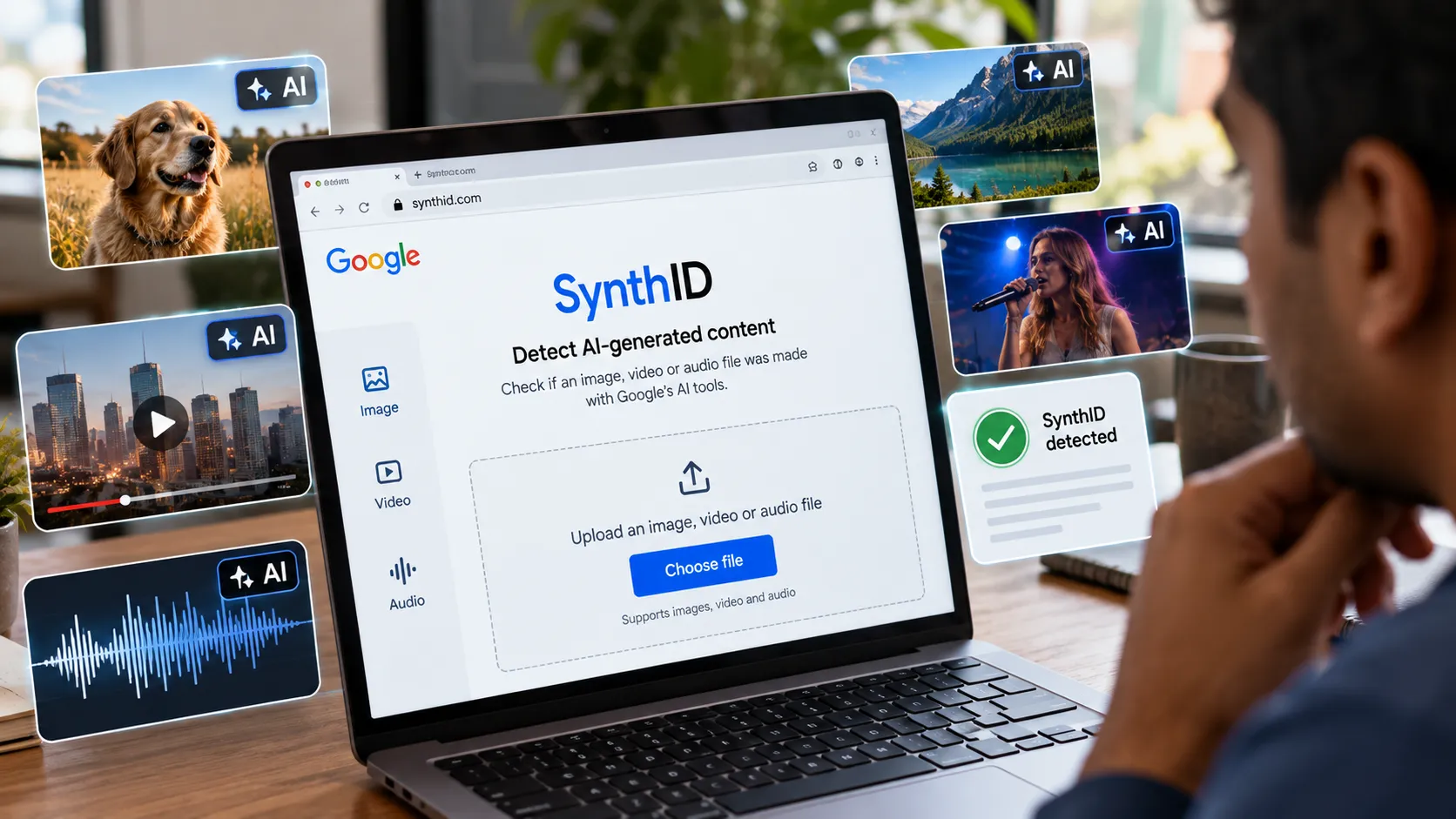
Google has opened a public website where anyone can check whether an image, video or audio clip was generated with AI, widening access to a detection tool that until now sat mostly in the hands of journalists, media professionals and researchers.
The site, synthid.com, went live on Tuesday, 6 October, TechCrunch reported. It looks for SynthID, the invisible watermark that Google introduced in 2023 and embeds in content from its generative AI tools. Google first made the detector available to a select group of testers at its I/O developer conference in 2025.
Google said people currently make about one million verification requests a day. The new site extends that checking to anyone with a browser, at a time when convincing synthetic images, cloned voices and video are spreading faster than most platforms can label them.
What the site can and cannot check
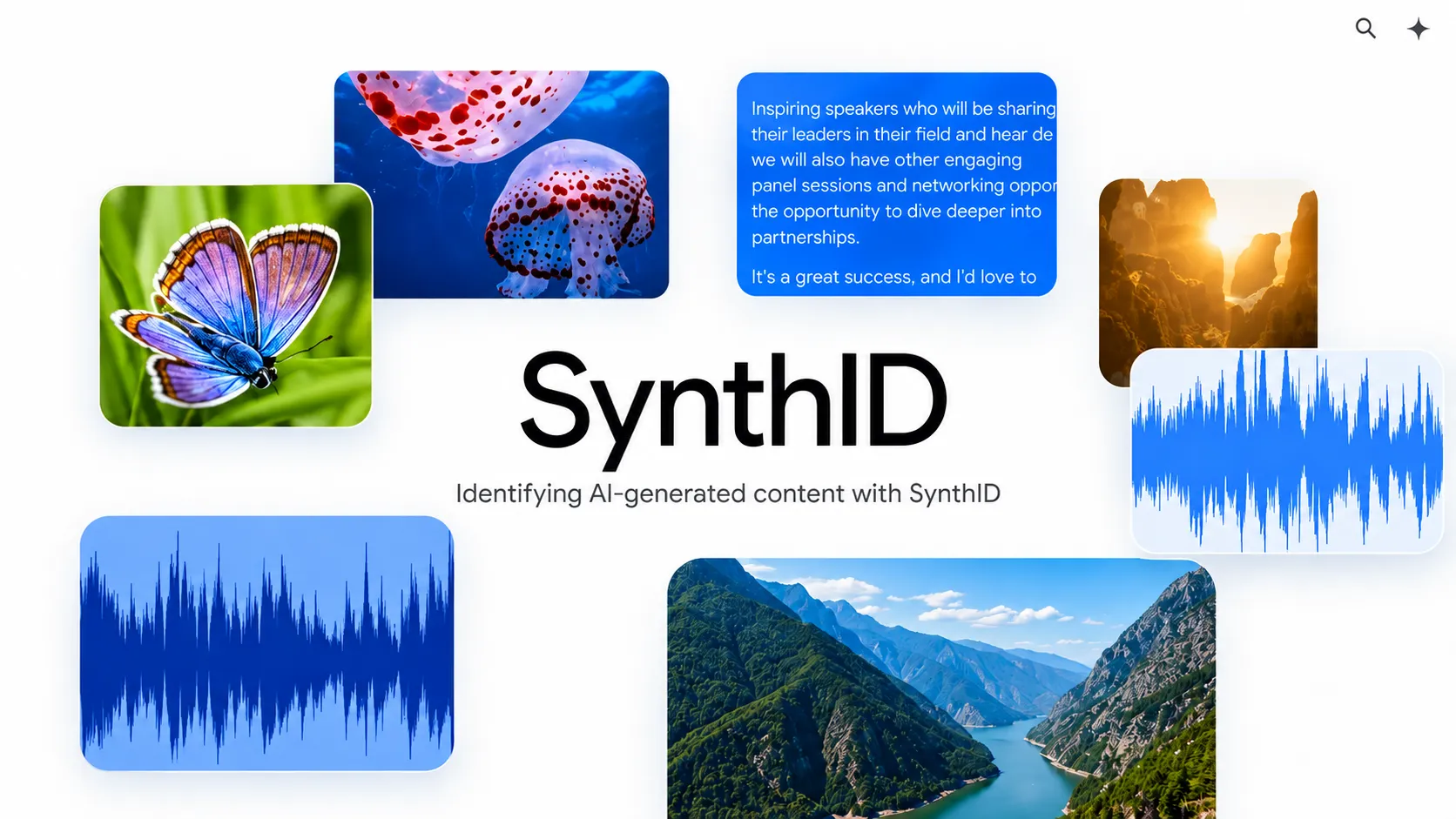
The website accepts a broad range of file types. For images, it supports JPG, JPEG, PNG, BMP, WEBP, AVIF, HEIC, HEIF, TIFF and GIF; for video, MP4, MOV and WEBM; and for audio, WAV, MP3, OGG, FLAC, AAC and M4A, according to TechCrunch.
Its central limitation is that it can only find SynthID watermarks. Google's own models and products apply them, including the Nano Banana image model, the Veo video model, the Lyria music model, and apps such as Gemini, Flow, ProducerAI and Vids. Content made with a tool that does not use SynthID will not carry the mark.
Google's help pages for the equivalent check inside the Gemini app spell out what that means in practice. A result showing SynthID was detected means Google's AI made or edited all or part of the file. A result showing no SynthID means Google's AI did not make or edit it, although another AI system might have. Unclear results can occur with very simple or abstract content, or when edits are too small to carry a watermark.
The watermark is built to be durable. Google says it usually survives resizing, recolouring and compression, but may go undetected after many alterations. For video, Gemini identifies which segments carry the watermark, though it may not run through every frame of those segments.
The Gemini version of the check also gives a sense of how Google meters the service. According to its help pages, users verify one file at a time; images and videos must be 100MB or smaller, videos must run under 90 seconds and audio under an hour. Within any rolling 24-hour period, a user gets roughly 10 image checks, 10 video checks and 10 audio checks. Google has not published comparable limits for the new website.
Watermarking and provenance records do different jobs. SynthID is embedded in the content itself and is meant to persist when a file is copied or re-saved. Content Credentials, by contrast, are attached records showing where a file came from and how it was edited, and they apply to camera images as well as AI output. Google's help pages caution that Content Credentials do not definitively prove a file is AI-generated; they offer context to help users judge.
Google has also built verification into existing products. The check is integrated into the Gemini app and Google Chrome. At I/O in May 2026, Google said users could ask whether an image was AI-made through Lens, AI Mode and Circle to Search, and that Gemini would verify C2PA Content Credentials, an industry provenance standard that records a file's origin and edit history, the technology site Wwwhatsnew reported.
A watermark rivals are adopting
SynthID's reach now extends beyond Google. OpenAI, Nvidia and Kakao support the watermark, TechCrunch reported, and Apple is reportedly adding support soon. At I/O in May, Google said OpenAI, Kakao and ElevenLabs would use SynthID to label content from their own models, a notable step given that all three compete with Google in generative AI.
Those I/O announcements were presented by Laurie Richardson, Google's vice-president of trust and safety, and Pushmeet Kohli, according to Wwwhatsnew. The public website is the next step in that programme: the earlier detector was a gated portal for professionals, while synthid.com is open to anyone.
Google also gave a sense of scale at that event, saying SynthID had watermarked more than 100 billion images and videos and more than 60,000 years of audio since its launch, and that the detector in the Gemini app had been used 50 million times.
Adoption is what gives a watermark its value. If most leading image and video generators embed SynthID, a single check covers a large share of the synthetic media in circulation. If major producers stay outside the system, a clean result tells a user very little.
Competing systems remain. Microsoft and Meta run their own watermarking and verification tools, and OpenAI operates its own content-verification site. TechCrunch noted that such tools are not infallible and often fail to identify content made by their own companies' models, citing a July 2026 Reuters report on Meta's detector.
Text is a separate matter. In October 2024, Google DeepMind open-sourced its SynthID Text watermarking tool for developers, and Digital Trends reported at the time that the text watermark could be weakened by heavy rewriting or translation and was less effective on short passages. The new website, as TechCrunch described it, covers images, video and audio rather than text.
Why it matters for India
The launch comes as India tightens its rules on synthetic media. Amendments to the IT Rules notified by the Ministry of Electronics and Information Technology on 10 February 2026, and in force from 20 February, require permitted synthetically generated content to be prominently labelled and to carry permanent metadata or provenance markers, according to an analysis by law firm Hogan Lovells. Platforms may not allow those markers to be altered, hidden or removed.
The same amendments require significant social media intermediaries, those with more than five million registered users in India, to ask users to declare whether content is synthetic, verify those declarations and label confirmed material. Government or court takedown orders must now be acted on within three hours, down from 36.
A public website does not by itself satisfy those obligations, but it gives Indian platforms, newsrooms, fact-checkers and ordinary users a free way to test suspect files against one of the most widely deployed AI watermarks, which by Google's account now spans its own tools and those of several rivals.
The caveat is one Google itself spells out. A SynthID check can confirm that Google's tools, or a partner's, touched a file, but a negative result is not proof that a person made it. Until watermarking and provenance standards are close to universal, detection will remain one input among several, alongside reverse image searches, metadata checks and old-fashioned reporting.