FundingMarket Data Women5 MIN READ

Grasim Swings to a ₹234 Crore Q2 Loss on a ₹767 Crore Charge for Its Idled Canadian Pulp Mill, Even as Revenue Climbs 26% to ₹50,105 Crore

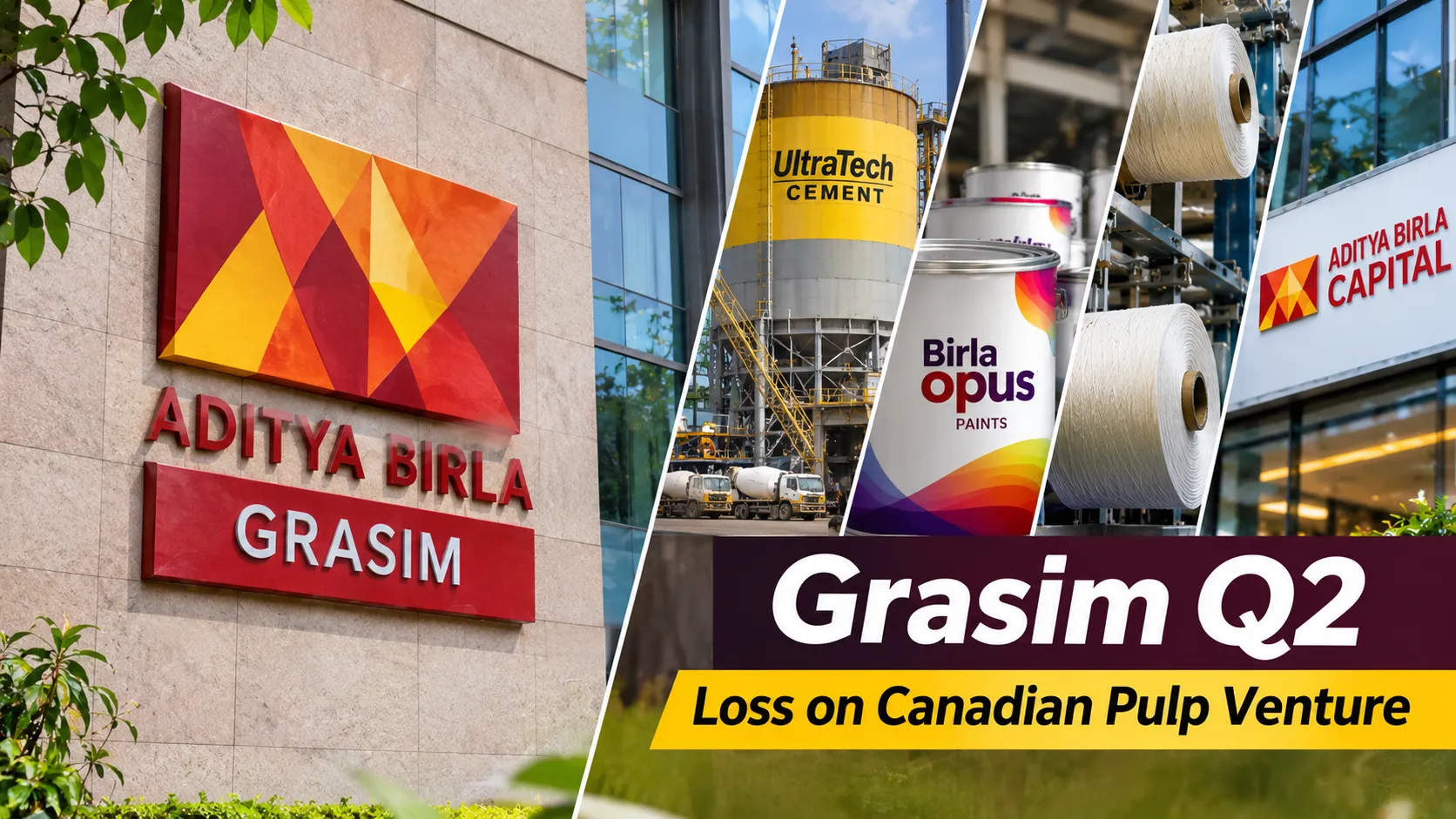
Aditya Birla Group flagship Grasim Industries reported a consolidated net loss of ₹234 crore for the September quarter on November 13, against a ₹595 crore profit a year earlier, after booking a ₹767 crore charge for its Canadian pulp joint venture, which has idled its mill in New Brunswick. Revenue rose 26% to ₹50,105 crore and EBITDA rose 25% to ₹6,513 crore, while standalone profit nearly tripled.

By Shaym Kumar · Author14 November 2026New
Grasim Swings to a ₹234 Crore Q2 Loss on a ₹767 Crore Charge for Its Idled Canadian Pulp Mill, Even as Revenue Climbs 26% to ₹50,105 Crore

Grasim Industries, the flagship of the Aditya Birla Group and one of India's largest conglomerates, reported a quarterly loss, but the red ink stems from a troubled overseas investment rather than weakness in its core Indian businesses.

The company reported a consolidated net loss of ₹234 crore for the July-September quarter, the second quarter of the 2026-27 financial year, compared with a profit of ₹595 crore a year earlier, according to results announced on Friday, November 13, as reported by HDFC Sky, Upstox and the Free Press Journal.

Consolidated revenue from operations rose 26% to ₹50,105 crore, and EBITDA rose 25% to ₹6,513 crore, according to HDFC Sky.

The Canadian pulp problem

The loss was caused by a one-time charge related to AV Group NB Inc, Grasim's pulp joint venture in Canada. The company booked a charge of ₹766.7 crore at the consolidated level, covering impairment of its investment and provisions for estimated exposure in the venture, according to HDFC Sky. At the standalone level, the exceptional charge was ₹825 crore, according to Apparel Resources.

The joint venture has temporarily idled its dissolving grade pulp mill in Nackawic, New Brunswick, citing "continuing challenges, prevailing market conditions and broader macroeconomic factors," according to HDFC Sky.

Dissolving grade pulp is a key raw material for viscose staple fibre (VSF), the man-made fibre that is one of Grasim's core businesses. The Aditya Birla Group has invested in pulp mills abroad to secure supplies of this raw material.

Standalone profit soars

Grasim's standalone results, which exclude subsidiaries such as UltraTech Cement and Aditya Birla Capital, were much stronger. Standalone net profit rose 187% to ₹2,306 crore from ₹805 crore, and revenue rose 33% to ₹12,747 crore, according to Apparel Resources. Standalone EBITDA rose 158% to ₹4,615 crore, and adjusted profit before exceptional items rose 289% to ₹3,132 crore.

Some data providers reported different standalone figures. MarketsMojo, for example, cited an unusually high effective tax rate of 61.82% and a standalone profit of ₹961.58 crore, so investors should consult the company's filings for the definitive numbers.

Building materials lead growth

Grasim's building materials segment, which includes cement through UltraTech, paints through Birla Opus and its B2B e-commerce platform Birla Pivot, reported revenue of ₹27,378 crore, up 23%, according to HDFC Sky. Growth was led by cement, paints and B2B e-commerce.

UltraTech Cement, India's largest cement maker, is Grasim's most valuable subsidiary. Cement demand has been supported by government infrastructure spending and housing construction.

The paints bet

Birla Opus, Grasim's paints business launched in 2024, is one of the most closely watched new ventures in Indian business. The Aditya Birla Group has invested heavily to challenge Asian Paints, Berger Paints and other established players in India's decorative paints market. Birla Opus has been gaining market share, though building a paints business requires substantial investment in manufacturing, distribution and marketing before it becomes profitable.

The entry of Birla Opus, along with JSW Paints and others, has intensified competition and put pressure on prices and margins across the industry.

Fibres recover

The cellulosic fibres segment, which includes VSF, reported revenue of ₹5,344 crore, up 29%, driven by volume growth, a better product mix and stable domestic prices, according to HDFC Sky. VSF is used in textiles as a sustainable alternative to cotton and polyester, and Grasim is one of the world's largest producers.

“Strip out the Canadian write-down and Grasim's quarter was one of broad-based growth.”
— TIGI Markets Desk

Financial services

Grasim also holds a significant stake in Aditya Birla Capital, the group's financial services business, which includes lending, insurance and asset management. Financial services contributed to EBITDA growth, according to HDFC Sky.

Cost pressures

Not all trends were positive. Total expenses rose 24% to ₹47,037.72 crore, and the cost of materials consumed rose 29% to ₹9,761.62 crore, faster than revenue, according to HDFC Sky. If material costs continue to rise faster than revenue, margins could come under pressure.

Market reaction

Grasim's shares fell 2.6% to ₹3,034, according to HDFC Sky. Investors may be concerned about the Canadian write-down and the possibility of further charges related to the pulp venture.

f3fe93c0-4b60-40af-897e-394068a8a753.png

The conglomerate model

Grasim's structure as a holding company with stakes in large listed subsidiaries, including UltraTech and Aditya Birla Capital, alongside its own businesses, makes its consolidated results complex. Analysts often value Grasim on a sum-of-the-parts basis, adding the value of its stakes in listed subsidiaries to the value of its own businesses, and applying a holding company discount.

What it means for investors

For investors, the key question is whether the Canadian pulp problem is a one-time issue or the start of a longer drag. The idling of the Nackawic mill suggests the venture faces serious difficulties. At the same time, Grasim's core businesses, including cement, paints and fibres, are growing strongly.

Why the pulp mill was idled

Pulp is a global commodity whose price depends on supply and demand across many markets, and it has faced weak prices as new capacity has come online in South America and demand has softened. Mills with higher costs, such as those in regions with expensive wood and energy, can struggle to compete when prices fall, forcing owners to cut production or close facilities.

Impairment charges like Grasim's are accounting adjustments that reduce the book value of assets to reflect lower expected future cash flows. They do not directly involve a cash outflow in the quarter, but they signal that management expects the asset to earn less than previously assumed.

Capital allocation questions

Grasim's large investments in paints, building materials and financial services have raised questions among some investors about how the conglomerate allocates capital. Supporters argue that the group is using cash from mature businesses to build new growth engines. Critics say that holding-company structures can obscure performance and that shareholders might prefer to own individual businesses directly.

The performance of the paints business, which faces strong incumbents, will be a key test of the strategy in the coming years.

Grasim's management has said it will continue to review options for the Canadian operations. Investors will look for clarity on whether the mill will be restarted, sold or permanently closed, since each outcome has different implications for future costs, cash flows and the company's balance sheet.

What comes next

Investors will watch for updates on the Canadian pulp venture, the market share and profitability of Birla Opus, and demand for cement and fibres. Grasim's ability to manage its diverse portfolio while investing in new growth businesses will determine its performance in the coming quarters.

TagsGrasim IndustriesAditya Birla GroupKumar Mangalam BirlaQ2 FY27 resultsUltraTech CementBirla Opuspaintsviscose staple fibrecellulosic fibreschemicalsAV GroupNackawicpulpimpairmentbuilding materialsB2B e-commerceAditya Birla CapitalIndian stocksconglomerateinvestors

Reader reviews

Sign in to rate and review this article.
Loading reviews…