FundingMarket Data Women5 MIN READ

Gulf Oil Lubricants' Revenue Jumps 44% to ₹1,379 Crore and Profit Rises 34% as Lubricant Volumes Grow 16%

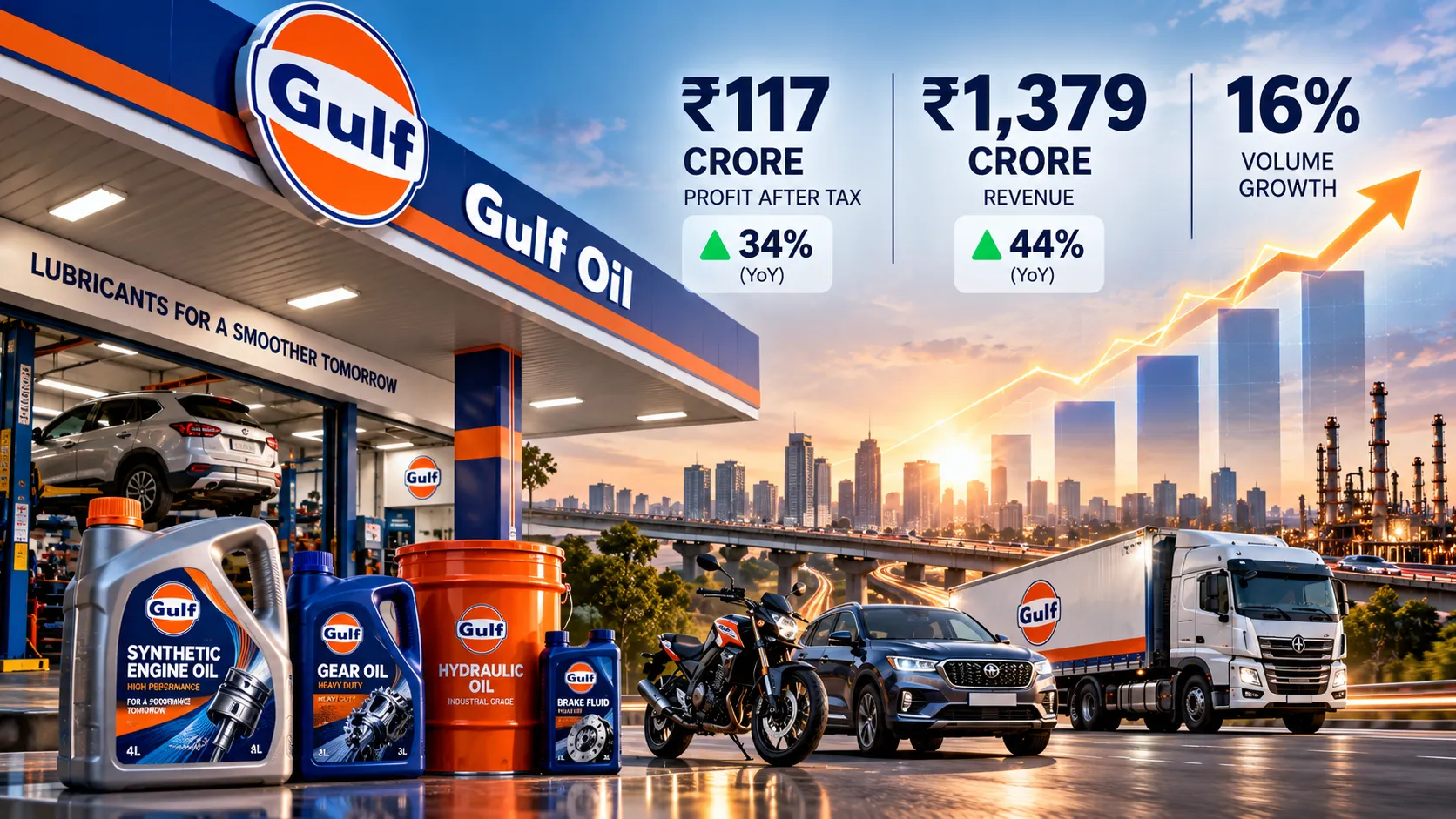
Gulf Oil Lubricants India reported standalone profit after tax of ₹117 crore for the September quarter, up 34% from ₹87 crore, as revenue rose 44% to ₹1,379 crore and lubricant volumes grew 16%. First-half revenue climbed 38% to ₹2,700 crore and net profit 33% to ₹245 crore, as the Hinduja Group company gained share in a market squeezed by crude costs.

By Shaym Kumar · Author29 October 2026New
Gulf Oil Lubricants' Revenue Jumps 44% to ₹1,379 Crore and Profit Rises 34% as Lubricant Volumes Grow 16%

While many Indian companies are struggling with high crude oil prices, a lubricants maker has delivered strong growth by expanding volumes and passing on higher costs.

Gulf Oil Lubricants India reported standalone profit after tax of ₹117 crore for the July-September quarter, up 34% from ₹87 crore a year earlier, according to Upstox on Thursday, October 29. Revenue rose 44% to ₹1,379 crore from ₹957 crore.

For the first half of the financial year, revenue rose 38% to ₹2,700 crore from ₹1,953 crore, and net profit rose 33% to ₹245 crore from ₹184 crore. Lubricant volumes grew 16%.

Strong volume growth

Volume growth of 16% is significant in a mature market where overall lubricant demand typically grows at low single-digit rates. It suggests that Gulf Oil is gaining market share from competitors.

Revenue growth of 44%, well ahead of volume growth, indicates that higher prices also contributed. Lubricant makers raise prices to pass on higher costs of base oil and additives, which are derived from crude oil. With Brent crude trading above $100 a barrel for much of the autumn, lubricant prices have risen.

The Hinduja connection

Gulf Oil Lubricants India is part of the Hinduja Group, which owns the Gulf Oil brand in many markets around the world. The Indian company manufactures and sells engine oils, transmission fluids, greases and other lubricants for motorcycles, cars, commercial vehicles, tractors and industrial applications.

Its brand is well known among motorcycle owners and truck drivers, and it has built a large distribution network reaching mechanics, workshops and retailers across India.

The lubricants market

India's lubricant market is one of the largest in the world, driven by its huge fleet of two-wheelers, commercial vehicles and tractors. The market includes multinational companies such as Castrol India and Shell, state-owned oil companies such as Indian Oil (Servo), Hindustan Petroleum and Bharat Petroleum, and private players such as Gulf Oil.

Competition is intense, and brand loyalty among mechanics and vehicle owners is important. Companies invest heavily in marketing, including sponsorship of sports such as cricket, and in relationships with mechanics who often recommend lubricant brands to vehicle owners.
a24d792b-7662-433a-9d03-2adcbd29c3d9.png

Benefiting from auto demand

Gulf Oil's results reflect strong demand in India's automobile sector. Two-wheeler makers such as Hero MotoCorp have reported strong dispatches, and passenger vehicle sales have reached record levels. A growing fleet of vehicles drives demand for lubricants, both from new vehicle manufacturers and from the aftermarket for servicing.

The EV challenge

The shift to electric vehicles poses a long-term challenge for lubricant makers, since electric vehicles do not need engine oil. However, they still require some lubricants, coolants and greases. Gulf Oil has been diversifying into adjacent businesses, including electric vehicle charging infrastructure and products for electric vehicles, to prepare for the transition.

In India, the transition to electric vehicles is still at an early stage for most vehicle categories, so conventional lubricant demand is expected to remain strong for years. Two-wheelers and three-wheelers are electrifying faster than cars and trucks.

Margin management

Managing margins in a period of volatile crude prices is a key challenge for lubricant makers. When base oil prices rise sharply, companies must raise prices quickly to protect margins, but this can affect demand if prices rise too much. Gulf Oil's ability to grow profit by 34% suggests it has managed this balance well during the quarter.


“In lubricants, brands that can grow volumes while passing on crude-driven costs are winning share.”
— TIGI Markets Desk

What it means for investors

For investors, Gulf Oil's results highlight a company gaining market share in a large, steady market while managing cost pressures. Its strong volume growth and pricing power are positive signals, though the long-term impact of electric vehicles remains a consideration.

Brand building and sponsorships

Lubricant brands rely heavily on visibility and trust, since most consumers cannot judge the quality of engine oil directly. Gulf Oil has invested in brand building through sports sponsorships, including cricket, and celebrity endorsements, aiming to make its brand familiar to vehicle owners across India. It has also built relationships with mechanics through loyalty programmes, as mechanics strongly influence which brand of oil a vehicle owner uses.

Gulf Oil has also expanded its partnerships with vehicle manufacturers, supplying lubricants that are filled in new vehicles at the factory. Such partnerships can boost brand recognition and aftermarket sales, as vehicle owners often continue using the oil recommended by the manufacturer.

Industrial and B2B demand

Beyond automotive lubricants, Gulf Oil supplies lubricants for industrial applications, including manufacturing, construction, mining and power generation. Industrial demand is linked to economic activity, infrastructure spending and manufacturing output. India's infrastructure push, including roads, railways and ports, supports demand for lubricants used in construction equipment and heavy machinery.

Competitive landscape

Castrol India, the market leader in automotive lubricants, has also faced high crude-linked costs. State-owned oil companies have large market shares, particularly in industrial lubricants and through their extensive retail networks. Gulf Oil's growth in volumes ahead of the market suggests it is winning share from both multinational and state-owned competitors.

What comes next

Gulf Oil's performance in the coming quarters will depend on crude oil prices, automobile demand and its success in gaining market share. The company's investments in electric vehicle-related businesses will also be watched as it prepares for the gradual shift away from internal combustion engines.

Investor checklist

Investors will track several indicators in Gulf Oil's coming results: lubricant volume growth relative to the overall market, gross margins as base oil prices move, the performance of its newer businesses and its ability to maintain pricing power. The company's strong first half, with revenue up 38% and net profit up 33%, gives it a solid base going into the second half of the financial year, which includes the festive and post-harvest seasons when vehicle use and servicing typically rise.

Crude oil prices remain the biggest external variable. A sustained fall in crude would ease input costs and could widen margins, while further spikes caused by conflict in the Middle East could squeeze them again.

For investors in Indian consumer and industrial companies more broadly, Gulf Oil's results offer an example of a mid-sized company that has managed to grow strongly despite one of the most challenging cost environments in recent years. Its performance suggests that well-managed brands with strong distribution can continue to gain ground even when larger competitors face pressure. Whether that momentum can continue through the rest of the year will depend on both its execution and on how the oil market evolves.

TagsGulf Oil LubricantsHinduja Grouplubricantsengine oilQ2 resultsautomotive aftermarketCastrol Indiacrude oilbase oilEV chargingcommercial vehiclestwo-wheelersmotorcycle oilIndian automobile industrymid-cap stocksoil pricesdistributionrural demandIndian stocksinvestors

Reader reviews

Sign in to rate and review this article.
Loading reviews…
