StartupsLatest5 MIN READ

Seoul's Gwanak Research Institute Raises ₩300 Million to Turn Banks' Messy Data Into AI Decisions

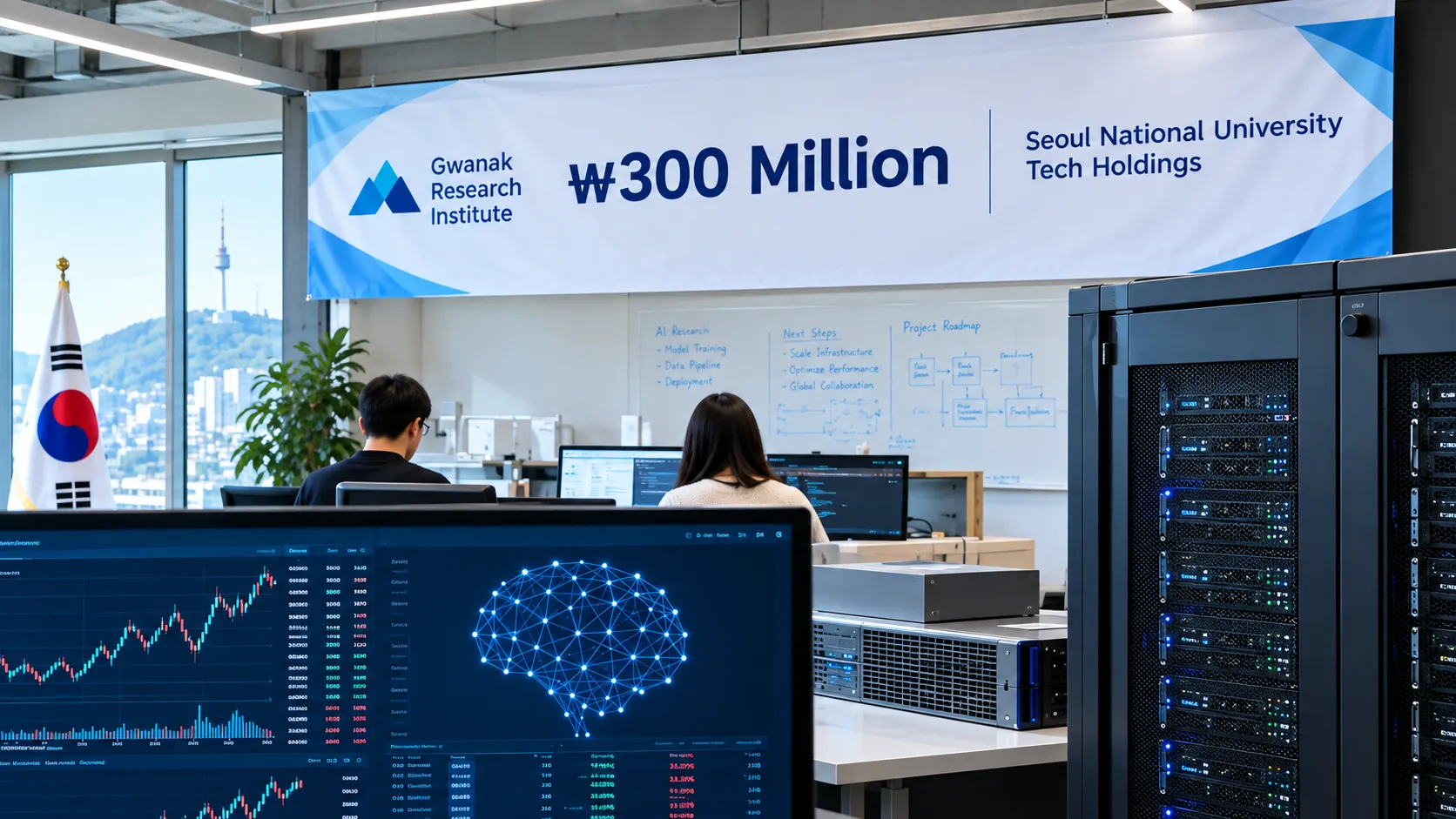
Seoul National University Technology Holdings has backed Gwanak Research Institute, a 2023-founded startup building an AI decision engine that combines transaction data with consultation records to help banks and insurers prioritise customers.

3 October 2026New
Seoul's Gwanak Research Institute Raises ₩300 Million to Turn Banks' Messy Data Into AI Decisions

A young South Korean startup is betting that the biggest barrier to using artificial intelligence in banking is not the quality of AI models but the state of the data inside financial institutions. Gwanak Research Institute, founded in 2023, has raised ₩300 million from Seoul National University Technology Holdings to develop an AI decision engine for banks, card companies, insurers and public-finance institutions.

The investment was reported on 2 October by Korea's Hankyung magazine and highlighted in a TechStartups funding roundup. The amount, roughly $200,000 to $220,000 at recent exchange rates, is small. But the startup's thesis touches on one of the most important questions facing financial institutions as they try to deploy AI: how to turn scattered, unstructured information into reliable, auditable decisions.

Gwanak says it will use the funding to improve its AI engine, hire developers, expand within financial services and adapt its technology to the security and data-handling requirements that financial institutions impose.
AI-Powered Finance, Better Decisions.png

What the engine does

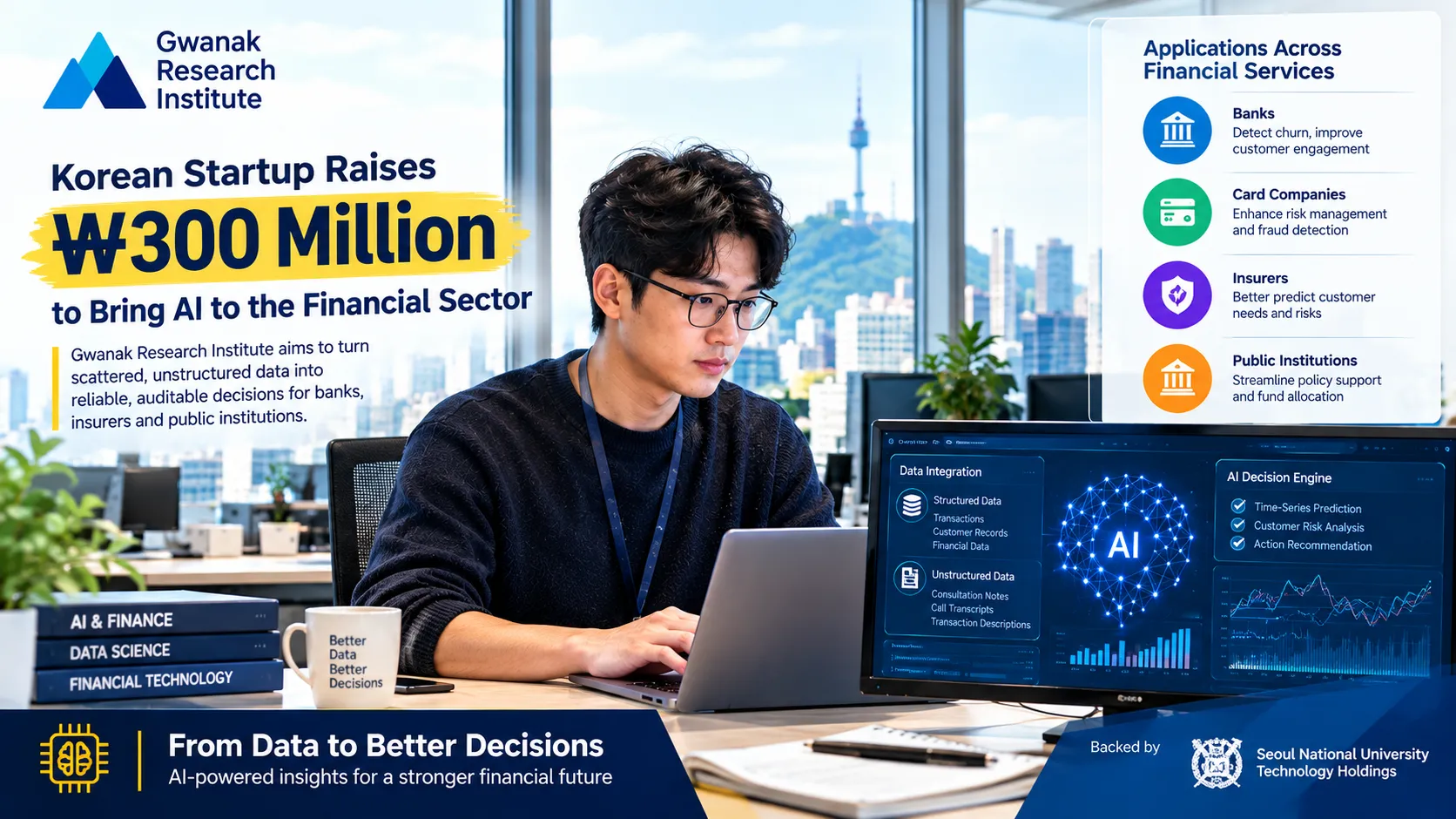
Banks and insurers hold enormous amounts of information about their customers. Some of it is structured, such as transaction histories, credit scores and loan repayment records, stored neatly in databases. Much of it is not. Notes from customer consultations, call-centre transcripts, free-text transaction descriptions and correspondence often sit in separate systems or in formats that software cannot easily read. Employees frequently have to interpret such records manually before they can be used in decisions.

Gwanak's product is designed to connect those two worlds. It combines structured financial data with unstructured information, including consultation records and transaction descriptions, and applies time-series prediction to estimate how a customer's financial condition may change. The system then recommends which customers a financial institution should prioritise and what action it should consider.

The potential applications are concrete. A bank could use the engine to identify customers likely to leave, allowing it to intervene before they do. A lender could use it to prioritise debt recovery efforts, focusing on accounts where early contact is most likely to help. A public finance agency could use it to screen applicants for policy funds, such as subsidised loans for small businesses, more consistently.

Why the data layer matters

The startup's approach reflects a lesson that many enterprise AI vendors have learned. Access to capable language models is becoming widely available and increasingly cheap. What differentiates useful AI in a regulated industry is everything around the model: the ability to bring together data from different systems, preserve permissions, explain outputs and fit into existing workflows.

Financial institutions are also cautious adopters. They must satisfy regulators that automated decisions are fair, explainable and secure. A model that produces accurate predictions but cannot show how it reached them, or that requires sending sensitive data outside the institution, may be unusable regardless of its technical performance.

Working inside a fortress

South Korea's financial sector presents particular challenges. Korean regulators have historically required financial institutions to separate internal networks from the internet, a rule known as network separation, designed to protect against cyberattacks and data leaks. The rule made it difficult to use cloud-based AI services. Regulators have in recent years begun to relax some of these restrictions to allow greater use of cloud and generative AI tools, but strict controls on customer data remain.


“In financial services, the model is often not the hard part. The hard part is the data around it.”
— TIGI Analysis

For a startup like Gwanak, that means its technology must be able to run inside institutions' own environments, often with limited connectivity, rather than relying on external cloud services. Adapting to such security requirements is one of the stated uses of the new funding. Startups that can solve these integration problems can compete with larger vendors even without owning a frontier model.

Early days

Gwanak's commercial traction is still at an early stage. The company says it is running proof-of-concept projects with financial institutions but has not yet confirmed commercial deployments or full contracts. That makes the ₩300 million investment a validation bet rather than scale capital.

The backing of Seoul National University Technology Holdings is nonetheless meaningful. The holding company commercialises technology linked to Korea's leading university and invests in startups emerging from its research and alumni networks. Its support provides credibility, connections and access to talent, all valuable for a small company trying to win the trust of conservative financial customers.

The company's name itself is a nod to that connection: Gwanak is the district of Seoul where Seoul National University's main campus is located. South Korea offers fertile ground for such companies. The country has one of the world's most digitally advanced banking markets, with high smartphone penetration and widespread use of mobile banking and card payments. That generates rich transaction data, but it also raises customer expectations for fast, personalised service. Korean financial groups have invested heavily in AI for credit scoring, fraud detection and customer engagement, and they increasingly look to university spinouts and startups for specialised capabilities that are difficult to build in-house. For a company like Gwanak, a successful pilot with even one large institution could become a reference that opens doors across the sector.

A global trend in financial AI

Gwanak's focus mirrors developments worldwide. Banks in the United States, Europe and Asia are investing heavily in AI for customer service, fraud detection, credit decisions and collections. Many have found that the most immediate gains come not from replacing human judgement but from helping staff prioritise their work: which customer to call first, which application needs closer review, which account shows early signs of distress.

In India, where banks and fintech lenders serve hundreds of millions of customers, similar challenges apply. Indian lenders have invested heavily in digital lending and analytics, and the Reserve Bank of India has emphasised responsible use of AI and data. Collections and early warning systems, in particular, have become areas of intense focus as lenders manage risks in unsecured retail credit.

For Gwanak, the opportunity is to become a specialist that institutions trust to work with their most sensitive data. The road from proof of concept to commercial contract is long in financial services, and many startups do not survive it. But the problem the company is addressing is real and growing: as AI becomes more powerful, the institutions that benefit most will be those that can make sense of the data they already have.

The ₩300 million is a first step. The next will be converting pilots into paying customers, the clearest proof that the company's engine can deliver value inside one of the most demanding industries in the world.

TagsGwanak Research InstituteSouth KoreaFinancial AISeoul National UniversityBanking TechnologyInsurtechCredit RiskDebt RecoveryCustomer ChurnFintechAI StartupsStartup FundingDecision Intelligence

Reader reviews

Sign in to rate and review this article.
Loading reviews…
