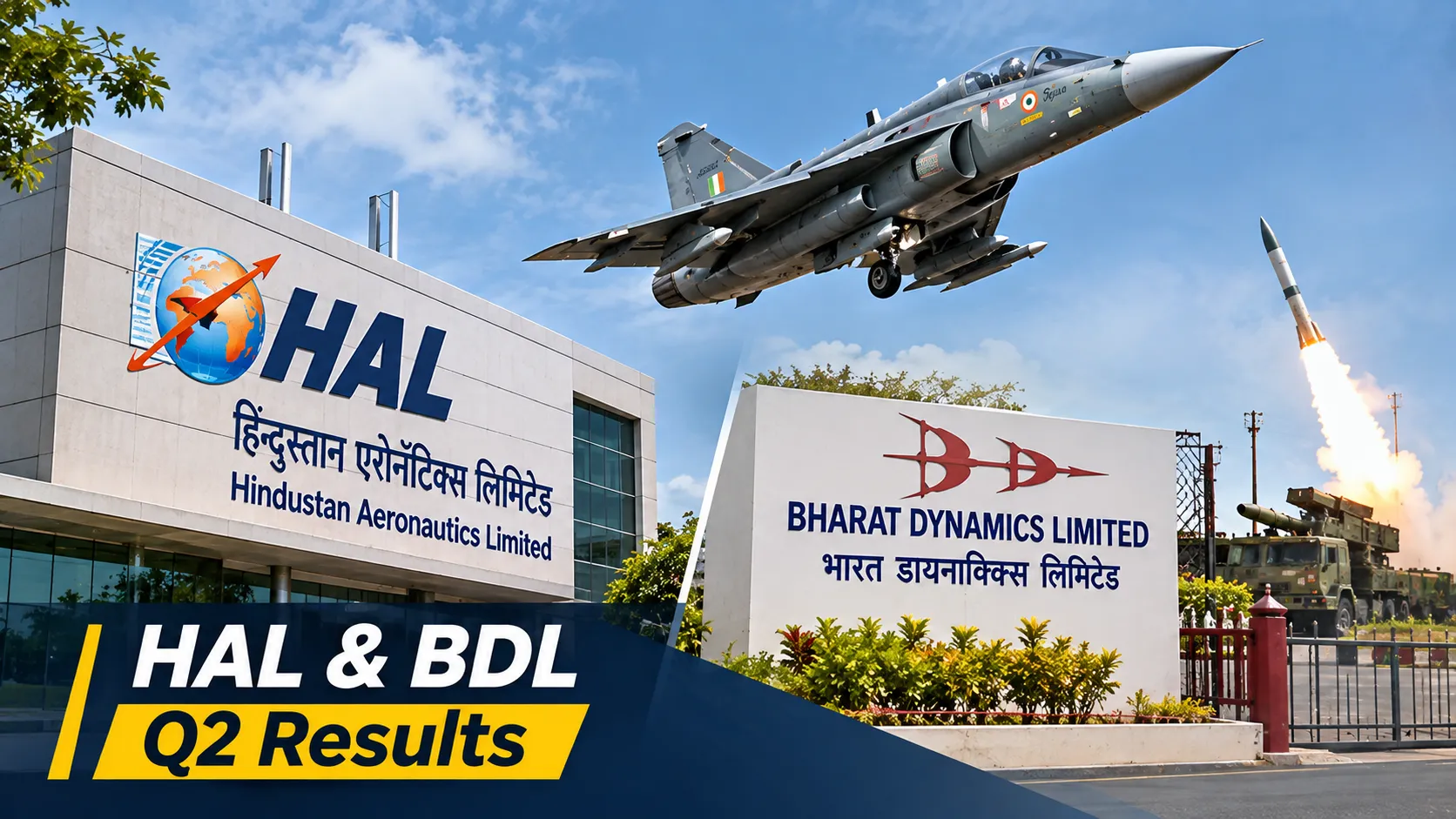
India's two largest listed defence manufacturers reported strong revenue growth in the September quarter, reflecting the government's push to equip the armed forces with domestically built aircraft and missiles, though their profits told contrasting stories.
Hindustan Aeronautics (HAL), the state-owned maker of fighter jets, helicopters and aircraft engines, reported a consolidated net profit of ₹1,936 crore for the July-September quarter, the second quarter of the 2026-27 financial year, up 16% from ₹1,669 crore a year earlier, according to Upstox, citing results announced on Thursday, November 12. Revenue rose 15% to ₹7,613 crore from ₹6,629 crore.
Bharat Dynamics (BDL), which makes missiles and related systems, reported revenue of ₹1,664 crore, up 45% year-on-year, but its net profit fell 15% to ₹183 crore from ₹216 crore, according to Upstox.
HAL's steady growth
HAL's results were in line with its guidance for revenue growth of 10% to 12% in the 2026-27 financial year, according to CompoundingAI. In the first quarter, the company's standalone revenue rose 14.44% to ₹5,515 crore and its standalone profit rose 14.77% to ₹1,581 crore. The second quarter's revenue of ₹7,613 crore represents a strong sequential increase, reflecting the typical pattern in which HAL's deliveries accelerate through the financial year.
The company has guided for an operating EBITDA margin of 30% to 31% for the year.
A massive order book
HAL's long-term prospects rest on its order book, which stood at ₹2,54,538 crore at the end of the 2025-26 financial year, up 34% from ₹1,89,302 crore at the start of that year, according to CompoundingAI. Management has guided for about ₹90,000 crore of additional orders over two years.
Major contracts include orders for the Tejas Mk1A light combat aircraft, light combat helicopters, advanced light helicopters and the upgrade of existing aircraft. The Defence Acquisition Council has also granted in-principle approval, known as acceptance of necessity, for proposals worth about ₹1.1 lakh crore, including advanced light helicopters for the Army.
The Tejas delivery challenge
The most closely watched issue for HAL has been the delivery of the Tejas Mk1A fighter jets to the Indian Air Force. The programme has faced delays, partly because of slow supplies of F404 engines from General Electric. As of September 18, HAL had received 10 GE engines and prepared 27 airframes, according to CompoundingAI.
First-batch deliveries have also reportedly been held up by pending testing of the aircraft's AESA radar and missile integration. HAL has guided for 15 to 20 Tejas Mk1A deliveries in the 2026-27 financial year, with the upper end dependent on receiving about 20 engines. HAL has said it will impose liquidated damages on GE for late deliveries.
The Indian Air Force needs the new fighters urgently, as it retires older aircraft and its squadron strength falls below its sanctioned level.
Bharat Dynamics: growth without margin
Bharat Dynamics' 45% revenue jump reflects stronger execution of its order book, which includes surface-to-air missiles such as the Akash, anti-tank guided missiles and torpedoes. However, the decline in profit suggests that costs rose faster than revenue, possibly because of a change in the mix of products delivered or higher material costs.
Defence manufacturers' margins can vary significantly from quarter to quarter depending on which contracts are being executed, so a single quarter's profit decline does not necessarily indicate a lasting trend.