Harmonic Security, a start-up that helps companies monitor and manage how their employees use artificial intelligence tools, has raised $50 million in a Series B round led by Crosspoint Capital Partners, as enterprises grapple with the security risks of AI adoption without wanting to slow it down.
Existing investors also participated in the oversubscribed round, though their names and the company's valuation were not disclosed. The raise brings Harmonic's total funding to $76 million, according to Tech Funding News. It follows a $17.5 million Series A led by Next47 in October 2024 and a $7 million seed round led by Ten Eleven Ventures the year before.
Harmonic, which is based in San Francisco and London, will use the money to expand its engineering, sales and marketing teams in both the United States and the United Kingdom.
Founders Who Have Done It Before
Harmonic is led by chief executive Alastair Paterson and chief technology officer Bryan Woolgar-O'Neil, who previously co-founded threat intelligence company Digital Shadows. Paterson sold Digital Shadows to ReliaQuest in July 2022 for $160 million. Woolgar-O'Neil was also Digital Shadows' chief technology officer, and Harmonic's data and machine learning team came from the same company.
The pair founded Harmonic in October 2023 after consulting more than 50 security leaders about the problems they faced as generative AI tools spread through their organisations.
"Every board I talk to is asking two questions: how do we reduce the risk of AI use and are we getting value?" Paterson said.
The Problem With Blocking AI
When ChatGPT and similar tools burst into the workplace, many companies responded by banning or blocking them, fearing that employees would paste confidential documents, customer data or source code into systems outside corporate control. Those bans often proved ineffective. Employees found workarounds, used personal devices or simply ignored the rules, creating what security teams came to call "shadow AI".
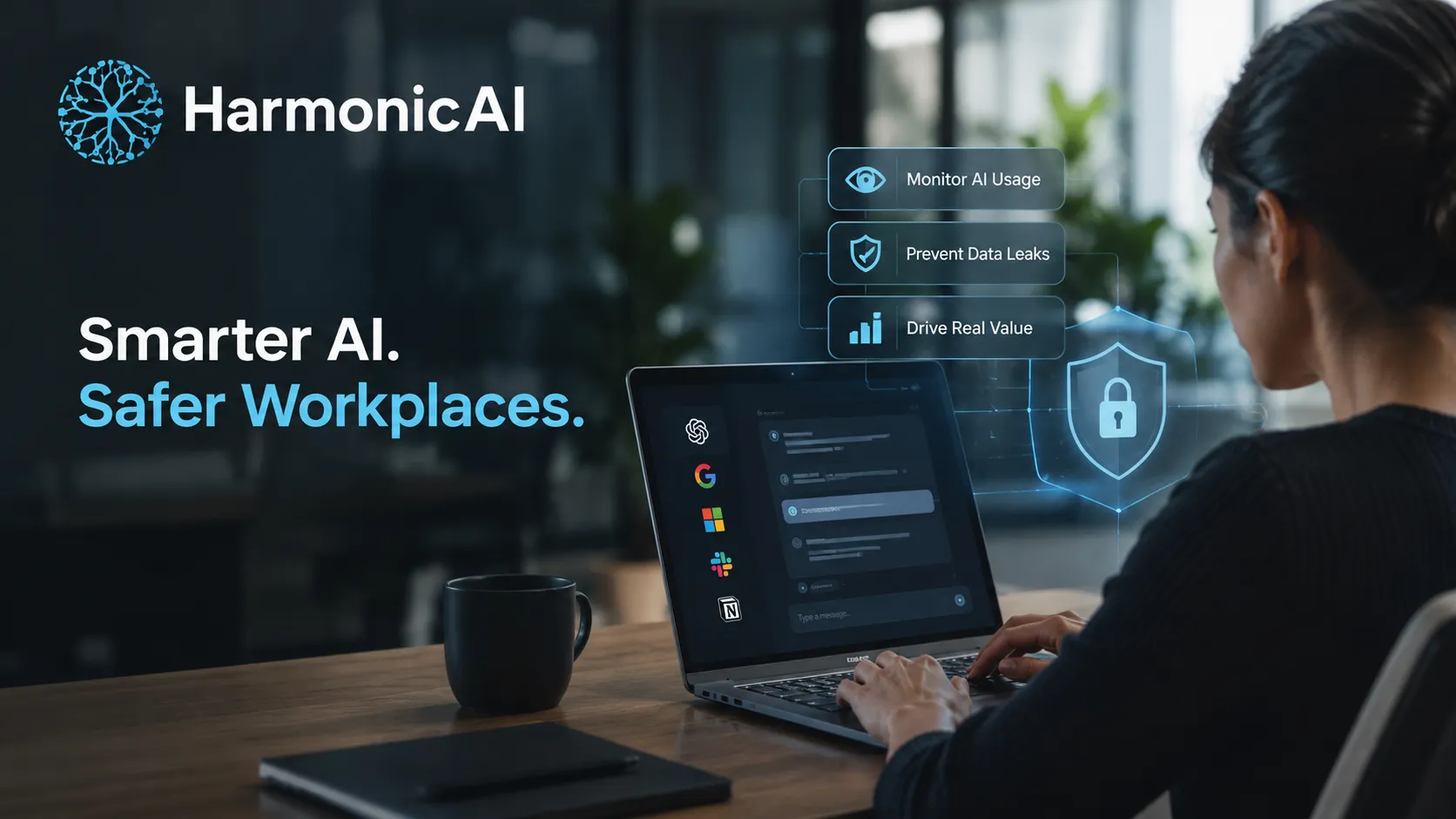
Harmonic's approach starts from the assumption that AI use is inevitable and largely beneficial. Rather than blocking tools outright, its software gives security teams visibility into which AI applications employees are using, what data they are sharing and why, and applies real-time controls to prevent sensitive information from leaking.
The technical challenge is distinguishing harmful activity from legitimate work. Harmonic uses custom small language models to examine each interaction within milliseconds. That allows the system, for example, to tell the difference between a developer referring to a database schema in general terms and someone pasting live credentials into a chatbot. Traditional data loss prevention tools, built on keyword matching and rigid rules, often struggle with that kind of nuance, generating false alarms that frustrate employees and overwhelm security teams.
From Risk to Value
Harmonic has also added a "Usage Intelligence" layer designed to help managers identify which AI use cases are delivering value and where to invest. That feature speaks to the second question Paterson says boards are asking: whether their spending on AI is paying off.
The company is also expanding its coverage of AI agents, the increasingly autonomous systems that can take actions on behalf of users. Agents introduce new security challenges because they can access data, call other tools and make decisions with less direct human oversight.
That shift changes the nature of the security problem. When an employee uses a chatbot, a human is at least reviewing what goes in and comes out. When an agent is authorised to read inboxes, query databases or move files on someone's behalf, sensitive information can flow between systems without anyone looking at it in real time. Security teams will need to know which agents exist, what permissions they hold and what data they touch, much as they already track human users. Vendors that can extend monitoring from people to software agents are likely to be best placed as enterprises move from experimentation to large-scale deployment.
Rapid Customer Growth
Harmonic says its software is used by millions of employees across more than 100 companies, including large enterprises. According to SecurityBrief UK, it signed about 100 customers in 2026 and reached its annual target in September. Headcount has grown from 30 in October 2024 to more than 90 across the US and the UK.
Zach Sivertson, a managing director at Crosspoint who joined the firm in 2024 and works in its early-stage practice, said: "Security has too often slowed the adoption of new technology." Crosspoint is a specialist investor in cybersecurity and identity companies.
A Crowded and Consolidating Market
Harmonic is competing in one of the fastest-growing segments of cybersecurity. Gartner forecast in June 2026 that security software, including AI security, would grow from $15.6 billion in 2025 to $37.6 billion by 2030, an annual growth rate of 18.5 per cent.
The category has already attracted significant acquisition activity. SentinelOne acquired Prompt Security in a deal Israeli business daily Calcalist valued at about $250 million, and Cato Networks agreed to buy Aim Security for an estimated $300 million to $350 million.
AI developers themselves are also building security integrations. Anthropic launched Compliance API integrations on 21 May 2026 with 28 security partners, including Cloudflare, CrowdStrike, Netskope, Palo Alto Networks and Zscaler, and later said the number had exceeded 100.
That combination of established security vendors, AI providers and specialist startups means Harmonic will face intense competition. Its advantage lies in its specialised focus, its experienced founding team and its approach of enabling rather than restricting AI use.
Why This Matters for Global Enterprises
For multinational companies, including the many Indian IT services firms and global capability centres that are deploying AI across large workforces, governing employee use of AI has become a board-level concern. Regulators in Europe, the US and India are paying closer attention to how companies handle personal data, and a single leak of customer information into an AI system could carry legal and reputational consequences.
At the same time, companies are under pressure to show productivity gains from their AI investments. Tools that can both reduce risk and measure value address two of the most pressing priorities for technology leaders.
The Road Ahead
With $50 million in fresh capital, Harmonic is positioned to scale in a market that is expanding rapidly but also consolidating quickly. Its ability to maintain technical differentiation as larger security platforms build similar features, and to keep pace as AI agents change how work is done, will determine whether it becomes a standalone leader or an attractive acquisition target.
For now, its growth suggests that enterprises are increasingly willing to pay for tools that let them say yes to AI safely, rather than simply saying no.


