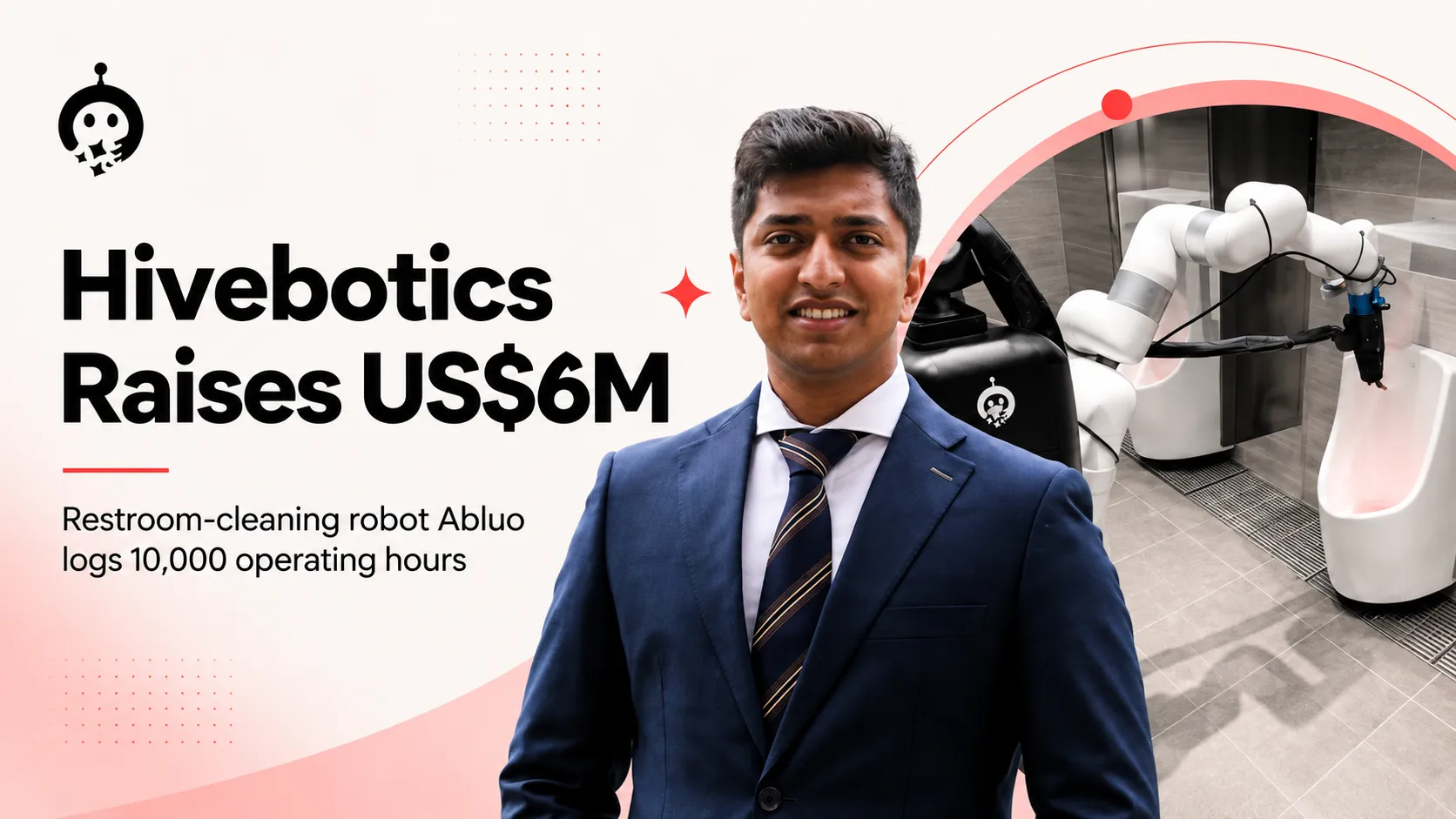
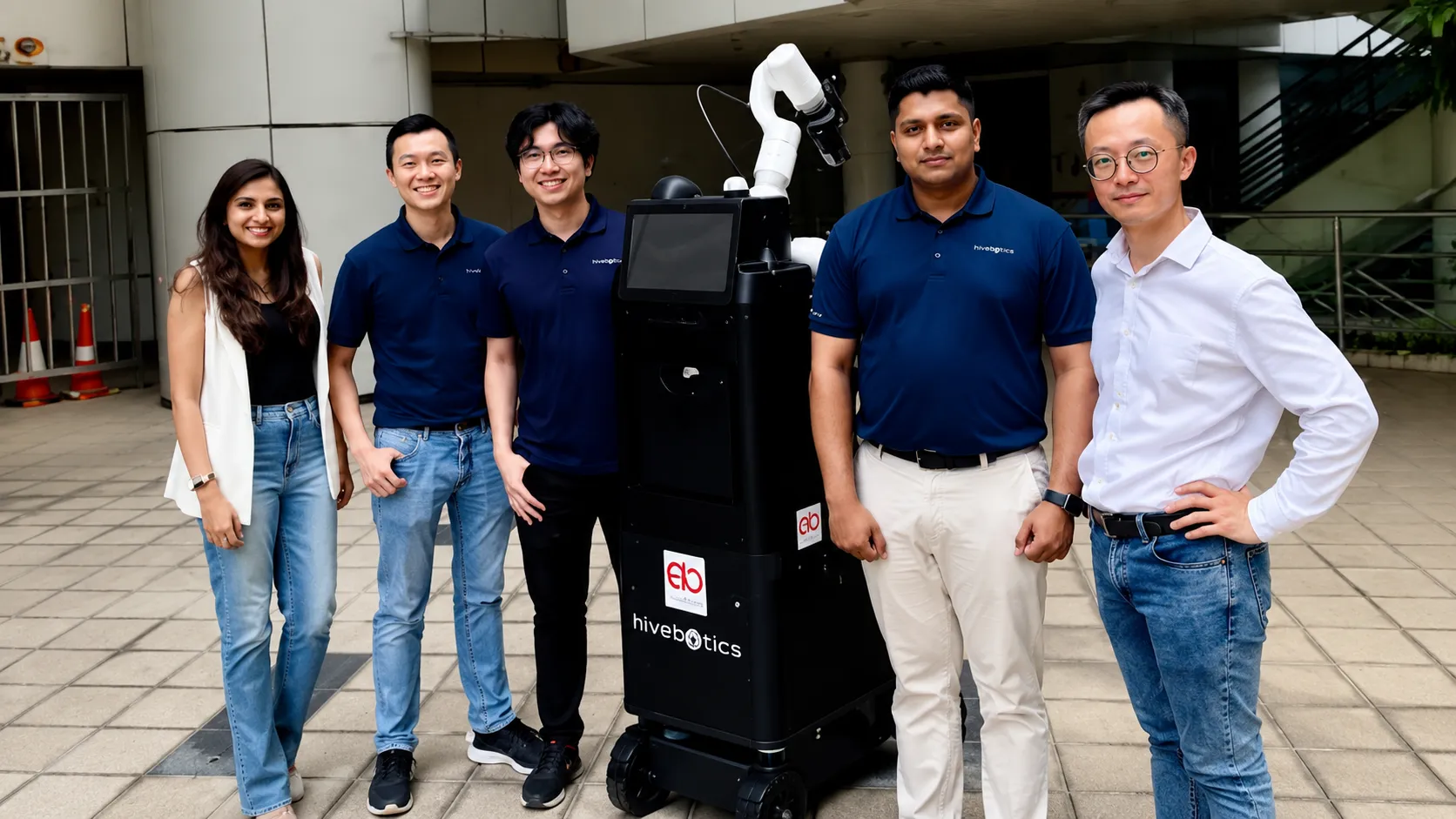
Hivebotics, a Singapore-based robotics startup, has raised $6 million in Series A funding led by Vertex Ventures Southeast Asia and India, with participation from Fareast Land Development and smart-restroom manufacturer Rigel. The round funds the company's push to move its autonomous restroom-cleaning robots from pilot deployments into mass production, addressing what founders describe as a deceptively difficult automation challenge within the broader physical AI and robotics sector.
While much of the current wave of robotics investment has focused on general-purpose humanoid robots capable of performing a wide range of tasks, Hivebotics has taken a narrower, more targeted approach, building a robot designed specifically to clean complete commercial restrooms, including toilets, urinals, sinks and floors, rather than pursuing broader multi-purpose functionality.
The funding also reflects a broader investment thesis gaining traction across the robotics sector in 2026: that near-term commercial success in physical AI is more likely to emerge from narrowly scoped, well-defined automation tasks with clear return-on-investment calculations, rather than from the more ambitious general-purpose humanoid robots that continue to attract significant investment but remain further from widespread commercial deployment.
Facilities management professionals note that commercial cleaning contracts increasingly incorporate service-level guarantees around hygiene standards and cleaning frequency that are becoming more challenging to meet reliably using human labour alone, particularly across the large, geographically distributed facility portfolios operated by major retail, hospitality and transportation clients, a dynamic that has made robotic cleaning solutions with consistent, verifiable output an increasingly attractive proposition for large facilities management contracts globally.
The company's Abluo robot uses an articulated robotic arm combined with cameras, steam cleaning, chemical dispensing jets, vacuum extraction and drying equipment to perform a full restroom cleaning cycle, a task that requires considerably more dexterity and environmental adaptability than simpler floor-cleaning robots that have already achieved commercial success in office and retail settings.
According to the company, its systems have accumulated nearly 10,000 operating hours across more than twenty sites spanning Asia, Europe, the Middle East and North America, a deployment footprint that suggests the technology has moved well beyond early prototype testing into genuine commercial validation across diverse facility types and cleaning requirements.
Commercial cleaning has historically been considered a particularly difficult category for automation given the wide variability in facility layouts, fixture types and cleanliness standards across different customer sites, challenges that Hivebotics' extensive deployment history across more than twenty locations in multiple regions suggests the company has made meaningful progress addressing through its combination of robotic hardware and adaptive software systems.
Facilities management industry surveys have consistently identified commercial cleaning as one of the sectors most affected by persistent staff turnover and recruitment difficulty across multiple developed markets, a labour dynamic that has strengthened the business case for automation solutions capable of handling specific, well-defined cleaning tasks reliably around the clock without the staffing challenges human-only cleaning crews face.
The commercial logic behind Hivebotics' approach reflects a broader pattern emerging within the physical AI and robotics investment landscape: rather than betting on a single robot capable of performing every conceivable human task, a goal that remains technically distant despite substantial investment, some of the more commercially advanced robotics companies are instead focusing on automating specific, well-defined, repetitive tasks where the return on investment can be clearly calculated by customers.
Commercial cleaning represents a particularly compelling category for this targeted automation approach, given persistent labour shortages in many developed markets alongside steadily rising wage costs for what is often physically demanding, unpleasant work that faces high employee turnover rates across the commercial cleaning services industry globally.
Labour market dynamics across many developed economies, characterised by persistent shortages of workers willing to perform physically demanding, often unpleasant commercial cleaning tasks alongside steadily rising minimum wage requirements, have created increasingly favourable unit economics for automation solutions in this category, a dynamic that investors backing Hivebotics are evidently betting will continue strengthening the commercial case for its technology over time.
For institutional investors evaluating the broader physical AI and robotics investment landscape, Hivebotics' commercial traction across multiple continents offers a useful counterpoint to the more speculative, longer-horizon bets being placed on general-purpose humanoid robots, illustrating that narrowly focused automation solutions can achieve meaningful commercial scale considerably sooner than more ambitious general-purpose robotics platforms.
For Hivebotics' investors, the appeal lies precisely in that narrow focus: a machine built around one specific, measurable, high-turnover job offers customers a clearer and more immediate return-on-investment calculation than a general-purpose humanoid robot still years away from reliably performing varied tasks across unpredictable environments.
As Hivebotics moves toward mass production, its ability to maintain reliability and cleaning quality consistency across an expanding range of facility types and geographic markets will determine whether its vertical, task-specific approach to physical AI can scale into a durable global business, potentially offering a template that other narrowly focused robotics companies may look to replicate in adjacent service categories.
The involvement of Rigel, a smart-restroom manufacturer, as a strategic investor also suggests potential for deeper product integration between Hivebotics' robotic cleaning technology and broader smart facility infrastructure, a combination that could differentiate the company's offering beyond standalone robotic hardware toward a more comprehensive, integrated smart restroom management solution for large commercial facility operators.
Business leaders across the global commercial facilities management sector are likely to watch Hivebotics' mass production ramp-up closely, since successful scaling could meaningfully accelerate broader industry adoption of task-specific cleaning robotics, potentially reshaping labour and cost structures across an industry that has historically relied almost entirely on manual human labour for even its most repetitive, physically demanding cleaning tasks.
The bottom line for TIGI's readers: Hivebotics is a reminder that the most commercially advanced physical AI right now may not be humanoid robots doing everything, but specialised machines doing one unpleasant job reliably.
Robotics industry analysts expect Hivebotics' mass production ramp-up to serve as a useful bellwether for investor appetite toward narrowly scoped, task-specific physical AI companies more broadly, at a time when capital continues flowing heavily toward more ambitious, general-purpose humanoid robotics platforms. Reliability data from its expanding commercial deployment base will likely matter more to future investors than any single new market announcement.