FundingAnalysis5 MIN READ

Honda's Indian Two-Wheeler Arm Weighs Expansion Beyond 8 Million Units as Demand Outpaces Its New Capacity

Honda Motorcycle & Scooter India, which is already raising annual capacity from 6.25 million to about 8 million units by 2028, is considering further expansion. Chief executive Tsutsumu Otani says 8 million "may not be enough" as India's two-wheeler market heads for 22 to 23 million units this year.

By Shaym Kumar · Author19 October 2026New
Honda's Indian Two-Wheeler Arm Weighs Expansion Beyond 8 Million Units as Demand Outpaces Its New Capacity

Honda Motorcycle & Scooter India (HMSI), one of the country's largest two-wheeler makers, is considering a further expansion of its manufacturing capacity even before it completes its current investment programme, as demand in the world's biggest two-wheeler market continues to grow.

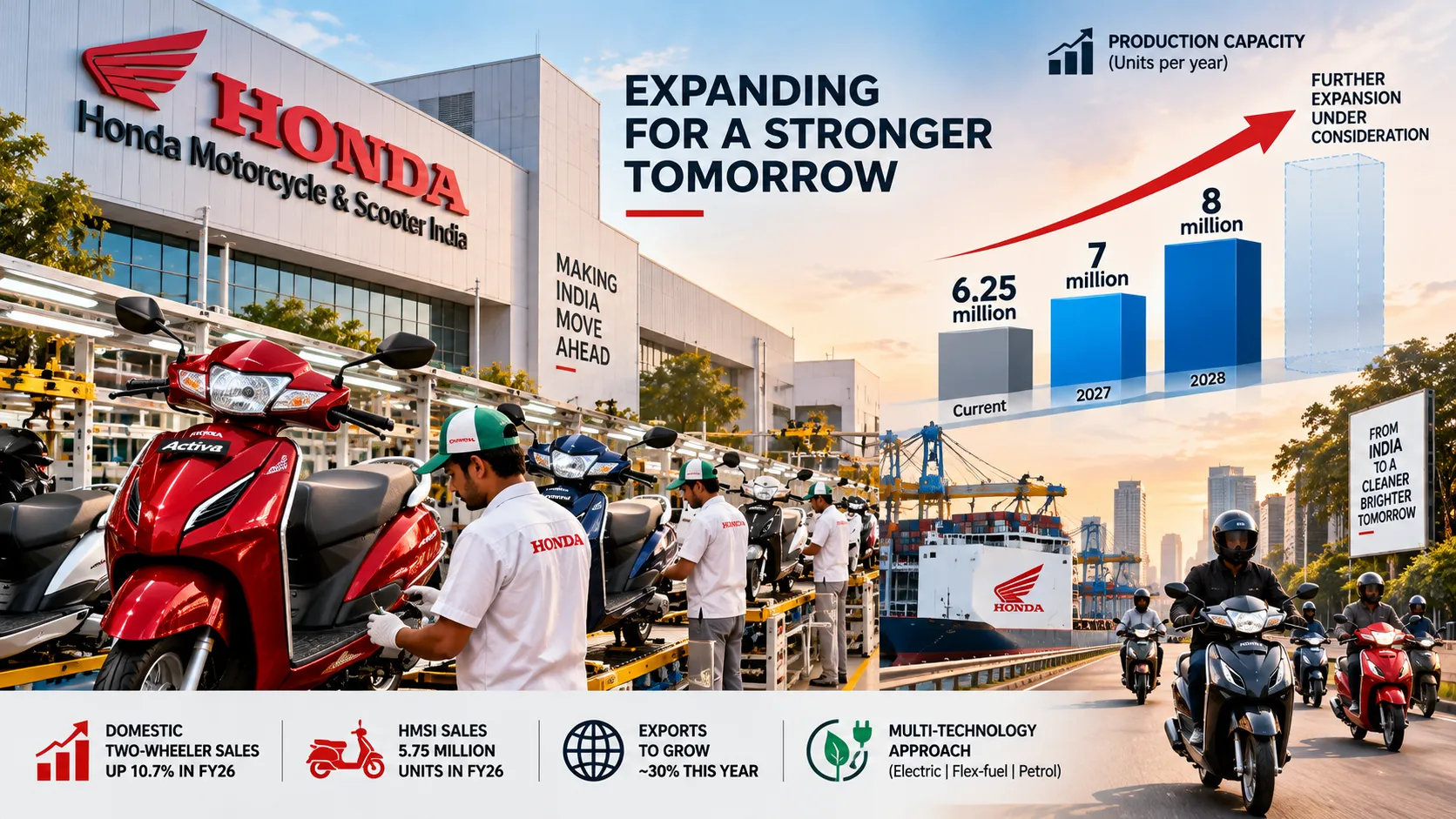
HMSI currently has the capacity to produce 6.25 million vehicles a year. Existing plans will raise that to about 7 million units in 2027 and around 8 million units in 2028. But the company's president and chief executive, Tsutsumu Otani, said on October 18 that even that may fall short.

"In the near future, the capacity of 8 million may not be enough," Otani said, according to Business Standard. "We have to consider expanding further." He said the company is evaluating options, including an additional production line at an existing plant or an entirely new factory, but no decision has yet been made.

New lines in Gujarat and Rajasthan

HMSI's current expansion involves two major projects. A fourth production line at its Vithalapur plant in Gujarat is scheduled to begin operations in 2027, taking total capacity to about 7 million units. A third line at its Tapukara plant in Rajasthan is due in 2028, raising capacity to around 8 million.

The company, a wholly owned subsidiary of Japan's Honda Motor, has been one of the most consistent investors in Indian manufacturing among global automakers. Its scooters, led by the Activa, have been among the best-selling two-wheelers in India for years, and its motorcycles compete across commuter and premium segments.

India is Honda's largest two-wheeler market by volume globally, and its Indian operations are increasingly important not only for domestic sales but also as an export base.

A growing market

The case for expansion rests on strong demand. India's domestic two-wheeler sales rose 10.7% year on year to 21.71 million units in FY26, according to industry data. HMSI's own domestic sales grew 7.9% to 5.75 million units over the same period.

For the current financial year, HMSI expects the overall market to reach 22 to 23 million units, and its own sales to exceed 6 million. The company said festive-season demand has been strong, although it did not give a precise estimate. Dealer inventories are at roughly two months of sales, slightly below the levels needed for some models.

Two-wheelers are the primary mode of personal transport for hundreds of millions of Indians, particularly in smaller towns and rural areas. Demand is closely linked to rural incomes, the monsoon, credit availability and fuel prices, as well as broader economic growth.

Exports set to grow

HMSI also expects exports to grow by about 30% this financial year, targeting markets in Latin America and the Middle East. However, Otani said committed production capacity and strong domestic demand limit how quickly exports can grow in the near term, a constraint that additional capacity would help ease.

India has become an important global production hub for two-wheelers, with manufacturers including Bajaj Auto, TVS Motor and Hero MotoCorp exporting to Africa, Latin America and Southeast Asia. Honda's ambitions to expand exports from India align with the government's push to make the country a global manufacturing base.

Electric, flex-fuel or petrol

HMSI is also preparing for a shift in powertrain technology. Otani said scooters are a more natural fit for electrification than motorcycles. Electric motorcycles face challenges with powertrain packaging, frame design and styling, and buyers of premium motorcycles often value the sound and feel of a combustion engine.

“In the near future, the capacity of 8 million may not be enough. We have to consider expanding further.”
— Tsutsumu Otani, President and CEO, Honda Motorcycle & Scooter India

Honda has experience with flex-fuel engines in Brazil, where vehicles run on blends of petrol and ethanol. The timing of a rollout in India will depend on government policy, fuel availability, pricing and demand. India has been increasing ethanol blending in petrol as part of efforts to reduce oil imports and support farmers.

"Customers will choose the energy option that best suits them, whether electric, flex fuel or conventional petrol," Otani said.

That multi-technology approach contrasts with some rivals that have moved more aggressively into electric two-wheelers. India's electric two-wheeler market has grown rapidly, led by startups such as Ather Energy and Ola Electric as well as established players like TVS and Bajaj, supported by government incentives.

22aaa7f1-1948-4606-87c3-4b9dd43821e5.png

Rising costs

HMSI is also facing higher costs linked to the conflict in West Asia, which has pushed up prices of energy, raw materials and logistics. Otani said the company is absorbing part of the increase rather than passing it all on to customers, in an effort to protect demand during a strong festive season.

High fuel prices are a double-edged sword for two-wheeler makers. They can encourage some consumers to switch from cars to more fuel-efficient two-wheelers or to electric models, but they also squeeze household budgets and raise operating costs for riders.

The competitive landscape

HMSI competes in a market dominated by a handful of large manufacturers. Hero MotoCorp, the market leader in motorcycles, TVS Motor, Bajaj Auto, and Suzuki and Yamaha's Indian subsidiaries all vie for share, alongside fast-growing electric two-wheeler companies. Honda's strength lies in scooters, where its Activa brand has been a market leader for years, and in a growing range of motorcycles.

Royal Enfield has also expanded strongly in the premium motorcycle segment. Competition increasingly centres on new models, financing options, dealership reach and service networks, particularly in smaller towns where rural demand has been recovering. Capacity matters because manufacturers that cannot meet demand during peak seasons risk losing customers to rivals with vehicles in stock.

What it means for India

HMSI's expansion plans are a vote of confidence in India's long-term consumption story and in the country's role as a manufacturing hub for global companies. New production lines bring investment, jobs and opportunities for local component suppliers in states such as Gujarat and Rajasthan.

They also reflect Japan's deepening economic engagement with India. Japanese companies are among the largest foreign investors in Indian manufacturing, particularly in automobiles and components.

For now, HMSI is sticking with its plan to reach 8 million units by 2028. But with the market growing and exports picking up, Honda's message is clear: India's two-wheeler demand is growing faster than even its own ambitious plans anticipated.

For India's component makers, many of them small and medium-sized businesses supplying parts such as castings, electrical systems and tyres, Honda's expansion also means more orders and more investment in their own capacity, extending the benefits of the new production lines well beyond the factory gates.

TagsHondaHMSIHonda Motorcycle and Scooter Indiatwo-wheelersTsutsumu OtaniIndian auto industrymotorcyclesscooterselectric two-wheelersflex fuelmanufacturingMake in IndiaGujaratRajasthanexportsHero MotoCorpTVS MotorBajaj Autofestive seasonJapan India investment

Reader reviews

Sign in to rate and review this article.
Loading reviews…

