The hottest gadget of the holiday season may turn out to be a small robotic duck.
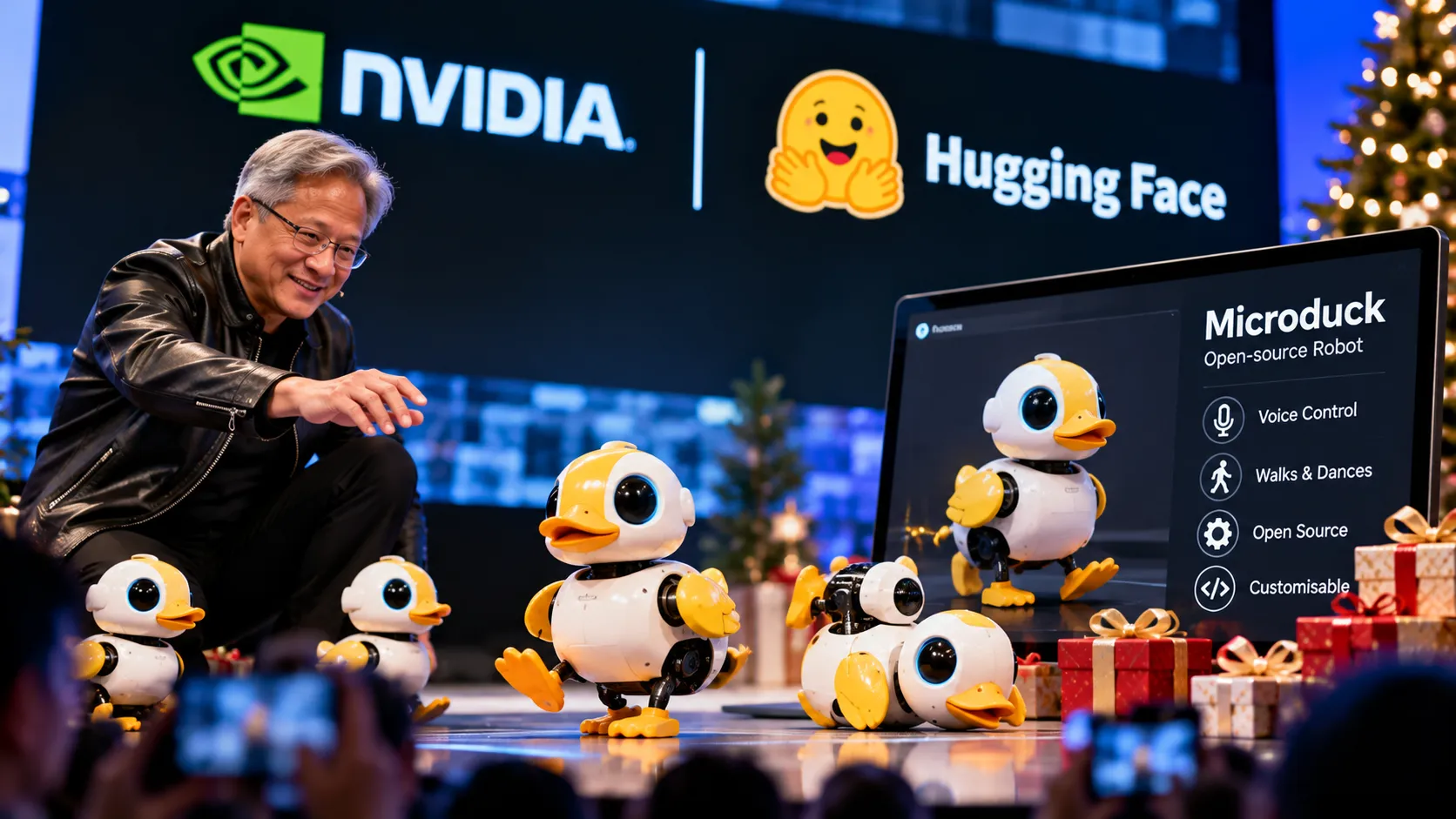
Microduck, an open-source robot duck made by Pollen Robotics, part of AI platform Hugging Face, attracted more than 20,000 preorders after Nvidia chief executive Jensen Huang played with the robots on stage, TechCrunch reported on Friday, October 23.
Huang showed off the Microducks during his keynote at Nvidia's GTC Berlin conference. A video of the robots, which walk, sit, fall over for a "nap" and do somersaults on voice command, went viral. TechCrunch described them "stomping their little feet and making tiny R2-D2 noises."
According to Hugging Face co-founder Clem Delangue, posting on X, the robots had passed 20,000 preorders by the day after the video spread. Delivery is expected in time for Christmas.
From Pollen to Nvidia
Microduck is Hugging Face's second robot, after Reachy Mini, a small desktop robot. Both come from Pollen Robotics, a French robotics company that Hugging Face acquired in 2025. TechCrunch reported that Nvidia acquired Hugging Face in September.
Hugging Face became famous as the leading platform for sharing open-source AI models and datasets, used by millions of developers. Its move into robotics reflects a broader belief that the next frontier for AI lies in the physical world.
Trained in simulation
The Microducks were trained in simulation using Nvidia's technology stack, according to TechCrunch. Training robots in virtual environments allows developers to teach them movements and behaviours much faster and more safely than in the real world, before transferring those skills to physical robots.
The robots ship with basic tricks, and owners can teach them new ones and share them with the community, in keeping with Hugging Face's open-source approach. That openness could turn the Microduck into a platform for hobbyists, students and developers to experiment with robotics and AI.
Not just for kids
Delangue suggested that Microduck could be the best-selling robot of the year and that adults, not just children, may buy it. Promotional videos show adults playing with the robots.
The appeal of small, expressive robots has been demonstrated before. Products such as Sony's Aibo robot dog and Anki's Cozmo attracted devoted fans, though some struggled commercially. Advances in AI, falling hardware costs and open-source software may give a new generation of consumer robots a better chance of success.
Physical AI goes mainstream
Nvidia has made "physical AI," the application of AI to robots and machines that interact with the real world, a central theme of its strategy. Huang has repeatedly said that robotics will be one of the largest opportunities in AI, from factory automation and logistics to humanoid robots and consumer devices.
The company supplies chips, simulation platforms and AI models for robot developers, and has partnered with numerous robotics companies. Showcasing a cheap, playful consumer robot on stage helps make that vision tangible for a broad audience.
Investment in robotics has surged. Humanoid robot developers have raised billions of dollars, and companies such as Tesla, Figure, Agility and Chinese manufacturers are racing to deploy robots in factories and homes. On the same day, robotics-as-a-service company Formic announced new funding to expand into general-purpose robotics.
The open-source advantage
Hugging Face's open-source approach to robotics stands in contrast to many companies that keep their robot software proprietary. By releasing designs, software and training tools openly, Hugging Face hopes to build a community of developers who create new behaviours and applications, accelerating innovation.
That approach has worked for AI models, where open-source releases from Meta, Mistral, Chinese developers and others have spurred rapid progress. Applying it to robotics could lower barriers to entry for researchers and startups.
What it means for India
India has a growing robotics and AI hardware ecosystem, with startups developing robots for manufacturing, warehousing, agriculture and education. Affordable, open-source robots like Microduck could be valuable tools for robotics education in Indian schools and colleges, where programmes such as Atal Tinkering Labs encourage students to experiment with technology.
Indian developers are also among the most active users of Hugging Face's platform, contributing models and datasets, and could become contributors to its robotics community.
Consumer robots' long road
Consumer robotics has a mixed history. Robotic vacuum cleaners, led by iRobot's Roomba, became mainstream, but many other home robots failed to find lasting markets. Anki, maker of the Cozmo and Vector robots, shut down in 2019 despite selling millions of units. Social robots such as Jibo struggled to justify their prices. Sony revived its Aibo robot dog in 2018 at a premium price.
The challenge has often been building robots that are useful or engaging enough to justify their cost beyond the initial novelty. Advances in AI, including voice interaction and the ability to learn new behaviours, could make robots more engaging over time. Open-source designs and community-created content could help sustain interest after purchase.
Nvidia's consumer moment
Nvidia is best known for the powerful chips that train and run AI models in data centres, and its gaming graphics cards. Huang's on-stage moments have become a feature of the company's events, often showcasing robots built on its platforms. A viral moment with an affordable consumer robot gives Nvidia a way to connect its technology to everyday experiences and broaden public interest in robotics.
What comes next
Hugging Face will need to manufacture and deliver more than 20,000 robots in time for Christmas, a significant logistical challenge for a company whose expertise lies in software. Smooth delivery and positive user experiences will determine whether the Microduck becomes a lasting hit or a viral moment.
For the robotics industry, the enthusiasm for a small robotic duck suggests that consumers are ready to welcome AI-powered robots into their homes, if the products are fun, affordable and easy to use. The Microduck's success could also encourage other AI companies to experiment with low-cost consumer hardware as a way to introduce their technology to a wider audience. If the robots deliver on their promise, they may become one of the first AI products many families interact with physically, rather than through a screen. Hugging Face has said owners will be able to share new tricks with the community, which could help keep the robots engaging long after the holidays, and turn a viral moment into a lasting platform for hobbyists, students and developers.


