
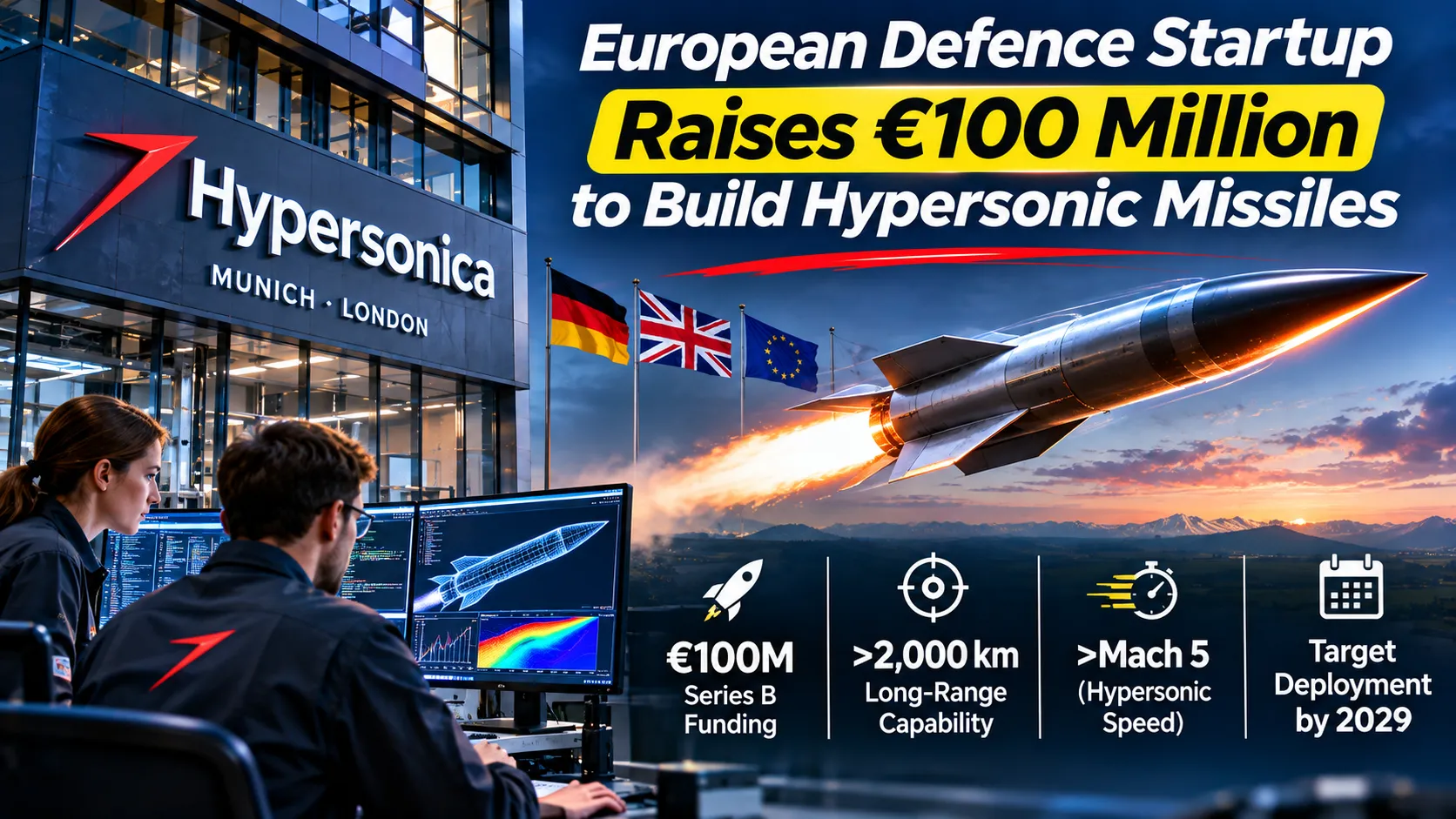
A three-year-old Anglo-German startup has raised €100 million to build hypersonic missiles for Europe, one of the starkest signs yet of how the continent's push to rearm is drawing venture capital into weapons development that was once the exclusive domain of governments and large defence contractors.
Hypersonica, headquartered in Munich with a subsidiary in London, raised the Series B round co-led by US investors Lightspeed Venture Partners and General Catalyst, with participation from existing investors Plural and 201 Ventures, according to Tech.eu, which reported the deal on Monday, November 2. The Financial Times reported a valuation of about €700 million, according to Tech Startups, although the company has not disclosed its valuation.
The round comes just nine months after Hypersonica's €23.2 million Series A in February 2026, led by Plural with General Catalyst and 201 Ventures.
What Hypersonica is building
Hypersonica is developing long-range hypersonic missiles, which travel at more than five times the speed of sound, according to Tech.eu. The company is working on "deep-strike" systems with ranges above 2,000 kilometres under the Trinity House Agreement, a defence partnership between the United Kingdom and Germany. It aims to develop these systems by 2029.
Hypersonic weapons are difficult to intercept because of their speed and, in many designs, their ability to manoeuvre in flight. Russia and China have deployed hypersonic weapons, and the United States has been developing its own, but Europe has lagged behind.
"The debate about whether Europe needs hypersonic deep-strike capability is over," said co-founders Philipp Kerth, the chief executive, and Marc Ewenz, the chief technology officer, according to Tech.eu. "Europe needs credible hypersonic long-range capability, and more value for every pound and euro it spends."
The founders
Hypersonica was founded in 2023 by Kerth and Ewenz, both of whom hold doctorates. The company plans to use the new funding for further testing, expansion of its operations across Europe and the creation of hundreds of engineering and manufacturing jobs in the United Kingdom and Germany, according to Tech.eu.
Europe's rearmament
The funding reflects a dramatic shift in European defence policy. Russia's full-scale invasion of Ukraine in 2022 prompted European governments to increase defence spending sharply, and NATO members have committed to significantly higher spending targets. Concerns about the reliability of US security guarantees have added urgency to efforts to build independent European capabilities.
Long-range strike capability has been identified as a key gap. European countries have relied heavily on US systems, and the war in Ukraine has highlighted the importance of being able to strike targets deep behind enemy lines. Several European initiatives aim to develop new long-range missiles, and the Trinity House Agreement, signed in 2024, commits the United Kingdom and Germany to cooperating on defence capabilities, including deep precision strike.
Venture capital embraces defence
Hypersonica's round is part of a broader surge of venture investment in defence technology. Investors that once avoided weapons companies because of ethical concerns or limited-partner restrictions have increasingly embraced the sector, arguing that supporting the defence of democracies is a legitimate and important goal.
European defence startups such as Helsing, a German AI defence company, Quantum Systems, a drone maker, and others have raised large sums in recent years. In the United States, companies such as Anduril, Shield AI and Castelion, which is also developing low-cost hypersonic weapons, have attracted significant funding.


