FundingAnalysis6 MIN READ

Hyundai Motor Group Commits $15.5 Billion to India Through 2032 in Its Biggest Bet Yet on the World's Third-Largest Car Market

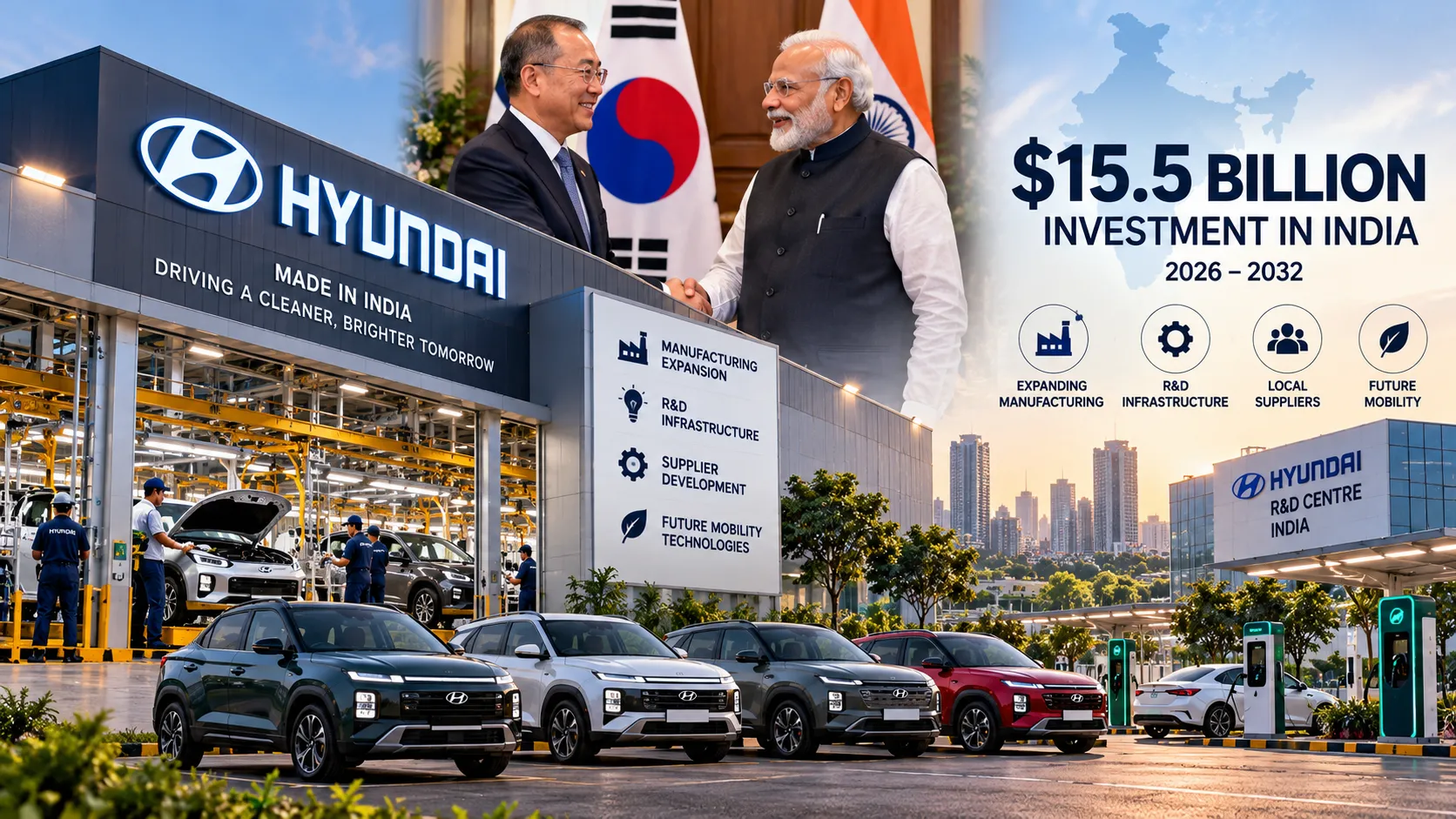
After a meeting between Executive Chair Euisun Chung and Prime Minister Narendra Modi, Hyundai Motor Group has pledged $15.5 billion for India between 2026 and 2032, covering factories, a $700 million R&D centre, local suppliers and new mobility businesses, run through a dedicated Indian investment entity.

By Shaym Kumar · Author14 October 2026New
Hyundai Motor Group Commits $15.5 Billion to India Through 2032 in Its Biggest Bet Yet on the World's Third-Largest Car Market

Hyundai Motor Group has committed $15.5 billion to India over the seven years from 2026 to 2032, the South Korean carmaker said on Tuesday. It is the largest long-term pledge the group has made to the country in almost three decades of operating there, and one of the biggest multi-year commitments any global automaker has made to the Indian market.

The plan was announced in New Delhi after Executive Chair Euisun Chung met Prime Minister Narendra Modi at the Prime Minister's Office on October 13. The money will go into four broad areas: expanding manufacturing, building research and development infrastructure, developing local suppliers to raise parts localisation, and investing in future mobility technologies. To manage the programme, the group will set up a dedicated investment entity in India to coordinate spending across its affiliates and deploy capital efficiently.

"India remains one of Hyundai Motor Group's most important and strategic markets globally," Chung said. "This investment reaffirms our commitment to India for the next 30 years and beyond."

At an exchange rate of roughly 95 rupees to the dollar, the commitment is worth about ₹1.47 lakh crore. It comes as global manufacturers rework their supply chains around tariffs, energy shocks and the electric-vehicle transition, and as New Delhi presses multinationals to make more of what they sell in India, locally.
ed30de5e-4438-4799-82ad-82fa977bf96e.png

What the money will buy

A large share of the programme is aimed at production capacity. Hyundai Motor India Limited (HMIL), the group's listed Indian arm, runs its main plant in Chennai with an annual capacity of 824,000 vehicles. Its newer facility in Pune, the former General Motors plant at Talegaon, has an initial capacity of 170,000 units that the company plans to raise in phases. Kia India, the group's second brand in the country, operates a 431,000-unit plant at Anantapur in Andhra Pradesh. Together, the group can already build more than 1.4 million vehicles a year in India.

The group has set aside around $700 million for a research and development centre in India, including a vehicle testing track. A dedicated proving ground would let engineers develop and validate vehicles designed specifically for Indian roads, climate and buyer preferences without sending prototypes abroad. That is a meaningful step for a company that has historically developed most of its models in South Korea and adapted them for India.

Supplier development is the third pillar, and arguably the one with the widest economic reach. Hyundai said it will work to cultivate local component makers so that a greater share of parts is sourced domestically. Affiliates already active in India include Hyundai Mobis, Hyundai Transys, Hyundai Wia, logistics arm Hyundai Glovis and financing unit Hyundai Capital. Deeper localisation lowers exposure to currency swings and import duties, which matters at a time when the rupee has weakened sharply and freight costs remain volatile.

Beyond building cars

The fourth pillar points to how carmakers increasingly see their future. Hyundai said part of the programme will back high-potential startups and develop new mobility services connected to its core vehicle business. It also named new verticals: automotive financing, electric-vehicle charging infrastructure and end-of-life vehicle recycling.

Each of these addresses a known gap in India's automotive ecosystem. Vehicle finance remains underpenetrated outside the big cities. Public charging networks are still thin across much of the country, which slows electric-car adoption. India's formal vehicle scrappage industry is young, even though the government has introduced policies to retire old, polluting vehicles. Moving into these adjacent businesses would give Hyundai more points of contact with customers over the life of a vehicle, and new revenue streams that are less tied to the sales cycle.


“This investment reaffirms our commitment to India for the next 30 years and beyond.”
— Euisun Chung, Executive Chair, Hyundai Motor Group

The company says the investment will create skilled jobs in manufacturing, research, engineering and supply-chain management, and generate further employment through supplier partnerships and technology ventures. The group already employs more than 24,000 people in India. It also plans a vocational institute in Chennai, the Hyundai Academy for Technical Skills, and runs a disability-inclusion programme called Samarth. Hyundai says its major affiliates have contributed about $110 million to social welfare, education, skill development and community programmes in India since 2016.

Why India, and why now

Hyundai's India business has become one of the most important parts of the global group. HMIL's stock market listing in October 2024 was, at the time, the largest initial public offering in Indian history, and the company has long been the country's second-largest passenger-car maker behind Maruti Suzuki.

The new commitment also goes well beyond the plan HMIL set out at its first investor day in October 2025, when the company said it would invest about $5 billion through 2030 and named its first Indian-born chief executive, Tarun Garg. That plan focused on HMIL's own manufacturing, hybrid and electric models, and export ambitions. The $15.5 billion programme runs two years longer, spans the wider group including Kia and the component affiliates, and adds research, supplier and mobility investments on top.

The macroeconomic backdrop helps explain the scale. On the same day as Hyundai's announcement, the International Monetary Fund raised its forecast for India's growth to 7%, citing resilient domestic consumption and strong services activity even as oil prices stay high. A large, young and increasingly urban population, rising incomes and still-low car ownership per head make India one of the few major car markets with years of structural growth ahead. Elsewhere, demand in mature markets has plateaued and competition in China has turned ferocious.

The competitive context

Hyundai is not the only foreign carmaker increasing its exposure to India, but few have made a pledge of this size and length. India is now the world's third-largest car market, and competition is intensifying across segments. Domestic players such as Tata Motors and Mahindra & Mahindra have taken share in sport-utility vehicles and electric cars, while Japanese, European and Chinese manufacturers are all positioning for growth.

The investment entity gives Hyundai a way to move capital quickly between manufacturing, suppliers and new ventures as conditions change, rather than tying the full commitment to fixed factory plans. Analysts will watch for detail on how the money is phased and how much flows into electric-vehicle production, batteries and charging. Execution risk is real: land, power, approvals and skilled labour have all slowed large industrial projects in India before. The group's long track record in the country and its existing plants, however, mean much of the new spending can build on infrastructure that is already working.

For India's policymakers, the announcement is a timely signal that large manufacturers still see the country as a long-term production base at a moment of global uncertainty. For Hyundai's suppliers, many of them small and mid-sized Indian firms, the promise of deeper localisation could mean larger orders and technology partnerships. And for Indian car buyers, a dedicated research centre and testing track raise the prospect of vehicles engineered from the start for the market they will be driven in.

The investment runs to 2032, but Chung framed it as a far longer commitment. If the group delivers on factories, research and the new mobility businesses it has outlined, India could become not just one of Hyundai's biggest markets but one of the main places where its future vehicles are designed, built and serviced.

TagsHyundai Motor GroupHyundai Motor IndiaKia IndiaIndia investmentFDIautomobile industryEuisun ChungNarendra ModiEVmanufacturingR&Dauto componentsMake in IndiaChennaiPuneAnantapurelectric vehiclessupply chainmobilityforeign investment

Reader reviews

Sign in to rate and review this article.
Loading reviews…
